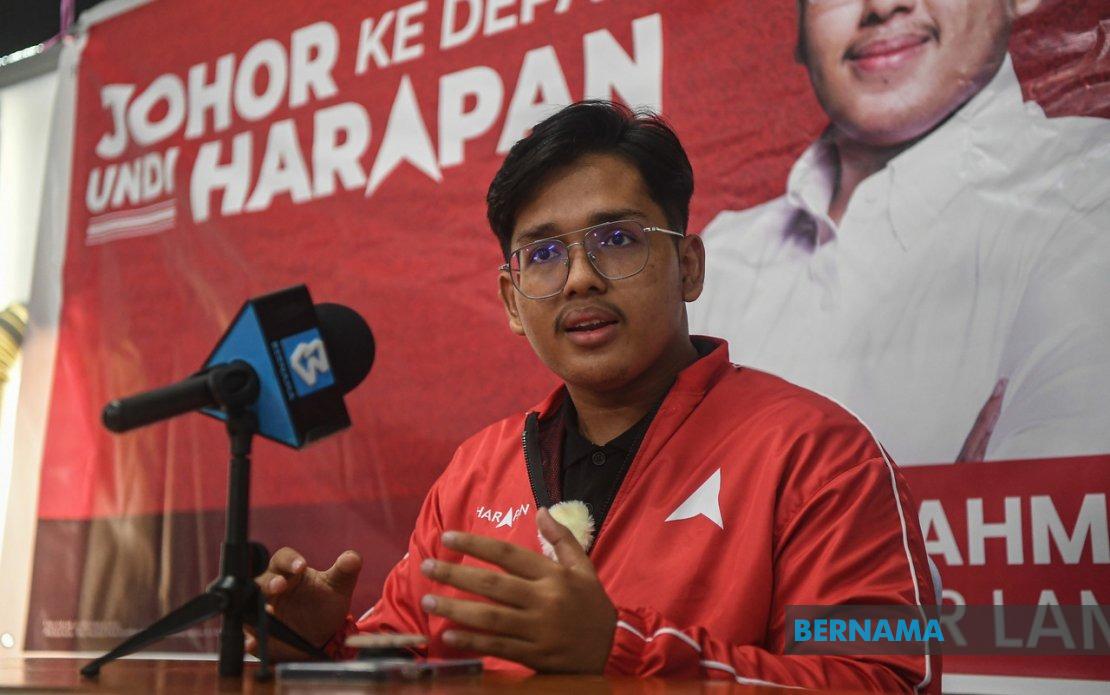
At 23 years old, Danish Hossman Abd Rahman stands as the youngest candidate contesting in the 16th Johor state election, bringing a fresh approach to constituency politics in Johor Lama. Running under the Pakatan Harapan banner with the campaign slogan "Wajah Baharu, Johor Lama" (A New Face, Johor Lama), the ambitious candidate has centred his platform on reversing economic stagnation and keeping young people rooted in their home communities rather than pushing them towards urban migration.
The core of Danish's political pitch targets the persistent development imbalance between Kota Tinggi's urban hub and the surrounding rural areas. While coastal and industrialised zones like Johor Bahru, Tebrau, and Kulai have captured most state investment and infrastructure spending, neighbouring Felda settlements have been largely bypassed by economic growth. This disparity has triggered waves of youth migration, with thousands of young adults from agricultural communities seeking better wages and prospects in Johor Bahru or across the causeway in Singapore. Danish argues that such outward migration represents both a human and economic loss for the state, depleting local labour pools and community vitality.
To address this challenge, Danish proposes attracting large-scale investment projects specifically designed for the Johor Lama constituency. His strategy rests on the premise that economic opportunity closer to home would eliminate the push factors driving young people away. He contends that effective coordination between state and federal governments is crucial to translating policy intentions into concrete infrastructure and business development projects. This alignment, he suggests, would allow both tiers of government to work in tandem rather than at cross purposes, ensuring that development funds allocated for rural areas actually materialise on the ground.
Beyond economics, Danish has identified a significant administrative gap affecting the 32,000 registered voters in the constituency. Kota Tinggi currently lacks a dedicated Immigration Department branch office, forcing residents seeking passport renewals or immigration-related services to undertake lengthy journeys to Johor Bahru, Kulai, or Mersing. This inconvenience disproportionately affects rural dwellers and elderly citizens with limited mobility. Danish sees establishing a local immigration centre as a pragmatic first step, reducing bureaucratic friction and signalling that government services should be distributed equitably across the constituency rather than concentrated in urban centres.
The candidate's campaign strategy reflects an understanding of contemporary political communication in Malaysia. Rather than relying solely on traditional door-to-door canvassing, Danish has embraced social media platforms to amplify his message across the digital landscape. This dual-channel approach allows him to engage voters during face-to-face encounters while simultaneously maintaining a visible online presence where he can post regular campaign updates and respond to constituents' concerns. Early feedback from voters across Johor Lama suggests this integrated strategy is resonating, with positive reception to his digital outreach.
Danish's emphasis on personal engagement reflects a broader generational shift in Malaysian politics. As one of the youngest candidates in the election, he represents a demographic cohort that has grown up with internet connectivity and digital-first communication. His willingness to meet voters directly while also leveraging technology addresses the reality that effective campaigning now requires presence in both physical and digital spaces. For a constituency with 32,000 voters spread across rural and semi-rural areas, this hybrid approach potentially reaches demographic groups that traditional campaigning might miss.
The electoral context in Johor Lama has become notably competitive. Danish faces incumbent Norlizah Noh representing the Barisan Nasional coalition and Aisah Esa contesting for Perikatan Nasional, setting up a three-way contest that will likely hinge on turnout and swing voter sentiment. The presence of three strong candidates suggests that voter preference may be fragmented, making ground-level campaign work and community engagement potentially decisive factors.
From a regional perspective, Danish's campaign reflects broader Southeast Asian trends where younger politicians are increasingly positioning themselves as alternatives to established political structures. His focus on rural development and youth retention addresses demographic challenges common across Malaysia and the wider region, where rural-to-urban migration has accelerated over two decades. His emphasis on keeping young people in their communities through local job creation taps into a growing recognition that sustainable development requires retaining human capital at the grassroots level.
The timing of the Johor state election carries significance for Malaysian politics more broadly. The 16th Johor state election on July 11, with early voting on July 7, occurs within Malaysia's broader electoral cycle and will provide indications of voter sentiment regarding state and federal governance. Results in constituencies like Johor Lama, where rural voters constitute a substantial portion of the electorate, could signal whether rural populations believe their concerns are being addressed by incumbent governments or whether they are receptive to alternative political offerings.
Danish's candidacy also reflects internal party dynamics within Pakatan Harapan. The decision to field a 23-year-old candidate in a contested seat suggests confidence in grassroots appeal and possibly a strategic calculation that younger candidates can mobilise dormant voter groups. Whether this youth-centred strategy proves effective in a constituency where older and middle-aged voters may constitute the electoral backbone remains to be seen. His emphasis on economic fundamentals—investment, jobs, and rural development—rather than purely generational messaging suggests a campaign grounded in pragmatic concerns rather than symbolism alone.
The specific focus on Felda settlements within the Johor Lama electorate reveals understanding of the constituency's demographic composition and economic structure. Federal Land Development Authority communities have historically received less political attention than urban areas, and politicians targeting Felda populations must address their particular concerns: agricultural viability, youth employment, and access to government services. Danish's recognition of this constituency-within-a-constituency indicates targeted electoral positioning.
Looking forward, the Johor Lama contest will test whether voters prioritise continuity with the incumbent BN government, express confidence in PN's alternative vision, or embrace PH's developmental promises through a young candidate. The result will provide insights into rural voter behaviour in Johor and potentially inform political strategies across Malaysia's agricultural constituencies. For Danish specifically, the election represents both an opportunity to represent constituent concerns and a test of whether youth, digital engagement, and localised economic development messaging can overcome the structural advantages enjoyed by longer-established political parties in state elections.

