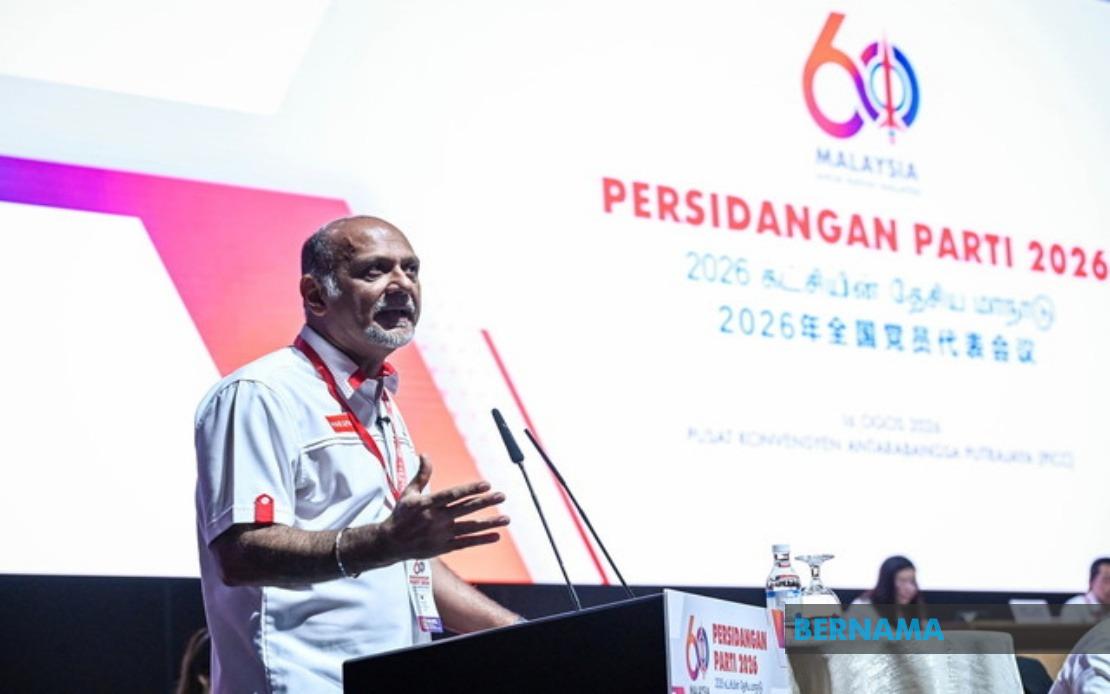
The Democratic Action Party faced an reckoning moment at its annual conference in Putrajaya on August 16, with national chairman Gobind Singh Deo issuing a candid acknowledgement that the party must fundamentally reconsider its trajectory in Malaysia's shifting political environment. Speaking at the DAP Party Conference 2026 held at the Putrajaya International Convention Centre, Gobind articulated the need for introspection following the party's participation in the Unity Government coalition for three and a half years, describing the recent state election results as a catalyst for honest evaluation of both achievements and shortcomings during that period.
Gobind's remarks signalled a pragmatic shift in DAP's approach to governance, one that reflects the complex realities of operating within a multi-party coalition rather than pursuing unilateral agenda items. He emphasised that the party's strategic focus must narrow to reforms capable of securing agreement among all coalition partners, a marked departure from the sweeping institutional overhaul platform that DAP campaigned on during the 2022 general election. This recalibration speaks to a broader challenge facing opposition-turned-ruling parties across Southeast Asia: the tension between campaigning ambitions and the constrained reality of shared power with ideologically diverse partners.
The chairman proposed that Parliament convene a special sitting dedicated to debating and endorsing amendments to several cornerstone statutes, including the controversial Security Offences (Special Measures) Act 2012, known locally as SOSMA. These amendments would also encompass the Peaceful Assembly Act 2012 and address the structural separation between the Attorney General and Public Prosecutor roles. Additionally, Gobind advocated for constitutional changes that would impose a two-term limit on the Prime Minister's tenure, framing these measures as essential safeguards against authoritarian drift and power concentration.
For Malaysian observers of constitutional governance, this institutional reform agenda remains symbolically important even as its implementation prospects remain uncertain within a coalition environment. SOSMA has long drawn criticism from human rights advocates for granting security agencies broad detention powers with minimal judicial oversight, making reform of this statute a litmus test for the government's commitment to civil liberties protections. The proposed separation of Attorney General and Public Prosecutor functions addresses a longstanding concern about prosecutorial independence, while Prime Ministerial term limits reflect global democratic practice yet remain contentious domestically given Malaysia's Westminster-influenced executive structures.
Gobind stressed that demonstrating governmental seriousness regarding institutional reform was not merely a technical exercise but rather foundational to establishing transparent governance frameworks and preventing power abuse. This argument carries particular resonance in the Malaysian context, where institutional safeguards have been inconsistently applied under different administrations, and where public trust in the integrity of government institutions remains fragile. The legitimacy of any administration rests partially on its ability to implement announced reform commitments, and DAP's emphasis on concrete legislative progress responds to voter disappointment evident in recent electoral results.
On economic matters, Gobind acknowledged that the government must develop deeper understanding of the material pressures confronting ordinary Malaysians and respond with substantive relief measures rather than rhetorical gestures. He framed economic stability and ease of living as interconnected priorities requiring coordinated policy intervention across portfolio areas. This recognition implicitly critiques the common tendency of coalition governments to defer difficult economic decisions in favour of consensus maintenance, suggesting that DAP intends to push for more decisive action on cost-of-living challenges.
Gobind further argued that maintaining political stability serves instrumental purposes beyond governance effectiveness, functioning as a critical factor in foreign investor confidence and decision-making. In an era of intensifying regional competition for foreign direct investment, Malaysia's political predictability and labour stability represent competitive advantages relative to some neighbouring economies. Economic growth driven by foreign investment creates employment opportunities that directly alleviate household financial pressure, establishing a logical chain linking political stability to population welfare that Gobind articulated clearly.
The conference proceedings themselves carried substantial internal significance, with party secretary-general Anthony Loke preparing to table a motion regarding DAP's continued participation in the government coalition through the end of the 16th Parliament's term. The decision on this matter would be determined by secret ballot among 4,264 delegates representing 1,704 eligible party branches, according to the democratic procedures governing DAP's internal structures. This mechanism ensures that any major strategic reorientation receives grassroots legitimacy rather than being imposed by leadership fiat.
The timing of this conference coincided with DAP's commemoration of its 60th establishment anniversary, marking six decades of operation spanning independent Malaysia's constitutional evolution. This historical milestone provided context for internal discussions about the party's future relevance and positioning within increasingly complex coalition politics. As one of Pakatan Harapan's three main components alongside PKR and Amanah, DAP's strategic choices ripple across the broader opposition alliance that collectively governs several states and participates in federal administration.
Gobind's call for reassessment reflects broader structural tensions within Malaysia's governing coalition, where parties holding divergent ideological positions and representing distinct constituencies must negotiate compromises on signature policy initiatives. For DAP, which has historically championed civil liberties, anti-corruption measures, and secular governance principles, operating alongside conservative partners in Perikatan Nasional-aligned coalition components requires constant negotiation and sometimes painful retreat from preferred positions. The party's electoral setbacks in recent contests suggest that rank-and-file members and voters question whether coalition participation adequately advances DAP's core policy objectives.
The conference spotlight on institutional reform rather than broader transformation represents a calculated recalibration towards deliverability. Rather than attempt comprehensive constitutional overhaul dependent on supermajority parliamentary support, DAP's focus on specific, identifiable legislative amendments targeting SOSMA, the Peaceful Assembly Act, prosecutorial independence, and executive tenure limits offers a more achievable reform pathway. This strategic narrowing does not constitute abandonment of institutional transformation principles but rather recognition that incremental progress on specific measures may prove more efficacious than failed campaigns for comprehensive change.
Looking forward, DAP's internal deliberations at this conference will substantially influence the trajectory of both the party and the Unity Government itself. If delegates endorse continued participation through the parliamentary term's conclusion, the party must demonstrate that its remaining tenure produces tangible legislative achievements in the reform areas Gobind prioritised. Conversely, any significant shift toward questioning coalition membership would create immediate political instability with consequences extending across multiple government levels. The secret ballot mechanism ensures that this pivotal decision emerges from genuine party membership consultation rather than leadership determination alone, preserving internal democratic legitimacy regardless of the outcome.

