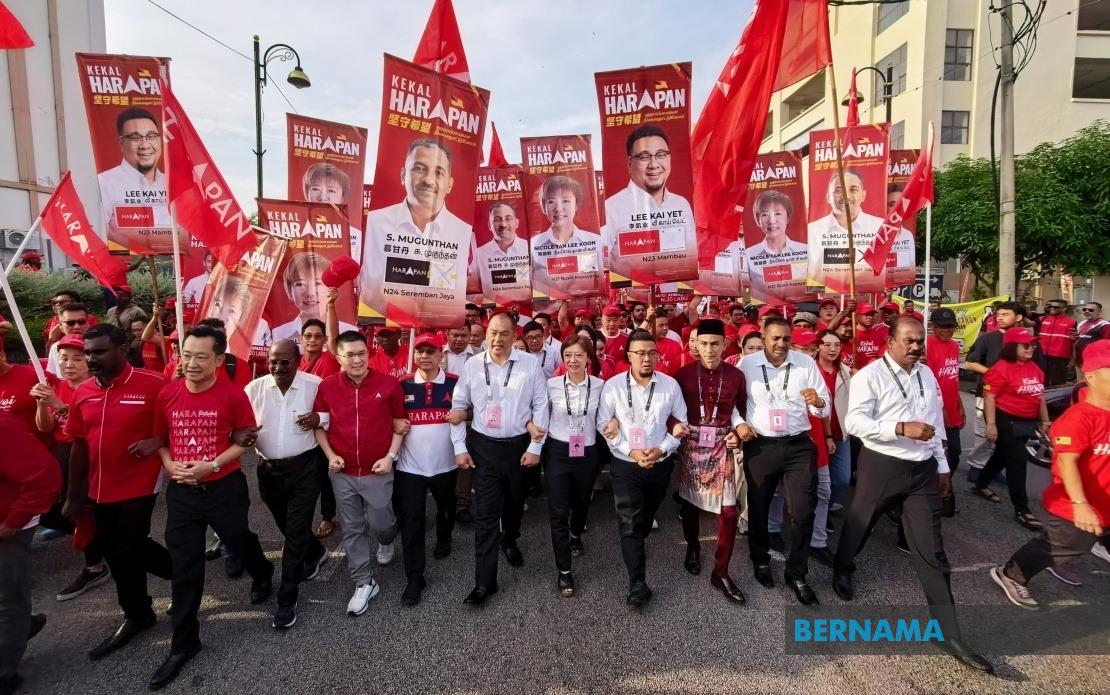
The Negeri Sembilan state election is shaping up to be a fiercely competitive affair in several constituencies, with the Rahang seat emerging as a particular flashpoint. Siaw Meow Keong, the current DAP treasurer in the state, will attempt to retain the seat he has held since 2023 when he secured it under the Pakatan Harapan banner. However, his path to re-election has become significantly more complex with the emergence of three competing candidates from different political camps, transforming what might otherwise have been a straight contest into a complex four-way battle that could fragment voter support across the spectrum.
The quartet vying for Rahang represents the fractured nature of Malaysian politics in 2024. Siaw faces Yap Siok Moy of the Malaysian Chinese Association, who brings the backing of Barisan Nasional to the contest and holds the position of Rasah MCA Wanita chief, potentially giving her organisational reach within the Chinese community. Running alongside them is S. Thinagaran representing Parti Sosialis Malaysia, a smaller player that occasionally contests state and federal elections to maintain its presence in the political landscape. Completing the lineup is Tang Jay San of Bersatu, the political vehicle that emerged from the former ruling coalition's fragmentation and has established itself as a significant force in several Malaysian states.
The nomination process unfolded rapidly on the morning that candidates filed their papers at the Seremban City Council Hall. Thinagaran was first to submit his nomination at 9.06 am, followed by Tang at 9.10 am just minutes later. Siaw lodged his papers at 9.12 am, while Yap completed the field with her submission at 9.13 am. The close clustering of submission times within a seven-minute window underscores the urgency with which campaigns have mobilised in this constituency. Returning officer Mohamad Najib Mustafa announced the confirmed candidate list after the one-hour nomination period concluded at 10 am, formally setting the stage for what promises to be an intense campaign.
Rahang is not the only seat witnessing multi-cornered contests across Negeri Sembilan. The state election features several constituencies where voter choice will be similarly fragmented. In the Bukit Kepayang seat, however, the dynamic differs markedly. Nicole Tan Lee Koon, the DAP Wanita chief defending the seat for Pakatan Harapan, faces a more straightforward two-candidate race against Lee Boon Shian representing Perikatan Nasional. This bilateral contest may prove clearer for voters seeking to understand the fundamental choice being presented, though Tan will still need to consolidate support effectively.
Three-cornered contests are occurring elsewhere across the state. In Labu, Pakatan Harapan has fielded Datuk Ahmad Faez Abdul Razak to take on Mohamad Hanifah Abu Baker of Bersatu and Siti Nur Umaira Hasim representing Barisan Nasional. The Mambau constituency features PH candidate Lee Kai Yet competing against Bersatu's N. Sarawanan and Eric Michael of Perikatan Nasional. Meanwhile, the Seremban Jaya seat will see PH's S. Mugunthan contest against Datuk T. R. Thinalan of Barisan Nasional and R. Mahendran of Bersatu in another three-way contest.
The proliferation of multi-cornered races reflects the evolving Malaysian political landscape where traditional two-coalition dynamics have become fragmented. The emergence of Bersatu as an independent force, separate from both Pakatan Harapan and Barisan Nasional, has fundamentally altered electoral mathematics across the country. In Negeri Sembilan's case, this fragmentation is particularly pronounced, with Bersatu contesting multiple seats and Perikatan Nasional also maintaining a presence. The smaller Malaysian Socialist Party's participation in Rahang also demonstrates that even marginal political actors continue attempting to maintain electoral relevance through targeted candidacies.
For Pakatan Harapan, defending seats held since 2023 becomes increasingly challenging when the opposition vote is fragmented across multiple parties. Siaw's position as DAP treasurer may provide organisational advantages and financial resources unavailable to other candidates, yet the split opposition still presents mathematical complications. If voter support for Barisan Nasional, Bersatu, and Perikatan Nasional candidates individually draws roughly equal shares from the anti-PH vote, Siaw's consolidated support base could prove decisive. Conversely, if one opposition candidate emerges as a clear rallying point for anti-PH voters, the contest becomes significantly more challenging for the incumbent.
Barisan Nasional's strategy in deploying Yap Siok Moy in Rahang reflects its continued attempt to compete for legislative seats despite the political challenges it has faced nationally. The MCA, as the party's primary Chinese-based component, remains critical to any Barisan revival strategy, particularly in constituencies with significant Chinese populations. Yap's position as Rasah MCA Wanita chief indicates her party has invested in developing her profile within grassroots structures, suggesting a serious campaign effort rather than a token candidacy.
Bersatu's expanded electoral presence in Negeri Sembilan, with candidates in multiple constituencies including both Rahang and Labu, underscores the political space it has carved out since its formation. The party's ability to run candidates across multiple seats simultaneously demonstrates it has achieved sufficient organisational maturity and financial capacity to mount statewide campaigns. For some constituencies, Bersatu may serve as a protest vote option for those dissatisfied with established coalitions but uncertain about voting for smaller parties or independent candidates.
The Election Commission has designated July 28 for early voting and August 1 as the general polling day for the entire Negeri Sembilan state election. This schedule provides candidates and political parties approximately two weeks for intensive campaigning following the close of nominations. Early voting on July 28 will likely determine the trajectories for election day itself, as turnout patterns and voter sentiment become apparent from these preliminary results. The August 1 polling date falls during the mid-week period, potentially affecting turnout levels compared to weekend elections.
For Malaysian political observers, the Negeri Sembilan election holds significance beyond the state's immediate political landscape. The results will provide insight into how Bersatu and Perikatan Nasional are performing at the sub-federal level, whether Pakatan Harapan's 2023 gains can be consolidated, and whether Barisan Nasional remains competitive in state-level elections despite its national difficulties. The fragmented nature of many contests means that even narrow vote margins could produce unexpected outcomes, with candidates winning on reduced vote shares due to opposition splitting.
The economic and social dimensions of Negeri Sembilan politics should not be overlooked amidst the party-political dimensions. The state's position as a significant manufacturing and service hub means that issues surrounding development, labour standards, and infrastructure investment will likely feature prominently in campaign messaging. How effectively each candidate addresses local concerns, particularly around cost of living pressures affecting Malaysian families, may prove as decisive as national party dynamics in determining electoral outcomes.

