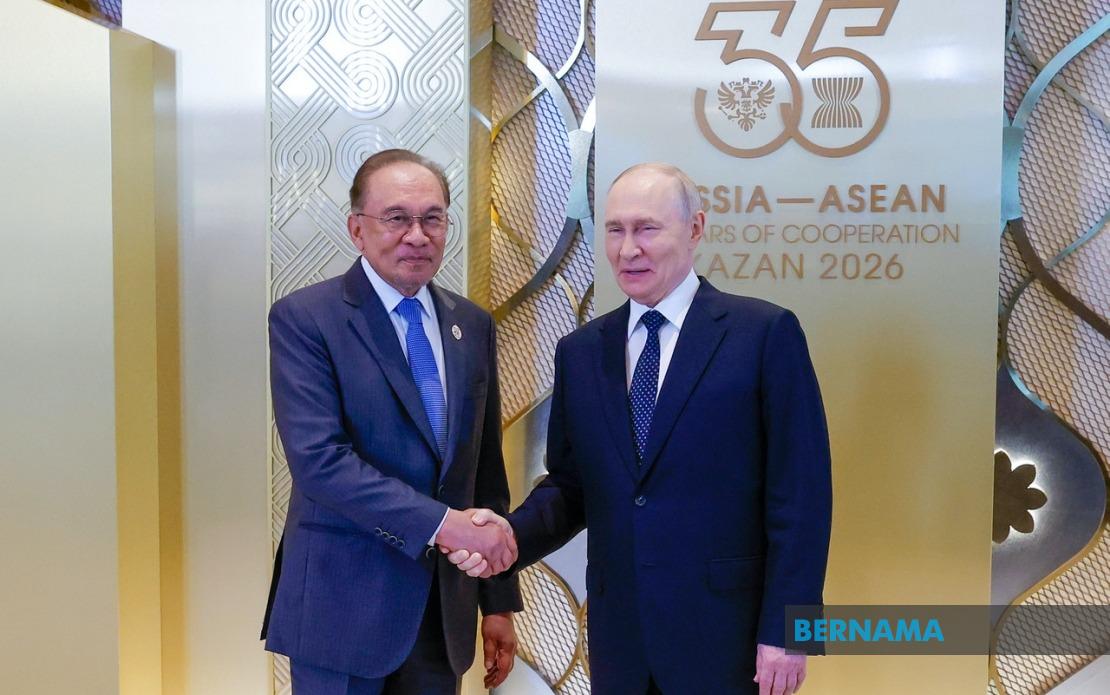
Prime Minister Datuk Seri Anwar Ibrahim has stressed that structured engagement platforms serve as vital conduits for building mutual understanding in an increasingly complex global environment marked by mounting challenges and unpredictable developments. Speaking following his attendance at a formal gala dinner hosted by President Vladimir Putin during the ASEAN-Russia Commemorative Summit in Kazan, the Prime Minister articulated how such high-level gatherings transcend ceremonial value and function as meaningful opportunities to deepen relationships between participating nations.
The ASEAN-Russia Commemorative Summit, held from June 17 to 18 in Kazan—the capital and largest city of Tatarstan—brought together regional and international leaders to explore mechanisms for strengthened collaboration. Anwar's participation underscores Malaysia's commitment to maintaining constructive relations with major powers while advancing collective ASEAN interests in an era of strategic realignment and shifting geopolitical priorities.
According to Anwar, who also holds the Finance Minister portfolio, these summits serve multiple diplomatic objectives beyond immediate policy discussions. They create spaces where leaders can establish personal rapport, exchange candid perspectives, and identify convergence points on matters of shared concern. This interpersonal dimension of diplomacy often proves instrumental in building the trust foundations necessary for substantive cooperation on contentious or complex issues.
The Malaysian Prime Minister highlighted that the Kazan gathering functioned as an important vehicle for exploring areas of mutual benefit between ASEAN member states and Russia. Given ASEAN's positioning as a geopolitically significant bloc and Russia's strategic interests in Asian affairs, such forums offer both parties opportunities to calibrate their respective approaches and identify practical collaboration frameworks in areas ranging from trade and investment to security and cultural exchange.
Beyond bilateral considerations, Anwar emphasized that the summit provided a platform for showcasing Russia's cultural heritage, historical significance, and contemporary standing. Such cultural diplomacy components often facilitate deeper mutual understanding by allowing nations to present their narratives, values, and societal characteristics beyond the transactional frameworks of official negotiations. For ASEAN participants, exposure to Russia's civilizational contributions fosters more nuanced appreciations of the country beyond geopolitical stereotypes.
The timing of the summit carries particular relevance for Southeast Asia, a region navigating complex relationships with multiple great powers while attempting to preserve strategic autonomy through non-alignment principles. Malaysia's active participation reflects the nation's diplomatic strategy of maintaining engagement with diverse partners rather than gravitating toward exclusionary blocs. This approach aligns with ASEAN's foundational commitment to balanced, inclusive regionalism that respects national sovereignty while pursuing collective interests.
For Malaysia specifically, sustained engagement with Russia extends beyond ceremonial exchanges. Economic partnerships, including cooperation in energy sectors and potential investment flows, benefit from the relationship cultivation demonstrated at high-level summits. Additionally, as ASEAN member states increasingly emphasize their strategic agency, maintaining substantive relationships with influential powers like Russia helps Malaysia and its regional partners resist pressure to align with competing strategic frameworks promoted by other major powers.
Anwar's remarks reflect a broader diplomatic philosophy recognizing that formal platforms, despite their sometimes repetitive nature, remain irreplaceable mechanisms for maintaining dialogue channels and preventing miscommunication or escalation during periods of international tension. In Southeast Asia's strategic context, where territorial disputes, competing maritime claims, and great power competition create ongoing friction, these engagement opportunities provide essential outlets for conflict management and confidence-building.
The Prime Minister's emphasis on bilateral relations alongside multilateral forums indicates awareness that both tracks serve complementary functions. While the ASEAN-Russia summit addresses collective regional concerns, bilateral Malaysia-Russia engagements allow for more specific national interest discussions. This two-level diplomatic approach enables nations to advance particular objectives while contributing to broader regional stability and cooperation frameworks.
Looking forward, the significance of such engagement platforms may intensify rather than diminish. As global uncertainties persist—whether from technological disruption, climate challenges, or geopolitical realignments—the capacity of nations to maintain open communication and explore collaborative solutions becomes increasingly valuable. For Malaysia and ASEAN, institutions and occasions enabling dialogue with major powers represent strategic assets that warrant continued investment and active participation, ensuring the region retains voice and agency in shaping outcomes affecting its security and prosperity.