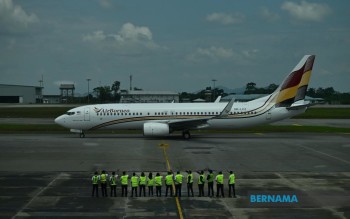
Deputy Prime Minister Datuk Seri Fadillah Yusof greeted the arrival of AirBorneo Airways' inaugural commercial flight at Kuala Lumpur International Airport's Terminal 1 on July 20, underscoring the political significance of Sarawak's latest venture into independent air transport operations. The milestone flight from Kuching carried Sarawak Premier Tan Sri Abang Johari Tun Openg alongside a delegation of state ministers and government officials, signalling strong political backing for the newly launched carrier.
The establishment of AirBorneo represents a strategic move by Sarawak to exercise greater control over its aviation infrastructure and connectivity. AirBorneo chairman Datuk Amar Mohamad Abu Bakar Marzuki, who simultaneously holds the position of Sarawak state secretary, positioned the airline as fundamental to the state's economic development strategy. In his remarks, he emphasised that aviation connectivity transcends mere transportation; it functions as an economic enabler that facilitates trade, attracts investment, and creates employment opportunities for Sarawakians. This framing reflects broader regional ambitions to reduce dependence on federal-level aviation decisions and build independent transportation networks that serve state-specific economic goals.
The timing of AirBorneo's commercial launch coincides with Malaysia's ongoing efforts to strengthen internal connectivity and regional linkages. The Kuching-Kuala Lumpur route, while appearing routine on the surface, carries symbolic weight as a confirmation of Sarawak's institutional capacity to operate scheduled commercial aviation. The federal government's participation, demonstrated through attendance by Tourism, Arts and Culture Minister Datuk Seri Tiong King Sing, Women, Family and Community Development Minister Datuk Seri Nancy Shukri, and Deputy Transport Minister Datuk Hasbi Habibollah, indicates alignment between state and federal interests in expanding the nation's aviation ecosystem.
Operationally, AirBorneo is commencing service with two Boeing 737-800 aircraft acquired through wet-lease arrangements, a pragmatic approach that minimises capital expenditure while allowing the airline to establish market presence and operational credibility. Chief Executive Officer Megat Ardian Mohd Aminuddin framed the launch as the beginning of an expansion phase, emphasising the airline's commitment to service quality, reliability, and passenger experience. These pledges carry weight given that customer expectations for safety and punctuality will shape the airline's reputation during its critical early months.
Ticketing for the Kuching-Kuala Lumpur route commenced in advance of the inaugural flight, with AirBorneo pricing Economy Class seats at RM375 for one-way travel and Business Class fares beginning at RM736. These price points position AirBorneo competitively within Malaysia's domestic market, where established carriers have long dominated trunk routes between major economic centres. The pricing strategy suggests AirBorneo intends to capture market share through competitive tariffs rather than premium positioning, a calculated approach for a carrier building brand recognition.
From July 21, 2026, AirBorneo will operate a twice-daily frequency on the Kuching-Kuala Lumpur service, establishing a baseline schedule that reflects anticipated demand patterns and operational capacity. This frequency level provides flexibility for business and leisure travellers while maintaining efficient aircraft utilisation. For Malaysian readers, particularly those with business interests in Sarawak or family connections between the state and the Klang Valley, the twice-daily pattern represents meaningful improvement in access and scheduling options.
The Kuching-Kuala Lumpur route functions as a foundation for broader network expansion. AirBorneo has already identified Singapore as its first international destination, signalling intent to position itself as a cross-border carrier serving the wider Southeast Asian region. This progression mirrors strategies employed by other successful regional airlines and reflects confidence in potential demand for Sarawak-originating international travel. For Malaysian commerce and tourism, a Sarawak-based carrier with Singapore connectivity could facilitate business travel and leisure journeys across the Malaysia-Singapore corridor.
The airline's domestic expansion plans warrant attention from an economic development perspective. By progressively extending its network beyond the initial Kuching-Kuala Lumpur route, AirBorneo can strengthen connectivity to secondary cities and facilitate provincial economic integration. Enhanced air links reduce travel times and costs, enabling smaller markets within Sarawak and potentially neighbouring regions to participate more effectively in Malaysia's broader economic activities. This connectivity dividend extends beyond aviation itself, influencing real estate values, retail activity, and service sector development in connected communities.
Sarawak's creation of a state-owned airline reflects a broader pattern of state governments seeking operational independence in critical infrastructure sectors. While federal entities oversee licensing and safety regulation, ownership and operational control vest with the state. This arrangement allows Sarawak to set strategic priorities aligned with its particular development objectives, though it also introduces questions about financial sustainability and competitive positioning. AirBorneo's success will likely influence calculations by other Malaysian states regarding similar ventures.
For passengers and stakeholders across Malaysia and Singapore, AirBorneo's launch introduces a new competitive element to routes previously serviced by established carriers. Competition typically benefits consumers through price pressures and service innovation, though sustainability depends on AirBorneo achieving sufficient scale and efficiency to operate profitably over the medium term. The airline's reliance on wet-leased aircraft rather than owned assets provides operational flexibility but also constrains long-term strategic autonomy.
The inaugural flight's ceremonial dimensions underscore political investment in AirBorneo's success. Government ministers' presence, the participation of Sarawak's premier, and the Deputy Prime Minister's welcoming remarks collectively signal that the venture enjoys high-level political support. This backing provides AirBorneo with legitimacy and potentially facilitates regulatory cooperation, though ultimate commercial success depends on operational execution, market demand, and prudent financial management.
Looking forward, AirBorneo's trajectory will provide insights into the viability of regional airline models within Malaysia's aviation market. The carrier must balance ambitions for growth and geographic expansion against the realities of operating thin-margin scheduled services in a competitive environment. Its performance will influence both investor confidence in regional aviation ventures and broader assessments of state-level economic development strategies across Malaysia.

