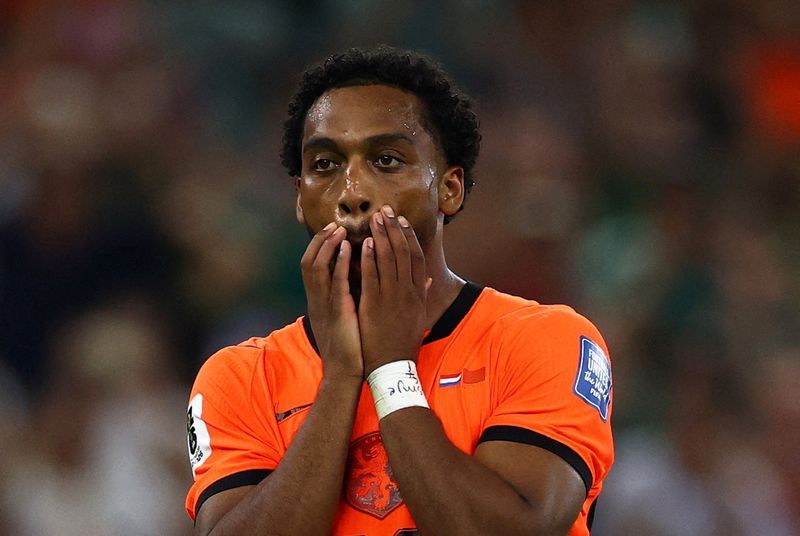
The Netherlands football association has condemned a wave of discriminatory online harassment directed at three of its players following the nation's elimination from the World Cup at the hands of Morocco on Monday. The incident represents a troubling continuation of a pattern in which athletes face abusive social media attacks in the aftermath of high-stakes sporting disappointments, particularly when penalty shootouts determine tournament outcomes.
Justin Kluivert, Quinten Timber, and Crysencio Summerville each failed to convert their penalty attempts during the shootout phase of the last-32 encounter held in Monterrey, which concluded with Morocco emerging victorious 3-2 on penalties. The match itself had remained deadlocked at 1-1 through extra time, making the penalty competition the deciding factor in determining which nation would advance further in the tournament. Following their defeat, the three players became targets for racist and hateful comments distributed across various social media platforms by individuals seeking to assign blame for the team's exit.
The Royal Netherlands Football Association, known by its Dutch abbreviation KNVB, responded swiftly by declaring the harassment unacceptable and announcing plans to escalate the matter through formal legal channels. The organisation intends to lodge a complaint with Meld Online Discriminatie, which translates to Report Online Discrimination, a Dutch platform established to address and combat discriminatory content distributed through digital channels. By utilising this official reporting mechanism, the KNVB initiated a formal investigative process that extends beyond the immediate domain of social media companies.
Once a complaint enters the Meld Online Discriminatie system, the organisation's legal specialists undertake a thorough assessment to determine whether the reported statements constitute offences under Dutch criminal law. This evaluation process serves as a critical gateway: complaints deemed to contain potentially punishable conduct are then forwarded to the Public Prosecution Service, the Dutch state body responsible for criminal cases. The Public Prosecution Service subsequently possesses the authority to initiate formal criminal investigations, potentially leading to prosecutions and convictions of the individuals responsible for the abusive messaging.
The situation in the Netherlands echoes a distressingly similar incident that occurred following the European Championship final in 2021, when England suffered a penalty shootout defeat against Italy. In that case, three Black English players—Marcus Rashford, Bukayo Saka, and Jadon Sancho—endured extensive racist abuse on social media platforms following their unsuccessful penalty attempts. The responses from British law enforcement authorities proved notably stringent, with police deploying significant investigative resources to identify and apprehend perpetrators of the online hate speech. The enforcement action resulted in concrete consequences: two individuals received custodial sentences, while another received a suspended prison term, demonstrating that judicial systems can impose meaningful penalties for online racist harassment.
The recurrence of such incidents underscores a persistent vulnerability within contemporary sports culture, wherein the combination of intense emotional investment, competitive stakes, and the affordances of digital platforms creates conditions conducive to racist abuse. The phenomenon intersects with broader patterns of online hate speech, yet carries particular significance within football contexts where international matches generate heightened passions and where visible differences among players become focal points for discriminatory targeting. For Malaysia and Southeast Asia, where football commands passionate followings and digital connectivity continues expanding rapidly, the European experiences carry cautionary relevance regarding the need for robust social media moderation and swift legal responses to online discrimination.
The KNVB's statement positioning the issue within the broader context of football's fundamental purpose carries important resonance. The association emphasised that sport fundamentally functions as an instrument for bringing together diverse populations across lines of ethnicity, nationality, and background, creating spaces where individuals from different circumstances interact toward shared competitive objectives. Racist discrimination, by contrast, operates as a mechanism for division and exclusion, explicitly contradicting the inclusive values that football ostensibly embodies. This philosophical framing suggests that responses to online racist abuse constitute not merely matters of individual conduct but rather questions about the integrity of sport itself.
The trajectory from social media complaint through official reporting mechanisms to potential criminal investigation demonstrates an evolving institutional recognition that online racist harassment cannot be dismissed as mere speech or harmless venting. The involvement of public prosecution services signals that democracies increasingly treat digital racism as a matter of criminal concern rather than a regrettable but inevitable aspect of online discourse. However, the effectiveness of such approaches depends substantially upon the resource commitments that authorities dedicate to investigation and prosecution, and upon the willingness of technology companies to facilitate law enforcement access to user information and content.
For the Netherlands, the formal response initiated by the KNVB represents a commitment to pursuing accountability through established legal frameworks rather than relying solely upon social media platforms' internal moderation capacities. This approach acknowledges that individual technology companies, despite their size and resources, may lack sufficient incentive or capacity to consistently identify and remove racist content or cooperate fully with enforcement efforts. By channelling the complaint through government institutions and formal legal processes, the KNVB positions the harassment as a matter of state concern requiring investigative and prosecutorial attention comparable to that accorded other forms of criminal conduct.
The visibility of these incidents and the institutional responses they generate carry implications extending beyond the affected players. Each publicised case of racist online abuse following sporting defeats establishes precedent regarding societal tolerance for such conduct, influencing both potential perpetrators' calculation of consequences and affected communities' understanding of institutional protection. The English precedent, wherein convictions and imprisonments resulted from the 2021 Euro final harassment, establishes a concrete template suggesting that jurisdictions can pursue serious criminal consequences for online racist abuse. Whether the Dutch legal system will similarly pursue convictions, and whether other nations experiencing comparable incidents will adopt comparable enforcement approaches, remains to be determined, but the KNVB's proactive stance signals institutional determination to protect its players and reinforce that racist abuse carries potential legal jeopardy.

