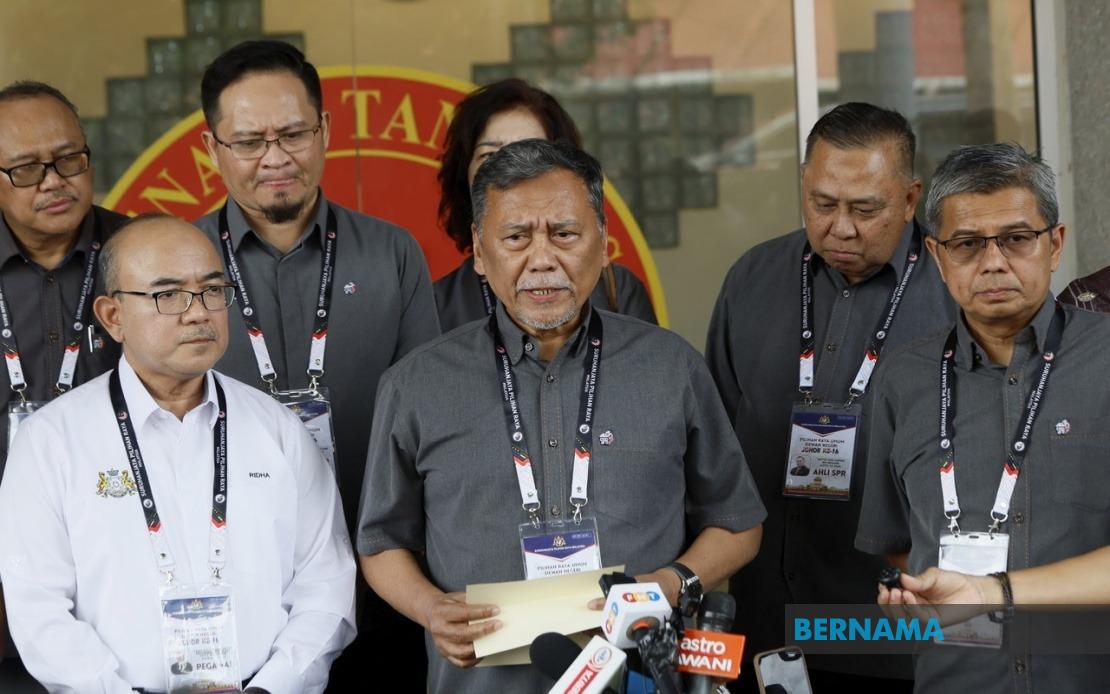
The Election Commission has set an ambitious 96 per cent participation target for early voting in the Johor state election, signalling confidence in voter engagement among priority groups ahead of Saturday's main polling day. EC chairman Datuk Seri Ramlan Harun disclosed the projection during an observational visit to Kem Mahkota in Kluang on July 7, anchoring the forecast in consistent patterns observed across past electoral cycles where early voters have demonstrated exceptionally high turnout rates.
The early voting framework deployed across Johor reflects the logistical complexity of managing concurrent electoral processes in a state with 2.7 million eligible ordinary voters. The EC opened 62 early voting centres throughout the state, each operating on staggered schedules to accommodate different groups and security requirements. Twenty-nine centres concluded voting at noon, five centres closed at 2 pm, while the remaining 28 facilities remained open until 5 pm, allowing the Commission to manage voter flows across military installations, police stations, and designated government facilities where eligible early voters congregated.
Early voting privileges extended to a narrowly defined but politically significant cohort numbering 20,607 individuals across the state. This comprised two distinct groups whose work schedules and operational demands typically prevent standard polling-day participation: 8,544 military personnel and their spouses drawn from the Malaysian Armed Forces, and 12,063 police officers alongside their family members. These voters represent institutional pillars of national security and public order whose regular duties on election Saturday would otherwise compromise their franchise rights, making early voting provisions essential to democratic inclusivity for uniformed services.
The procedural safeguards surrounding early ballot handling underscore the Commission's commitment to electoral integrity despite compressed timelines. Completed ballot boxes from all 62 early voting centres were secured at police stations immediately following each centre's closure, isolating them from mainstream polling infrastructure and creating segregated custody chains until the designated counting commencement. This separation persists until Saturday, when vote tallying commences at 5 pm—a delay that prevents early results from influencing ordinary voters' decision-making on polling day and maintains the temporal integrity of the electoral process.
Ramlan's projection of results completion before midnight, with potential announcement as early as 10 pm on Saturday, reflects technological and procedural improvements the EC has implemented in recent election cycles. The compressed timeframe between polling-day closure and result declaration demands precise coordination across counting centres, transport logistics, and tabulation systems. However, the realistic acknowledgment that full results might extend to midnight demonstrates the Commission's measured approach rather than unsustainable pledges that could invite procedural shortcuts or accuracy compromises under time pressure.
The 96 per cent early voting target carries broader implications for interpreting overall election participation levels and mandate strength in Johor. High early voter turnout among disciplined, uniformed constituencies typically correlates with elevated general election engagement across the broader electorate, though causality runs complex directions. Military and police participation demonstrates institutional respect for democratic processes and may signal favourable public sentiment toward electoral legitimacy, yet these groups vote under structured environments unlike ordinary citizens navigating multiple competing demands on polling day.
Ramlan's public appeal to the 2.7 million ordinary voters emphasised civic responsibility and democratic participation as interconnected national imperatives. This framing positions voting not merely as individual choice but as collective contribution to institutional stability and democratic renewal, language that resonates with Malaysia's political discourse around bumiputera obligations, national unity, and constitutional governance. By embedding voter participation within broader narratives of nation-building and constitutional fidelity, the EC sought to mobilise engagement beyond mere procedural compliance.
The Johor state election carries particular significance for Malaysian federalism and inter-state political dynamics. As Malaysia's southern industrial and commercial anchor, Johor's electoral outcome influences regional economic confidence, federal-state relations, and broader coalition calculations within national politics. Turnout patterns in this state thus transcend local electoral interest, shaping perceptions of voter mandate strength that political parties subsequently invoke in negotiating federal arrangements, parliamentary support, and policy alignment across Malaysia's complex multi-level governance architecture.
Historical early voting performance across Malaysian elections demonstrates the demographic reliability of these cohorts, though circumstances vary significantly. Security personnel maintain institutional discipline and familiarity with electoral processes through organisational channels, producing consistent participation rates that exceed ordinary voter engagement by substantial margins. The EC's 96 per cent projection reflects this established pattern while acknowledging that contingencies—operational emergencies, unplanned absences, procedural complications—always introduce marginal variance around long-term averages.
The staggered closure schedule across the 62 early voting centres reveals sophisticated logistical planning attuned to managing voter flows without bottlenecks while maintaining security protocols specific to military installations and police facilities. Closing 29 centres at noon accommodated personnel completing morning shifts, the five closing at 2 pm captured afternoon-shift workers, and the 28 facilities remaining until 5 pm provided buffer time for operational contingencies and late arrivals. This calibrated approach minimises administrative disruption to security force operations while maximising participation opportunity among entitled voters.
The Saturday vote-counting timeline establishes a tight but manageable operational window for the EC's technical personnel and scrutineers observing from contesting parties. Transporting sealed ballot boxes from 62 dispersed early voting locations to centralised counting centres, alongside logistics for 8 pm ordinary polling closing and 5 pm early count commencement, requires pre-positioned transport, trained personnel, and contingency buffers for inevitable delays. The EC's projected midnight result completion reflects institutional confidence in these preparations, though genuine uncertainties—transport delays, counting complications, disputed ballots requiring adjudication—retain realistic potential to extend timelines marginally.
Beyond electoral machinery, the early voting framework addresses practical governance realities in modern security-force deployment. Malaysian Armed Forces and police personnel stationed across multiple districts and operating rotating shifts require structural accommodation for democratic participation, recognising that security operations continue regardless of electoral calendars. Early voting provisions thus represent institutional compromise enabling democratic participation without compromising operational readiness, a balance essential in democracies employing substantial uniformed services.
The EC's emphasis on transparency throughout early voting processes—permitting observation, disclosing participation figures, explaining procedural timelines—reflects institutional accountability principles that democratic legitimacy increasingly demands. Public confidence in electoral outcomes depends partly on procedural visibility and institutional responsiveness to scrutiny, particularly when compressed timelines and segregated ballot handling might otherwise invite suspicion of irregularities. By facilitating observation and detailed explanation, the Commission sought to embed early voting transparency within broader narratives of electoral credibility.

