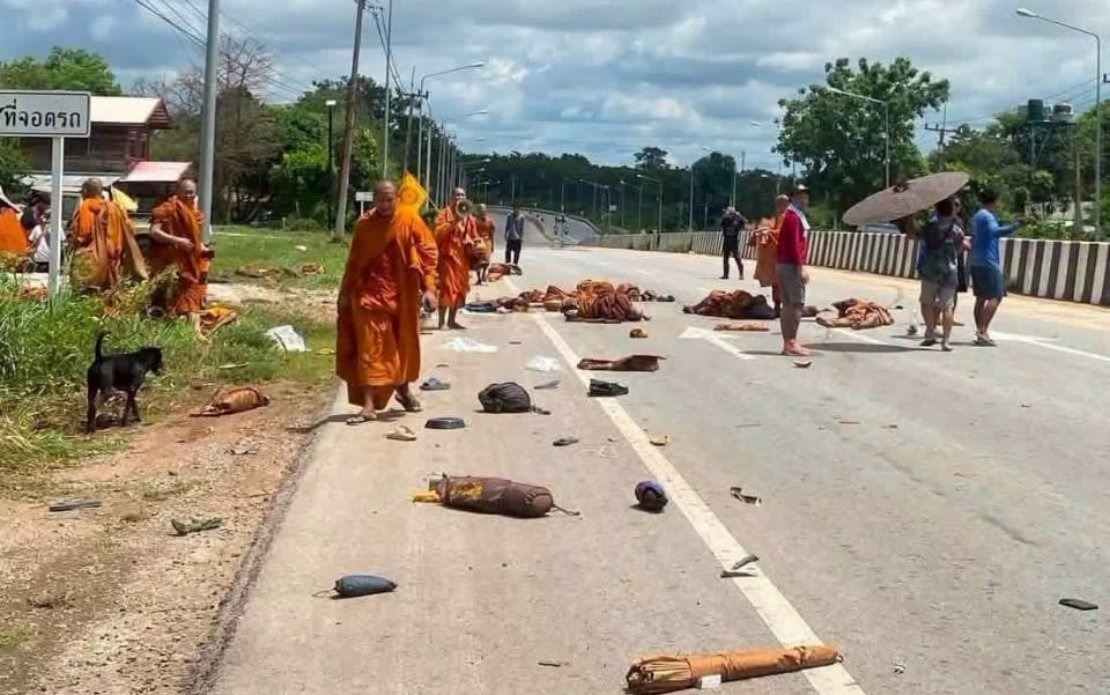
A tragic incident in Thailand's northeastern region has claimed the lives of eight Buddhist monks after a pickup truck ploughed into their religious pilgrimage group in Mukdahan province on Thursday morning. The accident, which also left 14 others injured, occurred as the monks walked along Ban Na Si Nuan Road in Mueang district while making their way to Nam Khun district in the neighbouring province of Ubon Ratchathani. The severity of the incident was evident from the immediate toll, with five monks dying at the scene and three others succumbing to injuries after reaching hospital.
According to Mukdahan Provincial Public Health Chief Dr Narong Chankaew, the injured sustained varying degrees of harm, with four victims experiencing critical injuries and a further ten suffering moderate wounds. In total, 23 patients were hospitalised in connection with the incident, comprising 22 monks and one civilian. The scale of the medical emergency prompted Mukdahan Hospital to issue an urgent appeal for blood donations to sustain treatment of the injured survivors.
Investigations by Mukdahan authorities established that the monks had begun their pilgrimage at approximately 11 am that morning, deliberately walking against the direction of traffic along the road to adhere to recognised pedestrian safety protocols. Mukdahan Governor Warayan Boonnarat provided further details from witness accounts, revealing that the pickup truck experienced a loss of control before veering off the roadway towards the monks. The first five members of the group managed to step clear of the vehicle's path, but those walking approximately two metres from the road's edge were not able to escape and bore the brunt of the impact.
The identity and circumstances surrounding the vehicle's operation present one of the most troubling aspects of this incident. Mukdahan Provincial Police Commander Police Major General Phairoj Thaiputra confirmed that the driver was under 15 years of age and had been placed into custody following the crash. This raises immediate questions about juvenile supervision and vehicle access control in Thailand, concerns that extend across Southeast Asia more broadly as incidents involving underage drivers continue to pose public safety hazards.
Investigators are currently working to establish the precise cause of the accident. Police are examining evidence from the scene and conducting interviews with the driver's parents to understand the circumstances that led to the juvenile operating the vehicle. The inquiry will determine whether mechanical failure, driver error, or other factors contributed to the truck losing control. Beyond establishing criminal liability for the driver, authorities are also weighing whether the parents should face negligence charges for permitting their underage child to operate the vehicle.
This incident carries particular resonance for religious communities across the region. Buddhist pilgrimage journeys hold deep spiritual significance, with monks often undertaking foot-based religious missions as acts of devotion and community engagement. The targeting of this group, whether through negligence or accident, strikes at the heart of communities that hold monks in high regard. In Thailand especially, where Buddhism forms a cornerstone of national identity and social cohesion, such incidents shake public confidence in road safety and child supervision practices.
The legal framework governing juvenile offences in Thailand will be applied to determine accountability. Police have indicated that action will proceed in accordance with Thai law, which typically treats crimes involving minors differently than those involving adults. The question of parental responsibility adds another dimension to the case, as courts increasingly examine whether guardians bear liability for harm caused by children under their care, particularly when vehicles are involved.
Road safety concerns in rural Thailand and across Southeast Asia remain persistently problematic. Pickup trucks and similar open-bed vehicles are widely used throughout the region for both commercial and personal transport, yet enforcement of speed limits, traffic regulations, and vehicle maintenance standards frequently lags behind urban areas. The placement of pedestrians and cyclists on roadways designed primarily for motorised traffic creates inherent hazards, particularly in provinces where infrastructure development has not kept pace with vehicle ownership growth.
The incident also highlights questions about youth access to vehicles and driving culture in Thailand. While the driver's age makes operation of a vehicle illegal, circumstances permitting this situation to arise suggest broader issues around enforcement and parental oversight. For Malaysian observers, the case serves as a reminder of how quickly tragic accidents can unfold when supervision lapses or when young people gain access to dangerous machinery without appropriate instruction or legal clearance.
As investigations continue, the focus will remain on determining exact causes while authorities grapple with the immediate human tragedy. The families of the deceased monks and the injured survivors now face the difficult process of recovery and mourning. For the Buddhist community and wider Thai society, the incident underscores the need for renewed attention to road safety protocols, particularly those designed to protect vulnerable groups such as religious pilgrims and pedestrians sharing space with motor vehicles.
For Southeast Asian nations including Malaysia, this tragedy offers lessons in the importance of robust enforcement mechanisms governing juvenile access to vehicles, parental accountability frameworks, and infrastructure investments that properly separate pedestrian and vehicular traffic. As regional nations continue developing their road safety policies and enforcement structures, incidents such as this in Mukdahan province provide sobering evidence of the consequences when such systems fail or when critical oversight lapses occur.

