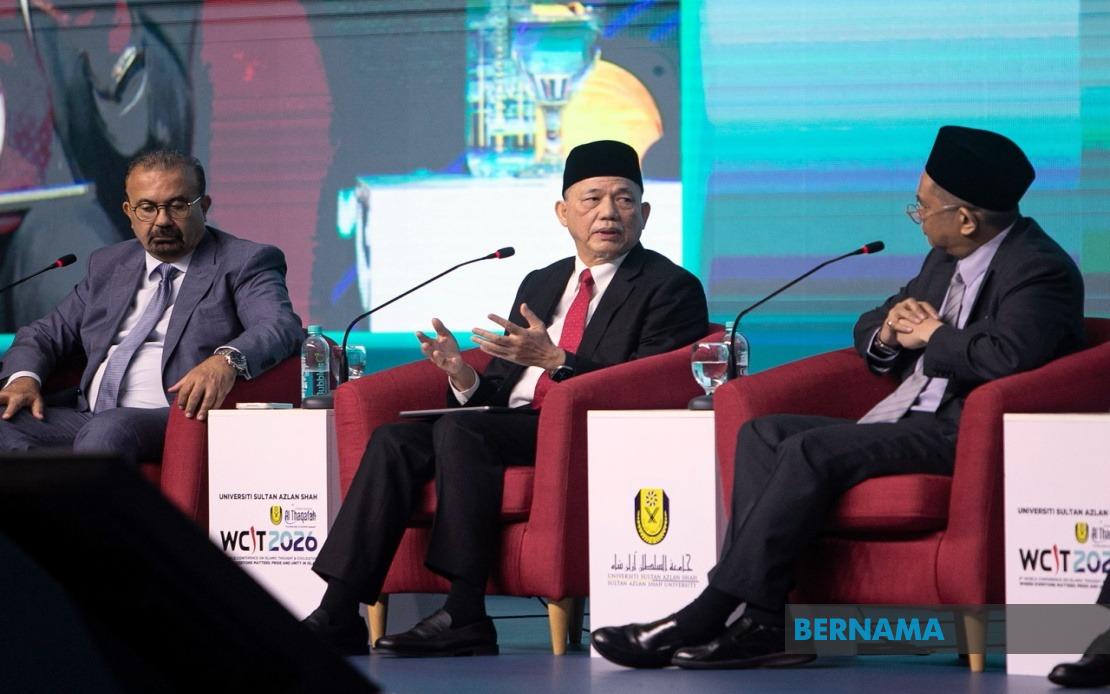
The escalating tensions between major powers and recent instability in critical shipping lanes have fundamentally reshaped the global security landscape, according to Deputy Prime Minister Datuk Seri Fadillah Yusof. Speaking during the 8th World Conference on Islamic Thought and Civilisation in Ipoh, Fadillah, who also serves as Energy Transition and Water Transformation Minister, underscored that energy security and maritime stability can no longer be treated as isolated policy domains. The distinctions that once separated these two spheres have eroded, creating a complex web of dependencies that now defines geopolitical and economic realities.
Fadillah's observations come against a backdrop of renewed hostilities between the United States and Iran, a development that carries significant ramifications far beyond the immediate region. When disturbances occur thousands of kilometres away, their economic shockwaves travel instantaneously across global markets. Electricity tariffs, fuel availability, and the smooth flow of international commerce all respond with surprising sensitivity to events in distant strategic chokepoints. For ordinary Malaysians, this translates into tangible consequences at the petrol pump, on utility bills, and in the prices of imported goods on supermarket shelves.
The Strait of Hormuz, through which flows a substantial portion of the world's petroleum supplies, has become a barometer of global economic health. Recent disruptions there have rippled through Malaysia's economy and the broader international system, demonstrating just how vulnerable modern supply chains have become to regional instability. The minister highlighted that the consequences extend well beyond simple price fluctuations. When shipping routes face heightened risk, insurance premiums for vessels increase substantially, effectively adding a security tax to every container that passes through contested waters. These elevated insurance costs then cascade through logistics networks, raising the final price of goods for end consumers.
Malaysia's geographic position makes it especially attuned to these dynamics. Straddling the Strait of Melaka, one of the world's most critical maritime arteries, the nation sits at the nexus of global trade. Approximately one-third of all maritime commerce passes through these waters annually, connecting the energy-rich Middle East with the manufacturing hubs of East Asia. Any disruption here immediately threatens Malaysia's role as a trading nation and its economic stability. The country's prosperity has been built on reliable access to international markets and stable energy supplies, making maritime security a core national interest rather than merely a peripheral concern.
Fadillah articulated Malaysia's response to these mounting challenges as fundamentally grounded in diplomatic engagement rather than confrontational approaches. The government has committed to pursuing dialogue and maintaining relationships with all nations, a posture reflecting decades of pragmatic foreign policy. This stance acknowledges that Malaysia cannot afford to take sides in great power competitions that might jeopardise its access to energy markets or threaten the sea lanes upon which its commerce depends. Instead, the emphasis rests on promoting rules-based frameworks that protect the rights of smaller nations and maintain the open, predictable trading system that has undergone continuous globalisation for more than a century.
The interconnectedness that Fadillah identified extends into supply chain economics with particular force. As insurance costs rise and fuel surcharges multiply, shipping companies face mounting pressures that ultimately reshape sourcing decisions and manufacturing locations. These seemingly distant financial adjustments can trigger factory relocations or production delays that affect workers and businesses across Malaysia. Understanding this causal chain illuminates why policymakers increasingly view maritime security through an economic lens rather than purely military terms.
The minister's emphasis on the Strait of Hormuz's impact highlights how regional conflicts instantly become Malaysian concerns. A blockade in the Middle East translates within weeks into higher electricity generation costs for Tenaga Nasional, which then potentially translates into tariff reviews for consumers. This transmission mechanism operates so efficiently that Malaysian policymakers must now factor Middle Eastern geopolitics into routine energy planning exercises. The traditional compartmentalisation of foreign policy, security strategy, and economic policy has proven increasingly obsolete.
Fadillah's remarks also implicitly underscore Malaysia's vulnerability as an energy importer deeply integrated into global commodity markets. Unlike energy-exporting nations that might benefit from price spikes, Malaysia must absorb increased costs across its entire economy. This structural position explains the Malaysian government's commitment to energy transition and diversification strategies that reduce dependence on imported fossil fuels. Renewable energy development and regional energy cooperation represent not merely environmental initiatives but essential components of strategic autonomy.
The 8th World Conference on Islamic Thought and Civilisation provided an appropriate forum for these observations, given the conference's emphasis on unity and collective wellbeing. Fadillah's framing positioned energy and maritime security challenges as shared problems requiring international cooperation rather than competition. This appeal to common interests reflects recognition that in an interconnected world, unilateral approaches to security prove counterproductive. The prosperity and stability that all nations seek depends increasingly on maintaining predictable global systems that benefit broad majorities rather than narrow interests.

