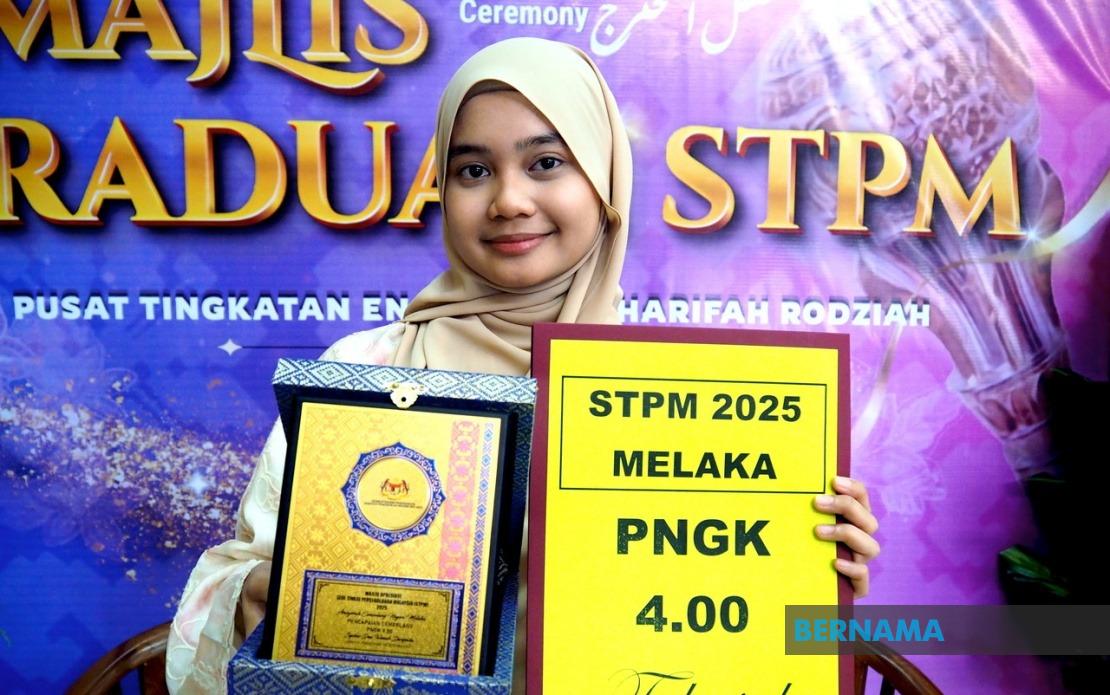
Nurfariesya Nasywa Hamedee's path to academic excellence was forged not in comfort but in crisis. The 21-year-old from Sekolah Menengah Kebangsaan Agama Sharifah Rodziah scored a flawless 4.00 cumulative grade point average in the 2025 Sijil Tinggi Persekolahan Malaysia examination, a distinction she describes as a tribute to her late father, Hamedee Asri, whose parting words became her most powerful study companion.
The loss struck at a particularly vulnerable moment in her academic journey. Her father, then 43, suffered a fatal heart attack just a week before she was scheduled to sit for her Sijil Pelajaran Malaysia trial examination. The timing of his death compounded her grief with practical despair—already reeling from bereavement, Nurfariesya found herself contemplating abandonment of her schooling to enter the workforce and provide for her family. The financial and emotional weight of her father's passing seemed, for a moment, too substantial to overcome.
What proved decisive was a message transmitted through her mother, Yusnita Ruslan, from her late father before his death. He had urged Nurfariesya not to squander her abilities, to persist in her education regardless of circumstance. This counsel, delivered at the threshold between his life and death, crystallized into the motivational force that would sustain her through the subsequent years. She resolved to transform her grief into determination, honoring his memory by achieving the academic success he had believed she was capable of attaining.
The achievement itself carries additional significance because Nurfariesya had not anticipated such a high outcome. Based on her trial examination results and preliminary calculations, she had projected a CGPA of approximately 3.92. The leap to a perfect 4.00 represents not merely the accumulation of good marks, but evidence of sustained effort and intellectual discipline applied across an entire curriculum. This unanticipated excellence suggests that her personal motivation extended beyond meeting expectations into the territory of exceeding them, a distinction meaningful for a student navigating both grief and aspiration.
Nurfariesya's academic trajectory had long pointed toward the humanities and religious studies. During her secondary education, she demonstrated consistent excellence, obtaining seven A grades in her SPM examination. Her genuine intellectual interest in Shariah law deepened her commitment to her studies and shaped her subject choices at the pre-university level. She pursued General Studies, Arabic, Usuluddin, History, and Shariah—a combination reflecting her intention to eventually practice as a Shariah lawyer, a career path demanding both rigorous legal knowledge and deep religious understanding.
Her decision to pursue STPM rather than alternative pre-university pathways reveals practical wisdom about educational strategy. She selected STPM specifically because it offered a more expedited route to tertiary qualification compared with other programs, while simultaneously providing comprehensive recognition from Malaysian universities. This calculation—balancing speed of progression with institutional credibility—demonstrates maturity in educational planning, particularly notable given the personal challenges she was managing simultaneously.
When asked to identify the secret formula behind her success, Nurfariesya declined to claim any special technique or shortcut. Instead, she articulated three foundational elements: disciplined study habits, psychological resilience in the face of setbacks, and spiritual grounding in Islamic faith. This combination of intellectual, emotional, and spiritual dimensions reflects a holistic approach to learning that extends beyond the mechanics of examination technique into the realm of personal character development. Her emphasis on not surrendering to difficulty suggests that her achievement stems partly from temperament and values rather than merely academic aptitude.
Nurfariesya's success was celebrated at the state-level announcement of 2025 STPM results in Telok Mas, an event officiated by Datuk Rosli Abdullah, the State Deputy Exco for Education, Higher Education, and Religious Affairs. The formal recognition underscores the significance of her accomplishment within Melaka's educational landscape. She now stands as an exemplar not only of academic achievement but of perseverance through personal tragedy, a narrative that carries particular resonance in a society where academic success is culturally valued as a pathway to upward mobility and family honor.
Nurfariesya's next objective involves pursuing tertiary education at Universiti Malaya, having recently completed an interview session for a Bachelor's Degree program at the institution. Her perfect STPM score substantially strengthens her candidacy for admission to a competitive research university. The convergence of her academic excellence, sustained motivation, and clearly articulated career aspirations positions her favorably for entry into the professional study of Shariah law, a field in which Malaysia has significant institutional capacity and professional demand.
Parallel to Nurfariesya's story, the 2025 STPM results also highlighted Ng Zhen Hong, a 20-year-old student from Kolej Tingkatan Enam Tun Fatimah, who secured the National-Level Best Student Award for the Science Stream. Ng obtained ten A grades in his SPM examination and attributes his achievement to parental support, teacher guidance, and intellectual passion for quantitative and problem-solving dimensions of scientific study. His daily investment of one to two hours in revision, combined with his reframing of scientific challenges as motivational opportunities rather than obstacles, mirrors Nurfariesya's philosophy of disciplined persistence.
That two such accomplished students emerged from different schools within Melaka in the same examination cohort suggests that the state's educational institutions are cultivating students capable of operating at the highest national levels. Ng's ambition to study Chemical Engineering or Electrical Engineering at Universiti Malaya reflects the pipeline of talent flowing from secondary and pre-university education into advanced STEM fields. The diversity of their intended specializations—one in Shariah law, one in engineering—demonstrates that excellence in STPM is not confined to any single disciplinary track but rather reflects institutional quality and student caliber across multiple domains.
For Malaysian readers, particularly those navigating their own educational transitions or supporting adolescents through similar passages, Nurfariesya's narrative offers a counterpoint to narratives of academic success achieved under favorable circumstances. Her achievement demonstrates that excellence is achievable even when personal circumstances are marked by loss and financial strain, provided that motivation derives from deeper sources—familial bonds, internalized values, and clear purposefulness about one's educational trajectory. Her story suggests that the most transformative learning often occurs not in the absence of adversity but precisely in the context of confronting and transcending it.