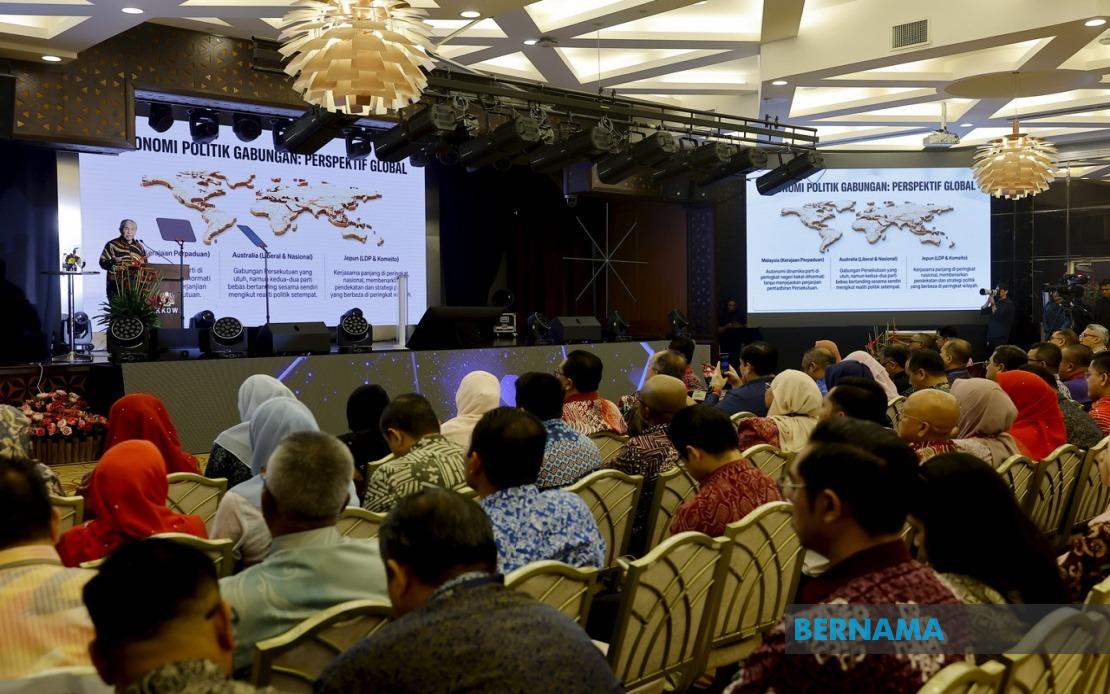
The federal government's stability will remain unaffected by political rivalries playing out in individual states, Deputy Prime Minister Datuk Seri Dr Ahmad Zahid Hamidi declared at a Ministry of Rural and Regional Development assembly in Putrajaya on August 6. Speaking as chairman of Barisan Nasional, Ahmad Zahid emphasized that the Unity Government coalition was underpinned by binding mutual understanding and formal agreements that would keep the administration on course regardless of state-level political developments.
Ahmad Zahid's statement comes as a pointed response to rising concerns about coalition cohesion following recent state elections, particularly in Johor and Negeri Sembilan, where electoral outcomes have sparked questions about the broader stability of the MADANI Government. The Deputy Prime Minister sought to draw a clear distinction between state politics and federal governance, arguing that divergent political fortunes at the state level need not translate into instability at the centre of power. His comments reflect an attempt to reassure both coalition partners and the Malaysian public that the machinery of government will continue functioning smoothly regardless of shifting political dynamics in individual states.
The cornerstone of Ahmad Zahid's assurance rests on the contention that the federal government's stability is anchored in a formal coalition agreement that will remain binding for as long as Parliament has not been dissolved. This legal and political framework, he argued, provides sufficient safeguards to ensure continuity of administration, implementation of policies, and delivery of programmes and projects that the government has committed to undertaking. The emphasis on the parliamentary dissolution trigger suggests a recognition that while the coalition agreement is robust, it is not indefinite, hinting at potential shifts once the next general election is called.
Crucially, Ahmad Zahid articulated a nuanced position on how coalition governments function in Malaysia's political system. He acknowledged that coalition members need not surrender their individual party identities or political principles in order to maintain governmental stability. This position is significant for Malaysian politics, where coalition governments have often been fragile arrangements vulnerable to party defections or sudden withdrawals. By framing the Unity Government as allowing what he termed "political autonomy within a coalition government," Ahmad Zahid was articulating a model in which member parties retain the freedom to pursue distinct political strategies and contest state elections on their own terms, provided they honour the overarching federal coalition agreement.
The distinction between party autonomy and coalition loyalty represents a carefully calibrated political philosophy. It suggests that individual member parties of the Unity Government can campaign aggressively in state elections, pursue their own electoral interests, and advance their own political agendas without this necessarily triggering a breach of the federal coalition arrangement. Under this framework, a state election loss or victory by one coalition member does not automatically threaten the stability of the federal government, as long as the formal coalition agreement remains honoured at the federal level. This approach has practical implications for how the government can function even when individual member parties experience electoral volatility at the state level.
For Malaysian readers and observers of regional politics, Ahmad Zahid's reassurance addresses a legitimate concern about coalition government sustainability in Southeast Asia's largest economy. The Malaysian political landscape has historically been prone to sudden shifts and unexpected defections, with state-level political upheaval sometimes serving as a precursor to federal-level instability. The 2020 collapse of the Pakatan Harapan government, triggered partly by state-level political maneuvering, remains a cautionary tale. Ahmad Zahid's explicit linking of coalition stability to the parliamentary dissolution trigger acknowledges this history while attempting to provide a clear legal and procedural anchor for the current arrangement.
The government's ability to implement its planned policies, programmes, and projects depends significantly on this coalition stability, Ahmad Zahid implied. Major development initiatives, infrastructure projects, and economic policies typically require multi-year commitment and sustained political support. A fragile coalition government could see implementation timelines slip or policy reversals occur following unexpected political shifts. By asserting the robustness of the Unity Government's coalition agreement, Ahmad Zahid was effectively signalling to civil servants, investors, and the business community that medium and long-term government commitments can be relied upon. This signalling function extends beyond political rhetoric to have real economic and administrative consequences.
The timing of Ahmad Zahid's statement is noteworthy, coming as various states navigate their own political dynamics under different configurations of power. The recent state elections in Johor and Negeri Sembilan appear to have prompted questions about whether wins or losses for particular coalition members might trigger a reassessment of federal coalition terms. Ahmad Zahid's intervention can be read as a deliberate attempt to prevent such speculation from gaining traction. By publicly and forcefully reiterating the binding nature of the federal coalition agreement, he sought to establish a clear and unambiguous position that state election outcomes, while politically significant, do not automatically translate into federal-level renegotiations.
The broader regional context adds another layer of significance to Ahmad Zahid's remarks. Southeast Asia has experienced recurring cycles of coalition government instability, from Thailand's frequent government changes to Indonesia's complex coalition mathematics. Malaysia's experience with multiple coalition arrangements over recent years has positioned it as a regional case study in coalition stability and durability. Ahmad Zahid's articulation of how the Unity Government maintains stability while allowing constituent parties political autonomy may offer a model worth examining for other coalition governments in the region grappling with similar tensions between unity and autonomy.
Looking ahead, the Deputy Prime Minister's emphasis on the parliamentary dissolution mechanism as the natural endpoint of the coalition agreement suggests that discussions about the timing of the next general election will inevitably become more politically charged. The longer Parliament remains in session without dissolution, the longer the current coalition framework remains in force. However, once the dissolution trigger is activated, the entire political landscape becomes fluid again. This implicit timeline provides coalition partners with a clear if unstated deadline by which state-level political achievements or disappointments may influence broader coalition strategies and negotiations.
In essence, Ahmad Zahid's message to political stakeholders, the business community, and Malaysian citizens was one of reassurance layered with realism. The federal government will function stably and deliver on its commitments, but this stability is conditional upon honour of the coalition agreement and the absence of parliamentary dissolution. State elections may produce varied outcomes and energize different political narratives in different parts of the country, but these developments operate within clearly defined parameters that do not automatically destabilize federal governance. This articulation reflects a matured understanding of how coalition governments can operate in Malaysia's political system while acknowledging the inherent tensions and potential flashpoints that require careful management.

