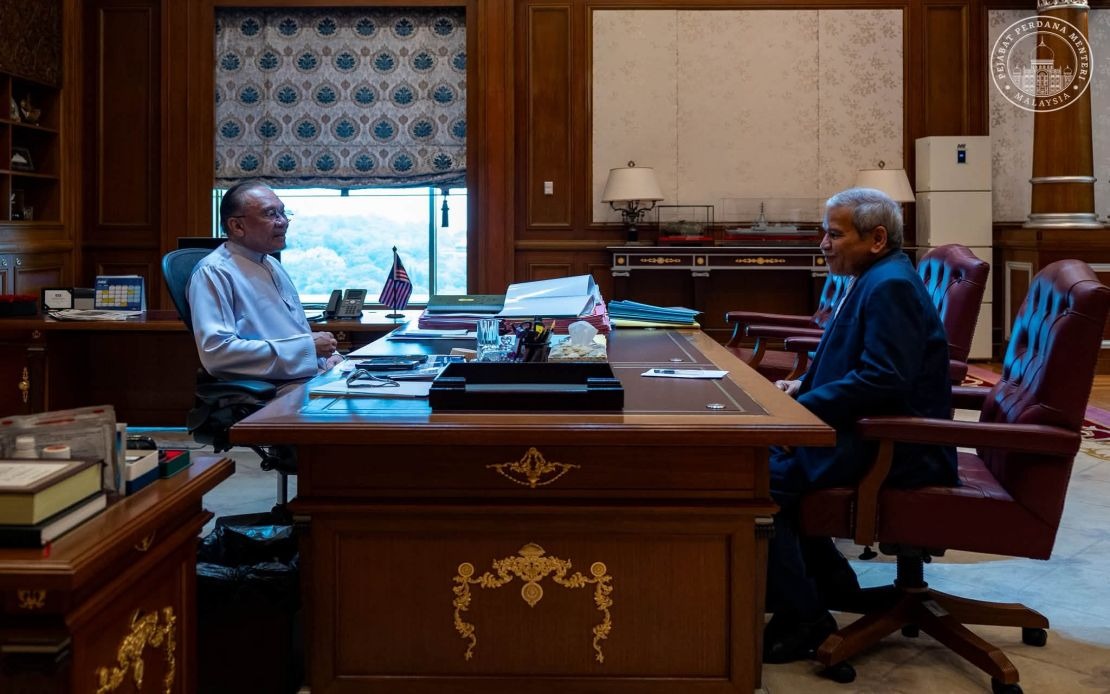
Prime Minister Datuk Seri Anwar Ibrahim has reinforced the government's commitment to fortifying the Federal Land Development Authority (FELDA) as a cornerstone institution dedicated to improving the livelihoods of settlers and their families. Speaking following a meeting with newly appointed FELDA chairman Tan Sri Ahmad Badri Mohd Zahir in Putrajaya, Anwar outlined his vision for an organisation that balances social welfare with institutional resilience in a rapidly changing economic landscape.
The appointment of Ahmad Badri as FELDA chairman, effective July 15, marks a transition in leadership at the authority, succeeding Datuk Seri Ahmad Shabery Cheek whose tenure concluded on June 30. For Anwar, who simultaneously holds the Finance portfolio, the timing of this leadership change presents an opportunity to recalibrate FELDA's strategic direction under the MADANI Government framework, which has positioned itself as a administration committed to inclusive development and institutional reform.
Central to Anwar's emphasis is the recognition that FELDA serves a dual mandate. Beyond its traditional role in supporting settler communities—a responsibility spanning decades since the authority's establishment—FELDA must simultaneously enhance its competitive positioning within Malaysia's evolving agricultural and economic sectors. This dual imperative requires sophisticated management of resources, innovation in farming practices, and strategic market positioning to ensure that settlers benefit not merely from subsidies or welfare provisions, but from genuinely sustainable livelihoods rooted in profitable agricultural enterprises.
The intergenerational dimension features prominently in Anwar's assessment. Younger settlers face distinct challenges compared to their parents' generation, including exposure to global commodity price volatility, shifting consumer preferences toward sustainable and organic produce, and the necessity of adopting digital agricultural technologies. By explicitly acknowledging these emerging issues, Anwar signals that FELDA's renewal must extend beyond preserving historical welfare mechanisms to actively positioning the next generation of farmers for success in contemporary markets.
Economic competitiveness remains a persistent challenge for FELDA schemes. Many settlers have historically relied on commodity crops such as rubber and palm oil, sectors subject to international price fluctuations and increasing scrutiny regarding environmental and labour practices. A strengthened FELDA would presumably facilitate diversification, value-added processing initiatives, and potentially higher-margin agricultural enterprises that insulate settlers from raw commodity market volatility whilst aligning with global sustainability expectations.
Anwar's framing of FELDA as an institution serving the people reflects broader governmental priorities around nation-building through inclusive economic participation. FELDA represents more than an administrative entity; it embodies a social contract with rural communities and symbolises the state's commitment to preventing agricultural marginalisation. When institutional frameworks weakened or became inefficient, settler communities bore direct consequences through reduced support, limited market access, and younger generations abandoning agricultural livelihoods for urban employment.
The incoming leadership under Ahmad Badri faces expectations to operationalise Anwar's stated priorities. This includes maintaining settler welfare—encompassing healthcare, education, and income support—whilst simultaneously driving operational efficiencies, improving transparency, and modernising FELDA's governance structures. The balance between these objectives is inherently delicate; cost-cutting measures that improve institutional profitability might adversely impact vulnerable settler segments, whilst expansive welfare provisions could compromise FELDA's financial sustainability.
For Malaysian stakeholders monitoring agricultural policy, FELDA's trajectory carries significance extending beyond settler communities. The authority manages substantial agricultural land, employs thousands directly, and influences rural economic dynamics across multiple states. A reinvigorated FELDA could contribute meaningfully to food security initiatives, rural income stabilisation, and agricultural sector resilience—objectives gaining prominence amidst global supply chain disruptions and climate variability.
Anwar's commitment to continued government support signals budgetary allocation and political will behind institutional renewal. The MADANI Government's positioning as a reform-oriented administration becomes partly validated through genuine resource commitment to longstanding entities like FELDA. This contrasts with rhetoric-only approaches where institutional renewal remains aspirational without corresponding financial or organisational backing.
The broader context involves Malaysia's agricultural sector facing headwinds from labour shortages, rising production costs, and intensifying environmental regulations. FELDA settlers, often smaller-scale operators compared to large commercial plantations, require particular support navigating these structural challenges. A strengthened FELDA could facilitate technology transfer, provide collective bargaining capacity for input procurement and produce marketing, and support compliance with emerging environmental standards.
Institutional strengthening also encompasses governance quality and settler representation in decision-making. Settlers' grievances historically included limited voice in strategic planning and resource allocation decisions. Enhanced institutional robustness might incorporate stronger governance structures ensuring settler participation, transparent decision-making processes, and accountability mechanisms protecting settler interests.
Looking forward, FELDA's evolution under Ahmad Badri's leadership will be scrutinised by multiple constituencies: settler organisations monitoring welfare provisions, environmental advocates assessing sustainability practices, policymakers evaluating institutional efficiency, and market observers tracking agricultural productivity. Success requires Ahmad Badri to navigate competing priorities whilst maintaining institutional credibility across diverse stakeholder groups.
Anwar's intervention emphasises that FELDA's renewal represents a government priority rather than an incidental administrative matter. Whether this translates into sustained policy attention, adequate resource allocation, and concrete institutional reforms remains to be demonstrated through coming months and years.

