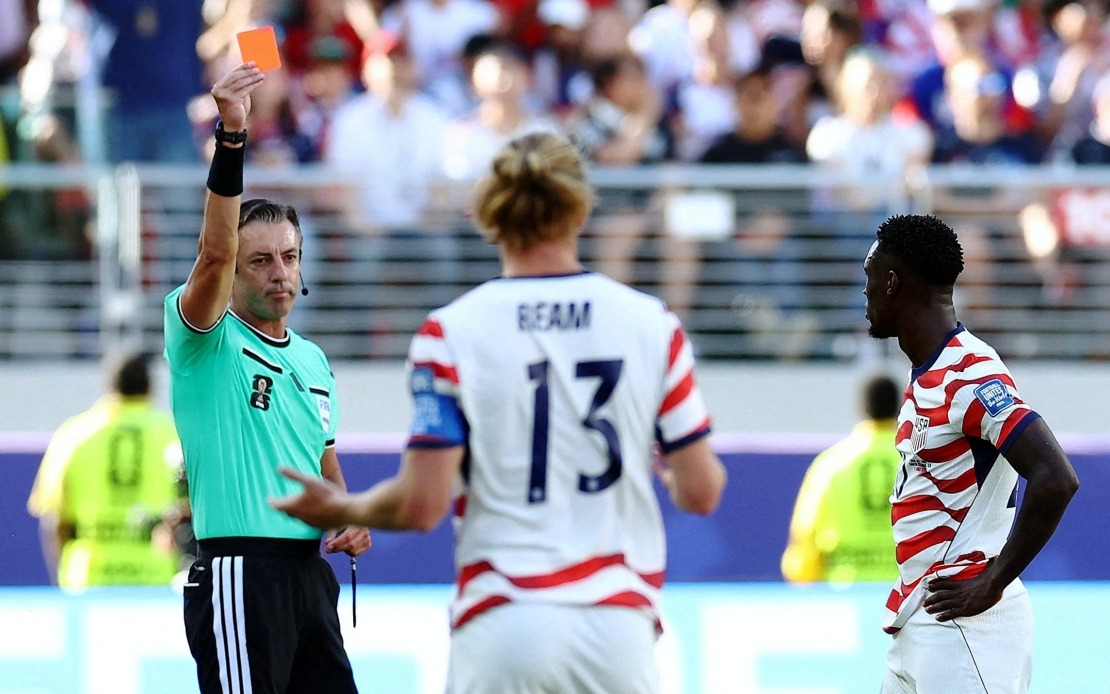
The football world's governing body FIFA issued a controversial ruling on Sunday that clears the path for United States striker Folarin Balogun to participate in Monday's knockout encounter with Belgium in Seattle, despite his recent dismissal from the pitch. The decision represents an unusual application of FIFA's disciplinary framework and has immediately drawn formal objections from Belgian officials, who contend the ruling undermines the integrity of the tournament's established regulations.
Balogun received a direct red card during the Americans' 2-0 group-stage victory over Bosnia and Herzegovina on July 1 after his foot made contact with defender Tarik Muharemovic. Under standard World Cup protocols that have been consistently enforced throughout the current tournament, such a dismissal would ordinarily trigger an automatic one-match suspension, barring the player from his team's next fixture. The FIFA Disciplinary Committee initially upheld this principle, formally sanctioning Balogun under Articles 14 and 66 of the FIFA Disciplinary Code.
However, FIFA subsequently invoked Article 27 of its Disciplinary Code, which grants the regulatory body discretionary authority to defer the implementation of a suspension during a probationary interval. In its official statement, FIFA announced that Balogun's suspension would remain in effect for one year on a suspended basis, providing he commits no further infractions of comparable severity during that period. Should the American attacker accumulate another serious disciplinary violation, the initial ban would activate automatically alongside any additional penalties imposed for the subsequent breach.
The Royal Belgian Football Association responded swiftly and sharply to FIFA's announcement, expressing formal bewilderment at the decision's rationale. Belgian officials outlined their position that Article 66.4 of the same regulatory code explicitly mandates automatic suspension following a direct red card dismissal, establishing a clear and unambiguous principle that has governed all previous red card incidents throughout this World Cup tournament. The federation's protest documents referenced this consistency as evidence that the Balogun decision represents a departure from precedent.
Belgian administrators further challenged FIFA's ruling by citing multiple provisions they argue should have prevented the suspension deferral. Article 10.5 of the FIFA World Cup 2026 Competition Regulations unambiguously stipulates that players receiving either direct red cards or second yellow card dismissals "will automatically be suspended from their team's subsequent match," while potentially facing supplementary disciplinary measures. The Belgian federation emphasised that this automatic suspension framework was formally reaffirmed in FIFA World Cup 2026 Circular No. 16, circulated to all participating member nations on May 12, and reiterated throughout the tournament via match coordination meetings and official workshops.
The stakes in Monday's Seattle encounter carry considerable significance for both nations. The United States, seeking to advance beyond the round-of-16 stage for the first time since 2002, currently benefits from Balogun's presence in the squad. The striker has emerged as a vital attacking asset for the American team, contributing three goals to lead the nation's scoring charts throughout the tournament. His availability substantially enhances the US team's prospects in what represents a crucial competitive fixture with a quarterfinal berth on the line.
For Belgium, the decision introduces a tangible tactical disadvantage, as they prepare to face a full-strength opposing attack in a knockout context where any marginal edge proves consequential. The Belgian federation's formal challenge to FIFA's suspension deferral reflects not merely disappointment with the outcome, but a principled objection to what they characterise as selective application of transparent regulatory standards. Their statement emphasised commitment to protecting "the legitimate rights of all participating teams and the fundamental principles of fair play" throughout the tournament and beyond.
The controversy illuminates underlying tensions within international football governance, where discretionary authority occasionally collides with procedural consistency. FIFA's invocation of Article 27 demonstrates the regulatory framework's flexibility, yet this same flexibility appears to have generated perceptions of unequal treatment. The fact that no other red card dismissal during the current World Cup has received similar suspension deferral strengthens Belgium's argument that precedent and fairness principles have been compromised.
From a regional perspective, Southeast Asian football observers should note how such governance disputes can shape tournament outcomes and international sporting relationships. The Balogun decision exemplifies how administrative rulings made by distant regulatory bodies can fundamentally alter competitive dynamics, regardless of on-field performance. It also underscores the importance for national football associations to understand and challenge regulatory decisions when they perceive inconsistent application of established protocols, as Belgium has done through formal diplomatic channels.
The Royal Belgian Football Association indicated it would exhaust all available remedies to protect its competitive position, suggesting potential escalation of the dispute. FIFA's regulatory apparatus does provide avenues for appeal and reconsideration, though the compressed timeline of knockout-stage competition constrains the practical utility of prolonged procedural challenges. Nevertheless, Belgium's formal protest creates an official record of their objection and may influence how FIFA applies suspension deferral authority in future World Cup editions or other major tournaments.
As the match approaches, the sporting dimensions of the controversy will recede behind actual performance on the pitch. Yet the broader implications persist—this decision will likely influence discussions about competitive fairness, regulatory transparency, and the balance between discretionary flexibility and procedural consistency in international football governance. For Belgian football administrators, the incident reinforces the necessity of vigilantly monitoring how regulatory bodies exercise delegated authority, particularly when such exercise appears to deviate from established patterns.

