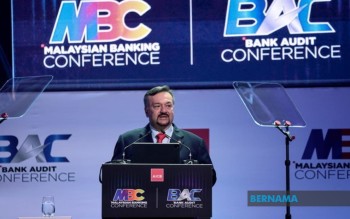
Malaysia's Finance Minister II, Datuk Seri Amir Hamzah Azizan, has drawn a clear line in the sand regarding the trajectory of financial services in an age of rapid technological change. Speaking at the Asian Institute of Chartered Bankers (AICB) Nexus 2026 Conference in Kuala Lumpur, he underscored a critical reality that many in the sector have struggled to articulate: the institutions that will thrive are not necessarily those with the most cutting-edge technology, but rather those that can marry machine intelligence with irreplaceable human qualities such as judgment, integrity, and the capacity to navigate complex situations with wisdom.
The minister's intervention carries particular significance for Malaysia, where financial services form a cornerstone of economic development and regional stability. As artificial intelligence increasingly automates routine banking functions—from transaction processing to basic customer service—the sector faces both an opportunity and a threat. The opportunity lies in efficiency gains and enhanced analytical capabilities; the threat centres on the potential hollowing out of skilled employment and the erosion of the human relationships that have historically anchored trust in financial institutions.
Amir Hamzah's central argument revolves around a notion that has become somewhat fashionable in technology circles but remains poorly implemented in practice: that human and artificial systems should be viewed as complementary rather than competitive. He made plain that a banking system's resilience depends on three pillars working in concert—sound regulation, capital adequacy, and technological infrastructure—yet emphasized that these mechanical elements mean little without people capable of understanding and governing the complexity those systems create. This represents a subtle but important rebuttal to the techno-optimism that sometimes dominates policy discussions, where algorithmic solutions are presented as panaceas.
The implications for Malaysia's workforce are substantial. The finance minister explicitly framed talent investment as core infrastructure, not as an ancillary expense that can be trimmed during downturns. This reframing has profound consequences for how Malaysian banks should budget for human capital development, training, and succession planning. If adopted strategically, it could signal a shift away from the cost-cutting mentality that has characterized much of the global financial sector since the 2008 crisis, where redundancy programmes often eliminated institutional knowledge faster than technology could replace it.
Amir Hamzah also sketched out a governance ecosystem that extends beyond individual institutions. He acknowledged that government, regulators, industry bodies, and professional associations like AICB each bear responsibility for building a banking workforce that is capable, adaptable, and trustworthy. This systems-level approach recognises that no single stakeholder can solve the skills gap unilaterally. The government must set policy and provide incentives; regulators must ensure standards don't slip; industry bodies must coordinate on best practices; and professional bodies like AICB must furnish the qualifications, leadership development, and continuing education that keep the workforce ahead of technological change.
For the Asian Institute of Chartered Bankers specifically, the minister's remarks amount to an endorsement of its evolving mission. AICB's role transcends merely certifying that individuals possess technical knowledge; it increasingly must function as a guardian of professional ethics and a conduit for leadership development in an industry grappling with unprecedented transformation. The conference theme itself—Nexus 2026—suggests a bridging function, a recognition that 2026 represents a near-term horizon where AI integration will have moved beyond pilot projects into mainstream operations across the region's banking sector.
The ethical dimension running through the minister's remarks deserves particular attention. He spoke of responsible innovation and ethical leadership, not as constraints on progress but as essential features of a banking system that retains public confidence. This is especially pertinent in the Malaysian and broader Southeast Asian context, where banking scandals and disputes over governance can rapidly erode depositor trust and destabilize markets. By emphasizing integrity as a connecting thread across all levels of the banking ecosystem, Amir Hamzah was implicitly arguing that technical competence divorced from ethical anchoring produces institutions that may be efficient but lack legitimacy.
The practical challenge now lies in translating this philosophy into concrete action. Malaysian banks will need to make sustained investments in retraining existing staff rather than replacing them with technology. They will need to recruit individuals with hybrid skill sets—those who understand both finance and technology, but who also possess strong communication abilities and ethical judgment. Regulators may need to establish frameworks that incentivize rather than merely permit this approach, perhaps through regulatory capital requirements that favour banks demonstrating strong governance and human capital metrics.
Regionally, Malaysia's positioning is important. As a financial hub with growing ambitions in Islamic finance and fintech, the country's approach to the human-AI balance could influence how other ASEAN nations tackle the same question. If Malaysian institutions successfully demonstrate that human expertise and machine intelligence can be orchestrated to deliver superior customer outcomes while maintaining employment and social cohesion, that model could resonate across the region. Conversely, if Malaysian banks pursue aggressive automation and see customer trust or employee morale deteriorate, that too would send regional signals.
The minister's remarks also implicitly challenge the notion that financial regulation is primarily about capital ratios, liquidity coverage, and stress testing—important though these are. By elevating professional standards, leadership development, and the quality of decision-making as regulatory concerns, Amir Hamzah was suggesting that prudential stability ultimately depends on the calibre of the human beings running institutions. This aligns with international thinking on governance and risk culture, but its explicit articulation by a sitting finance minister in Malaysia underscores that the country is unlikely to outsource its financial sector's future entirely to algorithms.
Looking ahead, the real test of this philosophy will emerge in how Malaysia's banking sector responds over the coming years. Will AICB find increased support and resources for its professional development programmes? Will banks expand or contract their graduate recruitment and management training? Will regulators introduce new metrics to monitor human capital quality alongside traditional supervisory indicators? These questions will determine whether the balance Amir Hamzah outlined becomes a defining feature of Malaysian banking or remains an aspirational vision.

