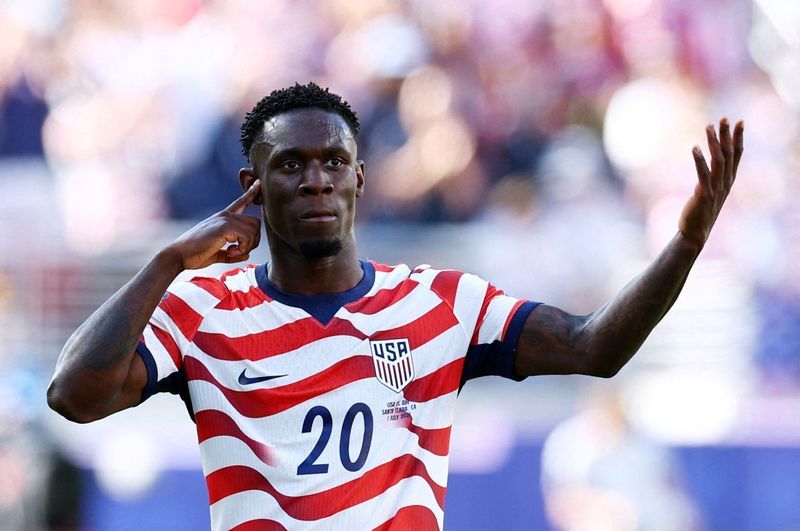
Folarin Balogun enters Monday's knockout match against Belgium carrying far more than his team's World Cup hopes. The Nigerian-born striker represents an extraordinary collision of sports, immigration policy and American political identity, a convergence made all the more remarkable by the unexpected intervention of President Donald Trump in FIFA affairs. What began as a routine disciplinary matter has transformed into a symbolic contest over what it means to be American, with Balogun's remarkable tournament run amplifying questions about citizenship, belonging and national representation at a moment when these issues dominate US political discourse.
Balogun was supposed to watch Monday's game from the sidelines. After receiving a red card during the United States' previous match against Bosnia and Herzegovina for a challenge that appeared largely inadvertent—planting his boot on defender Tarik Muharemovic's ankle—his participation seemed foreclosed. FIFA's announcement on Sunday that it would suspend the red card suspension shocked observers and prompted immediate scrutiny of the decision-making process. The reversal arrived with impeccable timing for the midfielder, yet arrived wrapped in uncomfortable questions about political pressure and FIFA's independence.
The irony proved impossible to ignore. Trump, who has spent years campaigning against birthright citizenship and framing it as a loophole requiring closure, personally lobbied FIFA President Gianni Infantino to reconsider Balogun's case. While Infantino denied that the president's intervention influenced the suspension decision, the proximity of events—occurring less than a week after the Supreme Court handed Trump a stinging defeat on his birthright citizenship ambitions—fed speculation about behind-the-scenes pressure. The timing proved too convenient for neutral observers, transforming a straightforward disciplinary matter into a political flashpoint.
Balogun's origin story underscores the layered complexity of his situation. His Nigerian mother, traveling in New York, discovered she was too advanced in pregnancy to safely fly home. Unable to return to Britain, she gave birth to Balogun in the United States, automatically conferring citizenship upon him through the 14th Amendment's birthright guarantee. When Balogun was one month old, his mother carried him back to London, where he would spend his formative years and develop into a world-class footballer through Arsenal's academy system. The United States remained merely the accident of his birth, a technical distinction of citizenship without emotional resonance or personal connection.
Yet Balogun chose America. After representing England at youth level, he deliberately opted to join the US Soccer program in 2023, a decision he explained through his growing affection for American supporters and a transformative vacation to Orlando. "It feels like I'm at home here," he declared in announcing his commitment to the Stars and Stripes, suggesting that national identity transcends birthplace and encompasses choice, commitment and emotional attachment. His selection elevated him from technical birthright citizenship to deliberate national representation, a distinction that proved crucial to the political narrative developing around his tournament.
Balogun's emergence as the United States' breakout star carries profound implications for American soccer's demographic evolution and international standing. For years, Christian Pulisic embodied the rare celebrity footballer that American soccer could produce, a charismatic standard-bearer for a sport that historically occupied marginal cultural space in a nation fixated on basketball, baseball and football. Balogun's three-goal tournament performance and genuine star power threatened to eclipse Pulisic's dominance, positioning a player whose family heritage bridges Nigeria, Britain and America as the face of US soccer ambitions. This shift reflected deeper changes in American soccer demographics, with recruitment increasingly drawing on diverse talent pools and international heritage.
The political implications reverberated across American discourse on immigration and citizenship. Supporters of birthright citizenship seized upon Balogun's accomplishments as powerful testament to the policy's virtue. The Miami Herald editorial declaring that Balogun "prove(s) birthright citizenship isn't a loophole—it's America" captured the progressive argument encapsulated by his story. Jorge Loweree, managing director of programs at the American Immigration Council, framed Balogun's case as demonstrating "the good that is made available to us by things like birthright citizenship, giving people an opportunity that they would not have otherwise, to be their best and to contribute to the United States in ways that benefit all of us." His World Cup success provided immigration advocates a compelling counternarrative to restrictionist arguments against unconditional birthright citizenship.
The policy context amplified these symbolic stakes. The United States occupies rare company as one of only 33 nations permitting unconditional birthright citizenship, predominantly concentrated in Western Hemisphere countries. An 1898 Supreme Court ruling in United States v. Wong Kim Ark affirmed that the 14th Amendment guarantees citizenship to children born on American soil regardless of parental citizenship status. Trump has repeatedly advocated eliminating this provision, framing birthright citizenship as an unintended loophole exploited by foreign nationals seeking American citizenship for their children. The Supreme Court's recent rejection of Trump's birthright citizenship ambitions rendered the Balogun moment particularly resonant, as immigration advocates effectively deployed a footballer's accomplishments as counterargument to restrictionist policy proposals.
Public opinion data suggested Balogun's narrative aligned with broader American sentiment on the citizenship question. A Reuters/Ipsos poll conducted during 2024 found that most Americans opposed eliminating birthright citizenship, indicating that restrictionist framing had failed to persuade majority opinion despite years of advocacy from Trump and allied figures. Balogun's tournament performances provided tangible exemplification of what birthright citizenship advocates contended—that the policy produced net societal benefits by incorporating talented individuals who might otherwise have represented competing nations or contributed their abilities elsewhere.
Yet the red card incident and Trump's intervention introduced complicating elements that threatened to overshadow these civic narratives. Trump's personal telephone call to Infantino requesting reconsideration of Balogun's suspension created the appearance, however unfounded, that executive political pressure influenced FIFA's disciplinary independence. For immigration advocates celebrating Balogun as vindication of birthright citizenship's value, Trump's instrumental use of Balogun's case for political purposes proved deeply troubling, suggesting that even a policy's strongest advocates might deploy it opportunistically when convenient. The irony deepened when one considered that Trump sought to overturn the very birthright citizenship provision that made Balogun's American citizenship possible.
Balogun's personal response to the red card suspension demonstrated maturity and composure. Rather than obsessing over the injustice of his ejection or expressing frustration at his unavailability for Monday's crucial match, he committed to supporting teammates from the sidelines, embodying team-first mentality and professional dedication. When teammate Christian Pulisic wrapped his arm around Balogun as he processed his ejection, the moment captured the mutual respect and camaraderie within the squad, transcending individual achievement or national background. Balogun's willingness to subordinate personal ambition to collective success conveyed character qualities that extend beyond his statistical accomplishments on the pitch.
The narrative surrounding Balogun's World Cup journey reflects broader tensions in contemporary American identity discourse. His simultaneous existence as a British-raised professional, Nigerian-heritage individual and American citizen by birthright defied simplistic categorization or nationalist frameworks insisting on singular, exclusive loyalty. His choice to represent the United States, made deliberately rather than by accident of birth or parental nationality, suggested that modern national identity increasingly encompasses conscious commitment and emotional affiliation rather than merely genetic inheritance or geographic accident. For a nation historically framing itself as a beacon of opportunity and meritocratic advancement, Balogun's trajectory from accidental American to world-stage competitor embodied aspirational national mythology.
As Monday's match against Belgium approaches, Balogun carries symbolic weight extending far beyond soccer's conventional concerns about tactics, possession percentages and goal-scoring opportunities. He represents competing visions of American citizenship, national belonging and what the United States owes to talented individuals born within its borders. Whether his presence in the lineup stems from FIFA's genuine determination to correct a disciplinary injustice or from political pressure remains contested, but the ambiguity itself illuminates how thoroughly sports and politics have become intertwined in contemporary discourse. For Malaysian observers following American soccer's development and international standing, Balogun's emergence signals that talent recruitment increasingly transcends traditional national boundaries, with identity and belonging becoming negotiated rather than predetermined categories.

