An encounter in a hospital administrative office in northwest England sparked an unexpected wave of nostalgia for a Malaysian doctor who had grown accustomed to life abroad. After a gruelling clinic day that stretched well past mid-afternoon without a meal break, she found herself confiding in a team secretary about her hunger. What followed was a small gesture of kindness that would bridge continents and generations: the secretary's simple offer to peel a mandarin orange, accompanied by an apology that it was all she had available. That moment transported her mind instantaneously back to Malaysia, where such expressions of care through food form the emotional bedrock of family relationships and community bonds.
Throughout her life in Malaysia, food has operated as something far more profound than mere sustenance. It has been the primary vocabulary through which her family members have articulated affection, concern, and presence. This linguistic heritage began in childhood and extended well into adulthood, creating a palimpsest of culinary memories that still define her understanding of what it means to be cared for. Her paternal grandmother initiated this tradition, and the baton was later passed to her mother—a silent but unmistakable succession that emphasised continuity and constancy. Even her late father participated in this language, spending patient hours cracking open crabs and meticulously extracting the sweet flesh so that his daughter could enjoy the delicacy without the labour, a gesture so thorough that she never learned the skill herself.
The act of feeding extended into her teenage years in ways that outsiders might find peculiar. Her grandmother hand-fed her for years, not out of constraint but out of a conviction born from love and quirky folk wisdom. Her granddaughter had developed a stubborn habit of reading storybooks during meals, and her grandmother's solution was to ensure that distraction would not rob her of proper nutrition. Whether this stemmed from genuine concern about choking or from an old woman's belief that food consumed inattentively would somehow fail to nourish the body, the message was clear: eating well mattered because the eater mattered.
Her mother has carried forward these traditions with consistency that speaks to their importance within the family structure. The blue packet Hup Seng Teddy biscuits that featured in her childhood shopping bags continue to appear whenever she returns home from England, a ritual her mother maintains despite the passage of decades. Even the family disagreements held their own significance—her mother's chronic inability to remember that her daughter preferred tomato-flavoured Mr Potato crisps rather than other varieties became itself a form of tender exasperation, a running joke within their relationship that proved how much attention had been paid to her preferences over the years.
The festive calendar of her childhood was distinctly punctuated by food that catered to her specific tastes. Her aunt's Deepavali chicken curry contained extra potatoes because she understood and accommodated her niece's preference for potatoes over chicken, a pattern that has persisted to the present day. These were not random acts of culinary improvisation but rather deliberate choices reflecting genuine knowledge of and care for another person's happiness. Similarly, her mother's colleague from the school where she taught became an annual fixture during Deepavali season, arriving without fail with her legendary chocolate moist cake, a gift that required no repayment and expected none beyond acknowledgment and consumption.
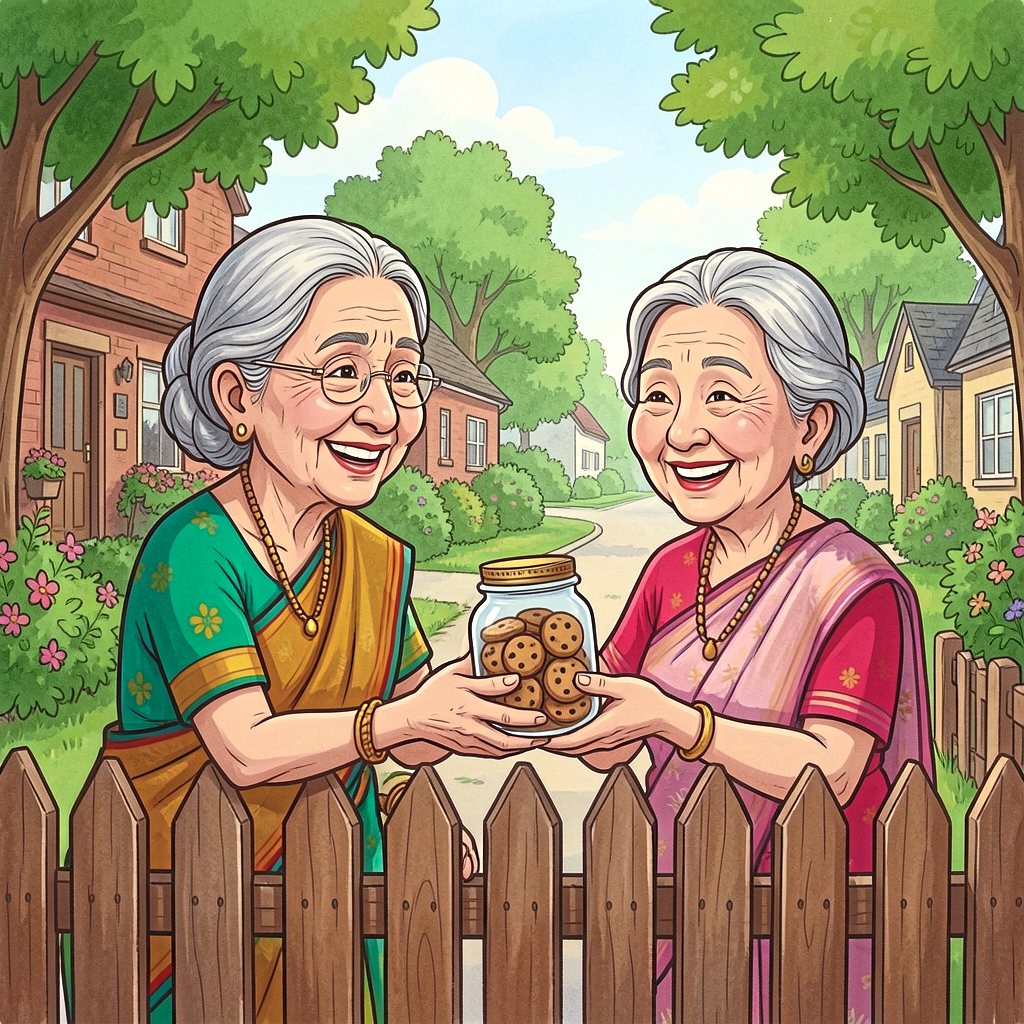
Community in Malaysia has historically expressed itself through this same grammar of food. Her aunt's Deepavali tradition of walking through the neighbourhood with cookies for neighbours, including those of different faiths, demonstrates how food transcends religious and cultural boundaries to become a universal medium of goodwill. The practice of packing treats for garbage collectors alongside neighbours reflects a philosophical understanding that care should extend to all members of society, regardless of social position. When Chinese New Year arrives, the cycle completes itself as cookies return to their house—a reciprocal exchange that has become institutionalised across decades, now often conducted through store-bought items but nonetheless meaningful in its ritual continuation.
One of the most poignant examples emerged from her relationship with a long-standing neighbour of more than fifty years. This woman developed a pattern of appearing over the dividing stone fence with containers of various dishes, sometimes breakfast sweet upma and sometimes afternoon onion cucur. The act of returning empty containers refilled with homemade delicacies created a rhythm of exchange that structured daily life and reinforced community bonds. Even after this neighbour suffered a stroke and relocated to live with her daughter, the memory that endures most vividly is not of mobility or health but of the taste of that sweet upma, suggesting how profoundly food becomes intertwined with identity and love in the Malaysian experience.
The crucial realisation arrived when the Malaysian doctor recognised that what she had always considered distinctly and uniquely Malaysian—this language of care expressed through food—was not confined to her homeland. A colleague in northwest England, separated by geography and likely by cultural background, responded to a statement of hunger with the same instinct: to provide food and to ease the labour involved in consuming it. The act of offering to peel the mandarin represented far more than practical assistance; it was a recognition of need and a commitment to alleviating it through direct action. In that moment, the doctor understood that the universal human instinct to care manifests through remarkably similar channels across cultures.
This realisation invites deeper reflection on how humanity communicates fundamental values. The specific foods may vary—Malaysian sweet upma in one culture, British tea and biscuits in another—but the underlying message remains consistent: I notice you, I acknowledge your need, and I take action to meet it. Food becomes a bridge across difference, a medium through which abstract concepts of love and belonging become concrete and consumable. The offering of food, the time spent preparing it, the attention to individual preference, and the ritual of sharing all communicate what words sometimes cannot express with equal force.
For many Malaysian readers, this narrative may feel deeply familiar. The practices described—hand-feeding children, remembering specific flavour preferences, preparing extra portions of favourite foods, maintaining gift-giving rituals across festive seasons—represent the everyday infrastructure of Malaysian family life and community. Yet the doctor's insight that this is not uniquely Malaysian offers a new perspective. While Malaysian culture may have developed particularly rich and elaborate expressions of this language, the underlying principle belongs to all humanity. In recognising this universality, she has not diminished what is distinctly Malaysian about her experience but rather elevated it to a broader significance.
The implications extend beyond personal reflection to question how communities, especially those undergoing rapid modernisation and urbanisation, can preserve and value the practices that build social cohesion. As Malaysian society continues to evolve, pressures of time, economic change, and technological disruption challenge the sustained commitment required to maintain these food-based rituals. Yet the example of her mother, who still purchases Hup Seng Teddy biscuits for a grown daughter living abroad, and the retired colleague who still visits every Chinese New Year with Mandarin oranges, demonstrates that some habits and rituals do persist when their meaning runs deep enough. The challenge for contemporary Malaysian society is to recognise and protect these expressions of care even as the pace of life accelerates.
Ultimately, the mandarin orange in an office in northwest England became far more than a piece of fruit. It became a bridge connecting a Malaysian doctor to her childhood, a reminder of the values embedded in her cultural upbringing, and a confirmation that the lessons of care learned through food transcend all boundaries. The willingness to peel that orange—to take on the labour on behalf of another—represents the fundamental impulse that has always driven Malaysian mothers to hand-feed reading children, aunts to add extra potatoes to curry, and neighbours to appear over dividing fences with containers of homemade dishes. Across continents and cultures, humanity speaks the same language: the language of food as care.

