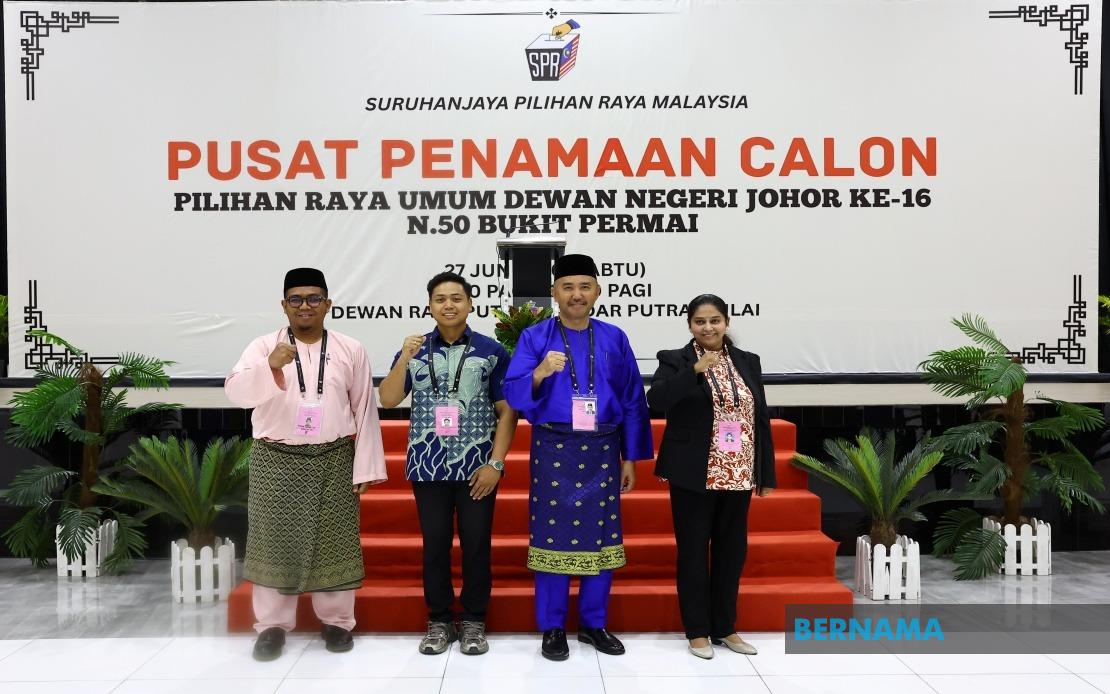
Datuk Mohd Jafni Md Shukor of Barisan Nasional is fighting to retain his Bukit Permai seat in a fiercely contested four-way battle at the 16th Johor state election scheduled for July 11. The incumbent assemblyman faces stiff competition from candidates representing Pakatan Harapan, Perikatan Nasional, and the newer political entry Parti Bersama Malaysia, signalling a highly fragmented electoral landscape in this constituency.
The nomination process closed this morning at the Dewan Raya Putra in Bandar Putra, with returning officer Afzan Azhari confirming the final slate of contenders. Mohd Jafni's main challengers are Mohamad Shafwan Ani, representing the opposition Pakatan Harapan coalition, M. Lina Manoh fielded by Perikatan Nasional, and Muhammad Aidil Riduan Mohd Yusof contesting on the Parti Bersama Malaysia ticket. The presence of four distinct candidates underscores the increasingly competitive nature of Johor state politics, where traditional two-party dominance has given way to multi-cornered contests across numerous constituencies.
Mohd Jafni's previous victory in 2022 provides him with a proven track record in the constituency, though his margin of 4,755 votes suggests potential vulnerability if opposition support consolidates. That earlier election also unfolded as a four-way contest, indicating that Bukit Permai has become a battleground where multiple political forces vie for influence. The assemblyman's ability to navigate a divided electorate twice demonstrates organisational strength, yet changing political dynamics and voter sentiment could alter calculations in his favour or against him this time around.
Pakatan Harapan's decision to field Mohamad Shafwan Ani reflects the coalition's commitment to challenging Barisan Nasional across Johor despite recent mixed electoral fortunes. The opposition partnership sent party chairman Teo Nie Ching, the Johor DAP head, to the nomination centre in the morning, signalling the importance the coalition places on this contest. This show of institutional support highlights Pakatan Harapan's determination to present a competitive alternative in a state where BN has traditionally held substantial influence.
Perikatan Nasional's participation through M. Lina Manoh adds another layer to an already intricate political landscape. The coalition, which has gained traction in several Malaysian states and federal politics, continues to position itself as a distinct choice beyond the BN-Pakatan Harapan binary. This fragmentation of the anti-BN vote potentially works in the incumbent's favour, though it also reflects voter demand for political alternatives beyond the two major coalitions that have dominated Malaysian politics for decades.
The emergence of Parti Bersama Malaysia as a contender in Bukit Permai exemplifies the evolving Malaysian political ecosystem. The party's participation, alongside more established political forces, suggests that voters increasingly have options spanning the ideological and organisational spectrum. Whether this newcomer can convert candidacy into meaningful support remains an open question, though the act of fielding candidates signals ambitions to build a national footprint beyond its current presence.
The Election Commission's scheduling reflects standard procedures for this election cycle. Early voting has been set for July 7, providing flexibility for voters with mobility constraints or scheduling conflicts. The subsequent polling day on July 11 will determine which candidate claims the Bukit Permai seat in the state assembly. This timeline gives all camps roughly two weeks for campaign activities, candidate engagement, and voter mobilisation efforts in what appears to be an increasingly competitive constituent battleground.
For Malaysian political observers and Johor voters specifically, Bukit Permai exemplifies broader trends reshaping state and national electoral politics. The transition from two-party contests to multi-cornered fights reflects increasing voter sophistication and willingness to consider alternatives beyond traditional power holders. Incumbent advantage, demonstrated party machinery, brand recognition, and local service delivery all become factors, yet the presence of multiple challengers introduces unpredictability that earlier, simpler electoral contests often lacked.
Mohd Jafni's background as an incumbent carrying state and federal party resources provides structural advantages that newer political entrants cannot easily replicate. Barisan Nasional's extensive ground organisation throughout Johor has historically translated into electoral success, though recent national and state electoral results demonstrate that incumbency no longer guarantees victory regardless of margin. The assemblyman must maintain support among existing constituents whilst potentially winning over persuadable voters without appearing complacent in a competitive field.
The broader Johor state election context matters for understanding individual constituency races like Bukit Permai. State-level campaigns, manifesto announcements, and campaign rallies by senior party leaders generate momentum that trickles down to constituency level contests. Voter sentiment regarding state governance, economic management, and development priorities will influence outcomes beyond purely local considerations, making Bukit Permai's result indicative of broader provincial trends that analysts will scrutinise closely.
Regional implications extend beyond Johor itself. Malaysian political watchers across Southeast Asia monitor such contests as indicators of democratic health, inter-party competition vitality, and voter behaviour patterns in one of the region's most politically engaged societies. Results from the Johor election will provide insights into whether multi-cornered contests are becoming structural features of Malaysian politics or temporary phenomena reflecting specific grievances and circumstances in particular states or constituencies.

