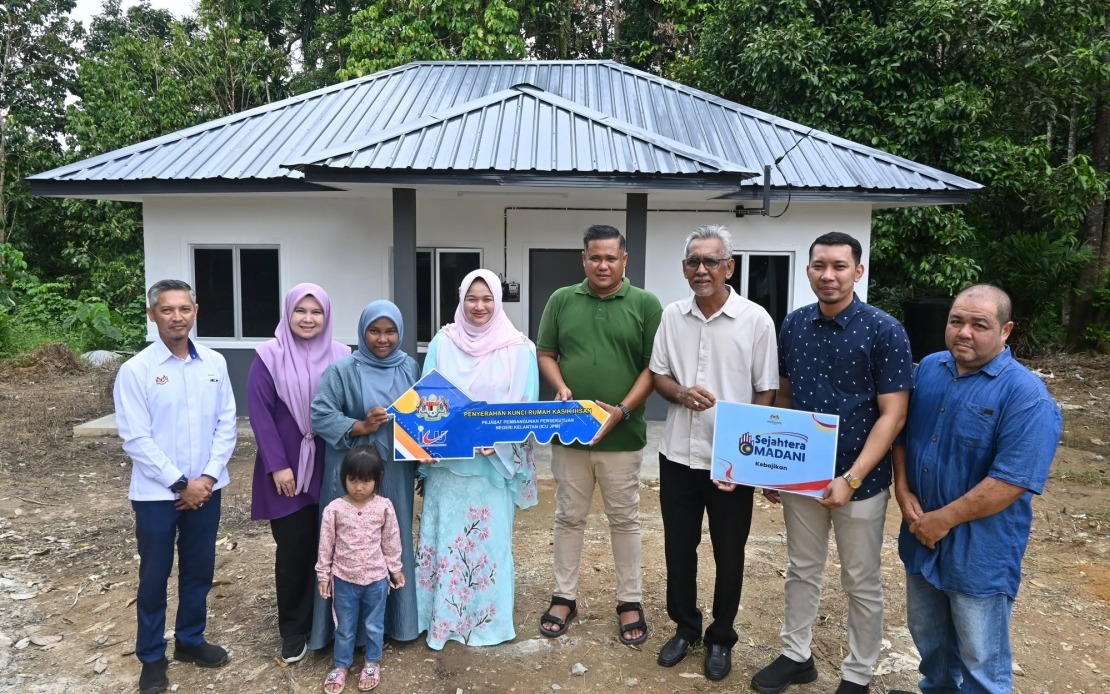
Prime Minister Datuk Seri Anwar Ibrahim has underscored the government's sustained commitment to elevating living standards across Malaysia by overseeing the distribution of Rumah Kasih Ihsan housing units in Jeli, Kelantan. The initiative represents a tangible manifestation of the administration's people-centric approach to development, with two beneficiaries receiving homes designed to provide security and dignity. The handover ceremony, conducted by Dr Wan Nur Ibtisam Wan Ismail, director of the Kelantan Implementation Coordination Unit (ICU) under the Prime Minister's Department (JPM), marks another milestone in a programme aimed at identifying and assisting vulnerable populations facing housing insecurity.
The Rumah Kasih Ihsan scheme operates under the PMX Coordination Team framework, reflecting the government's institutional focus on translating policy into direct community benefits. For Yusof Mohamed Nawawi from Kampung Renyut, the initiative provided a formal letter of acceptance for constructing an entirely new residence, effectively replacing his existing dwelling with a structure meeting contemporary safety and comfort standards. His neighbour, Shamsul Bahri Che Musa, received the keys to a completed home ready for immediate occupancy. These two families represent thousands of Malaysians living in substandard housing conditions, a persistent challenge across both urban and rural areas that affects health outcomes, educational attainment, and long-term economic mobility.
Beyond the physical structures themselves, the programme encompasses supportive measures designed to affirm government concern for holistic welfare. Both recipients were presented with food baskets, a symbolic gesture acknowledging that housing security operates within a broader context of meeting essential needs. This multifaceted approach reflects an understanding that vulnerable populations often face cascading challenges—inadequate shelter frequently coincides with food insecurity, limited access to healthcare, and financial stress. By bundling housing intervention with immediate material support, the government signals recognition of these interconnected hardships and attempts to address immediate pressures whilst longer-term housing solutions take root.
The Kelantan ICU JPM has articulated a philosophical framework positioning safe housing as foundational to dignified living. Officials emphasise that adequate shelter transcends its conventional definition as merely walls and roof, instead functioning as a prerequisite for psychological stability, family cohesion, and engagement with broader economic opportunity. This conceptualisation aligns with international development discourse emphasising housing as a human right rather than a commodity accessible only to affluent segments. For residents in districts like Jeli, where rural poverty remains concentrated and construction costs present barriers for low-income households, government-facilitated housing becomes a critical intervention preventing the intergenerational transmission of disadvantage.
Kelantan's implementation structure mirrors broader coordination mechanisms increasingly embedded within Malaysian governance architecture. The ICU framework, operating under JPM purview, suggests an attempt to synchronise programmes across multiple ministerial silos and ensure localised adaptation of national policies. This layering—national programme, departmental coordination, state-level implementation—can theoretically enhance responsiveness to regional contexts whilst maintaining consistent standards and equity in resource allocation. However, such structures also introduce bureaucratic complexity that may slow delivery and create implementation bottlenecks unless accompanied by adequate funding, skilled personnel, and accountability mechanisms.
The Rumah Kasih Ihsan programme addresses a documented gap in Malaysian housing policy. Whilst national development strategies emphasise infrastructure expansion and commercial real estate growth, marginalised communities often remain excluded from formal housing markets due to income constraints, limited credit access, and geographic isolation. Government-administered schemes targeting specific vulnerable populations—whether rural poor, indigenous communities, or urban squatters—represent targeted corrections to market failures. The Jeli handovers demonstrate this corrective impulse operating at ground level, though broader questions persist regarding programme scale relative to the magnitude of unmet housing need across the country.
Kelantan specifically has experienced persistent development disparities compared to more urbanised states, with poverty rates historically exceeding national averages and infrastructure development lagging peer regions. Housing inadequacy intertwines with these broader inequalities, reflecting limited private investment in lower-income residential development and constrained state budgets for social housing. Government-led initiatives like Rumah Kasih Ihsan thus acquire particular importance within Kelantan's development context, potentially influencing perceptions of state responsiveness and legitimacy in communities that have experienced prolonged marginalisation. The visibility of housing handovers, particularly when highlighted through official communications, serves multiple functions: demonstrating tangible government action, building political goodwill, and potentially catalysing broader community engagement with development initiatives.
The programme's emphasis on housing safety and comfort reflects evolving standards around what constitutes adequate shelter in contemporary Malaysia. Traditional measures—roof integrity and basic weatherproofing—have expanded to encompass sanitation facilities, electrical safety, thermal comfort, and spatial adequacy for family activities. These elevated standards, whilst representing genuine improvements in quality of life, also increase construction costs and complexity. Balancing comprehensive living standards against fiscal sustainability requires careful calibration of programme scope, material specifications, and geographic coverage. The government's approach in Jeli suggests commitment to meaningful standards rather than minimal interventions, though questions surrounding programme replicability and scalability warrant ongoing scrutiny.
The integration of welfare gestures—notably the food baskets—within housing handovers reflects an important recognition that immediate material needs cannot await long-term housing solutions. In rural Kelantan contexts where unemployment and underemployment persist, households frequently navigate multiple deprivations simultaneously. Bundled interventions acknowledging this reality may prove more effective than single-issue approaches compartmentalising housing, nutrition, health, and income support into separate administrative silos. This holistic orientation aligns with contemporary social policy thinking emphasising integrated service delivery, though implementation demands sophisticated coordination and adequate cross-sectoral funding.
Looking forward, the implications of Rumah Kasih Ihsan extend beyond individual beneficiaries to broader questions about Malaysia's social safety net architecture. As economic volatility and labour market disruptions create new vulnerabilities alongside persistent structural poverty, housing security emerges as an increasingly central policy concern. The programme's operational experience in Kelantan—spanning identification of beneficiaries, construction quality assurance, delivery coordination, and post-handover support—generates evidence valuable for refining implementation elsewhere. Furthermore, community-level visibility of government housing support may influence political participation and social cohesion, particularly in regions where citizens perceive state institutions as remote or unresponsive. The Jeli handovers thus warrant interpretation not merely as discrete welfare transactions but as component elements within broader state-building and distributive justice initiatives that will shape Malaysia's development trajectory across coming years.

