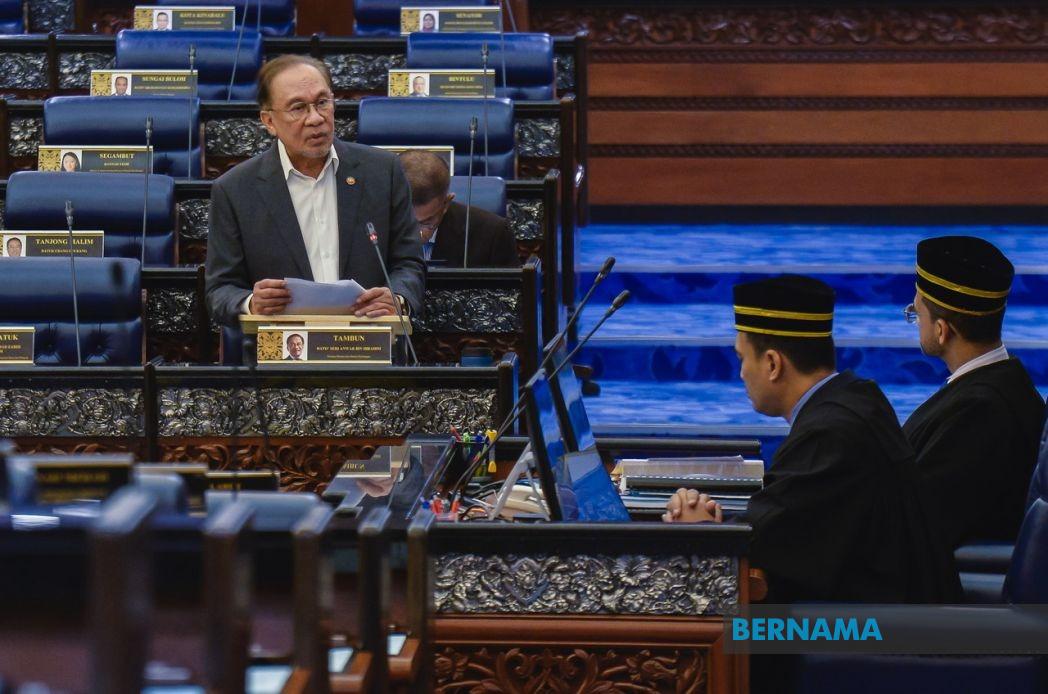
Prime Minister Datuk Seri Anwar Ibrahim has moved to dispel claims that his administration is preventing activities in Federal Land Development Authority settlements, stating unequivocally that no blanket ban exists on such programmes. Speaking during Minister's Question Time in parliament on June 30, Anwar sought to distinguish between permissible community activities and impermissible use of government resources for partisan purposes, a distinction that carries particular weight given ongoing tensions between federal and state governments over the conduct of electoral campaigns in rural constituencies.
The clarification emerged in response to queries from PN-Larut representative Datuk Seri Hamzah Zainudin, who had raised concerns about programme cancellations in FELDA areas. Anwar explicitly denied issuing directives to cancel the FELDA Settlers' Day programme scheduled for Kluang, Johor on June 20 and 21, addressing what appears to have been emerging controversy over the fate of that particular event. The statement reflects the government's attempt to balance legitimate rural development activities with strict adherence to electoral regulations that have become increasingly contentious across Malaysia's political landscape.
The Prime Minister drew a critical line between what state governments may legitimately undertake within FELDA settlements and what remains legally impermissible. According to Anwar's parliamentary exposition, menteri besar officials retain complete freedom to organise their own programmes and community events within FELDA areas without government obstruction. Furthermore, state governments continue to exercise their prerogative powers regarding land titles and related matters, though such actions must remain compliant with the broader electoral framework that governs how public resources may be deployed during campaign periods.
What remains prohibited, Anwar emphasised, is the weaponisation of government machinery—including FELDA's administrative and logistical infrastructure—for election campaigning. This distinction reflects Malaysia's electoral law requirements that separate the conduct of government business from partisan political activity. The restriction targets not the content or occurrence of programmes themselves but rather their funding mechanisms and the deployment of state apparatus to advance particular electoral interests. This technicality has become increasingly important in Malaysian politics, where the boundary between development initiatives and campaign activities often blurs, particularly in rural constituencies where FELDA settlements hold significant electoral weight.
The government's posture toward FELDA communities appears to form part of a broader strategic repositioning under the MADANI administration. Rather than viewing FELDA settlements as peripheral to national development, the government has signalled commitment to revitalising these areas through targeted interventions that Anwar characterised as addressing historical neglect. Deputy Prime Minister Datuk Seri Dr Ahmad Zahid Hamidi has been named as a key architect of this policy shift, working alongside Anwar to redirect resources toward communities that, in the government's assessment, received inadequate attention during previous administrations.
The concrete manifestations of this renewed commitment have begun appearing across FELDA settlements. The establishment of dialysis centres represents a direct response to healthcare accessibility challenges affecting FELDA residents, many of whom face distances to urban medical facilities. Simultaneously, the federal government has accelerated expansion of development infrastructure through its various agencies, recognising that FELDA communities have fallen behind comparable rural and semi-rural settlements in basic amenities and services. These initiatives suggest the government views improved FELDA conditions not merely as a welfare imperative but as essential to sustaining political support in constituencies where settler populations hold considerable electoral significance.
For Malaysian observers, the distinction Anwar articulates carries implications extending beyond FELDA areas themselves. The emphasis on legal compliance regarding government machinery deployment reflects broader attempts by the federal administration to establish clear protocols governing how development activities and campaign activities remain properly separated. This concern has assumed heightened importance given recurring allegations from opposition parties that ruling coalition members conflate government programmes with partisan politicking. By explicitly clarifying boundaries, Anwar positions the government as respectful of electoral law while simultaneously defending its right to conduct legitimate development activities.
The historical context of FELDA management also merits consideration in evaluating the government's current approach. FELDA settlements, originally established as vehicles for agricultural development and settler prosperity, have experienced varying fortunes depending on commodity prices, management efficiency, and government support levels. Anwar's acknowledgment that settlements suffered from poor management previously implies acknowledgment of systemic failures that extended beyond any single administration but which his government now explicitly owns as a priority for remediation. This rhetorical positioning attempts to transform the government's FELDA engagement from a potential political liability into evidence of competent stewardship.
State governments, particularly those under opposition control, retain significant autonomy in their dealings with FELDA areas within their jurisdictions. Anwar's clarifications appear calibrated to forestall accusations that the federal government is using legal restrictions on campaign machinery deployment as a pretext for controlling state-level development initiatives in FELDA settlements. By explicitly confirming state authority over certain matters—particularly land titles—the Prime Minister seeks to establish that federal oversight targets only partisan campaign conduct rather than legitimate governance activities. This distinction becomes particularly important in states where federal and state governments operate under different political colours.
Looking forward, the trajectory of government engagement with FELDA communities will likely determine whether current assurances translate into sustained resource allocation. Electoral considerations remain unavoidable given FELDA's demographic concentration and historical significance to Malaysia's political geography. However, the government's articulation of a development agenda specific to these areas suggests recognition that mere campaign activity cannot substitute for genuine infrastructure improvements and service delivery enhancements. Whether implemented initiatives genuinely address longstanding deficiencies or represent primarily rhetorical repositioning will become evident as these programmes progress through implementation cycles in coming months.

