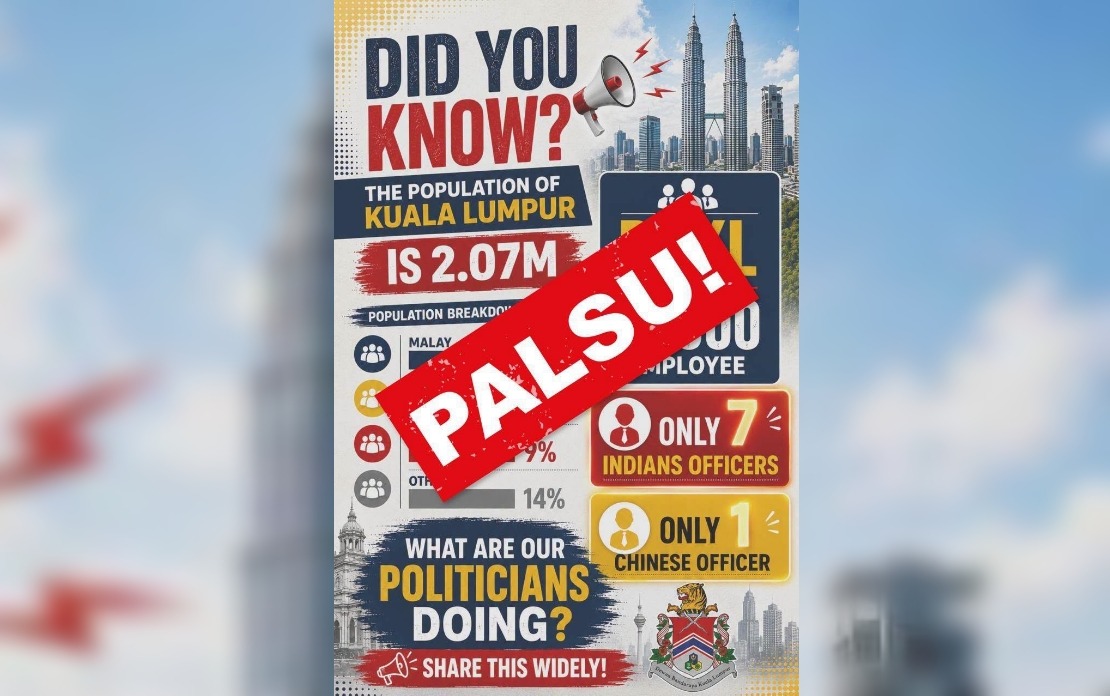
The Minister in the Prime Minister's Department (Federal Territories) Hannah Yeoh has moved to counter a false narrative about workforce diversity at Kuala Lumpur City Hall (DBKL) that has gained traction through social media platforms during the current election cycle. A WhatsApp poster making the rounds has alleged that the municipal authority employs just seven Indian staff and a single Chinese employee—a characterization Yeoh strongly refuted as inaccurate and misleading to the public.
Drawing on official records, Yeoh disclosed that DBKL's actual workforce composition tells a markedly different story. As of July 1, 2026, the local authority maintains a total complement of 9,131 employees, encompassing 490 Indian staff members and 22 Chinese personnel. These figures represent a substantial variance from the claims being disseminated online, suggesting that the false narrative may have been crafted to inflame tensions or manipulate public perception ahead of electoral contests. The clarification underscores how misinformation can propagate rapidly through messaging platforms, particularly when tied to sensitive subjects such as ethnic representation in public institutions.
Within the higher echelons of DBKL's organisational hierarchy, the presence of minority ethnic groups, while limited, remains meaningful. The Management and Professional Group includes ten Indian officers and two Chinese officers, demonstrating that minority representation exists across multiple levels of the municipal structure. Yeoh's disclosure of these granular figures suggests an attempt to provide documentary evidence against the viral narrative, though she simultaneously acknowledged that room for enhancement persists. This balancing act—defending current achievements while conceding imperfection—reflects the political sensitivity surrounding employment diversity in Malaysian government agencies.
The minister's response goes beyond mere fact-correction. Yeoh has instructed DBKL to undertake a comprehensive audit of its workforce management systems, targeting recruitment methodologies, hiring protocols, advancement mechanisms, and the channels through which vacant positions are promoted to potential applicants. This directive signals an institutional commitment to identifying systemic obstacles that may inadvertently restrict minority participation. By ordering a transparent review of these processes, Yeoh aims to distinguish between intentional discrimination and structural barriers that may be rectified through procedural reform. The emphasis on merit-based selection and fairness suggests that any improvements will be framed around meritocratic principles rather than quota-based approaches, a distinction that carries political weight in Malaysia's multiethnic context.
Yeoh's statement carries broader implications for how Malaysian government communicates with the public during electoral periods. She explicitly urged all stakeholders to refrain from exploiting diversity concerns as tools to incite racial division, calling instead for a fact-based approach to addressing legitimate representation gaps. This framing positions factual accuracy as integral to national cohesion, suggesting that false narratives about ethnic employment patterns threaten not merely institutional credibility but social harmony. The appeal reflects an awareness that misinformation campaigns targeting government competence or fairness can resonate particularly strongly when they invoke ethnic sensitivities, making preemptive clarification a strategic necessity.
The timing of this rebuttal carries electoral significance. Election campaigns frequently become conduits for unverified claims about government performance and resource allocation, and accusations of ethnic favouritism or discrimination hold particular resonance among Malaysian voters. By addressing the false poster swiftly and with specific numerical evidence, Yeoh seeks to contain the spread of a narrative that might otherwise gain credibility through repetition. Her intervention demonstrates how government officials attempt to manage the information environment during politically charged periods, using direct communication channels such as Facebook to bypass traditional media filters and reach voters directly.
The incident also illuminates patterns of how misinformation travels within Malaysian society. The use of WhatsApp to distribute the false poster reflects the widespread reliance on encrypted messaging platforms for political communication and rumour-spreading. These platforms' private nature and ease of forwarding make them particularly effective vectors for unverified claims, often outpacing institutional capacity to respond. Yeoh's use of Facebook as a counter-platform suggests official awareness that government entities must maintain active social media presence to challenge false narratives in near real-time, rather than relying solely on formal press releases or traditional media coverage.
Moreover, the substance of the controversy touches on enduring questions about ethnic representation within Malaysia's public service. While federal and state agencies theoretically follow meritocratic recruitment standards, persistent disparities in employment figures across ethnic groups have historically generated debate about whether structural barriers or other factors account for observed patterns. Yeoh's acknowledgment that representation can still be improved implicitly concedes that current levels may not reflect either workforce availability or population demographics, lending some credibility to underlying concerns about diversity even as she rejects the specific false claims. This nuance suggests that while the particular WhatsApp narrative is baseless, broader questions about inclusion in public institutions remain valid subjects for institutional reflection.
The minister's call for all parties to correct misinformation and address genuine shortcomings presents a framework for distinguishing between bad-faith attacks and legitimate reform agendas. By proposing that DBKL undertake systematic improvements in how it recruits, promotes, and advertises opportunities, Yeoh offers a pathway for converting a potentially divisive incident into a mechanism for institutional enhancement. This approach attempts to neutralize the political utility of the false claims by demonstrating that government is responsive to diversity concerns, even while firmly rejecting dishonest characterisations of current practices. The outcome will likely influence how stakeholders assess government transparency and commitment to inclusive employment practices in the months ahead.

