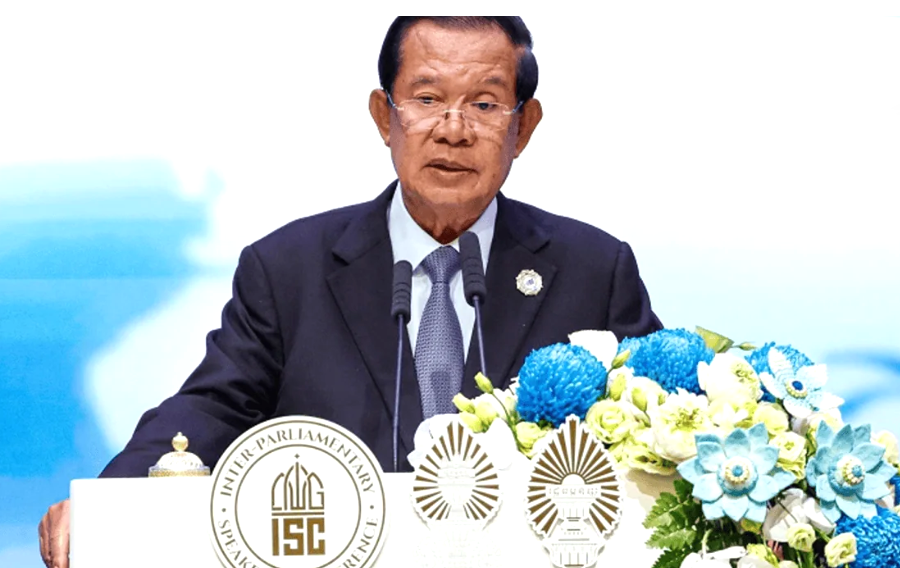
At the 2nd Inter-Parliamentary Speakers' Conference in Phnom Penh on Thursday, Hun Sen delivered a sharp critique of what he characterised as Cambodia's weaponisation by neighbouring states. The Senate president alleged that Thailand has exploited international concern over cross-border cybercrime syndicates as cover for what he describes as unlawful territorial expansion along their shared frontier. His remarks to an audience that included parliamentary delegations from Pakistan, Malaysia, Myanmar, Australia and Russia centred on a troubling pattern: the instrumentalisation of legitimate global security challenges to justify aggressive state behaviour that violates established conventions.
Hun Sen's statement represents an escalation in rhetoric around the long-standing Cambodia-Thailand border dispute, which has periodically flared into armed confrontations over overlapping territorial claims and contested areas. By framing Thailand's actions within a broader analysis of contemporary conflict, he positioned Cambodia's bilateral struggle within a larger narrative about the erosion of international norms. The reference to ceasefire agreements being treated as merely "paper" underscores Cambodian frustration with what officials view as bad-faith compliance by Bangkok, suggesting that diplomatic instruments once considered binding have become contingent on shifting political interests.
The Senate president articulated a vision of modern warfare that extends far beyond traditional military engagement. According to his analysis, contemporary conflicts operate across multiple domains: economic instruments such as trade wars and the weaponisation of tariff regimes; technological competition centred on semiconductor supply chains and cyber-security dominance; and resource nationalism involving control over energy and rare earth minerals critical to industrial production. This multidimensional framing echoes concerns raised across Southeast Asia and the developing world about asymmetric pressure applied by wealthier nations through mechanisms that fall short of declared conflict but exact real costs on smaller economies.
Hun Sen drew particular attention to what he termed a dangerous double standard in how international law operates. While powerful nations claim exclusive rights to pre-emptive military action and unilateral self-defence determinations, weaker states face intense scrutiny and sanctions for alleged violations of human rights, environmental standards, and cross-border crime regulation. This asymmetry, he argued, reflects a systemic bias wherein wealthy established powers set global rules but reserve the right to break them when convenient. For Malaysia and other mid-sized Southeast Asian nations, this observation resonates with longstanding frustrations about how international governance structures privilege certain actors over others.
The Senate president's warning about a potential collapse of the international non-proliferation framework carries significant implications for regional security. He suggested that as vulnerable nations lose confidence in multilateral treaties and collective security arrangements, they increasingly turn to military buildups and weapons acquisition as survival mechanisms. This dynamic could accelerate arms racing in Southeast Asia, where several countries already maintain substantial defence spending and competition for advanced military technology has intensified. The prospect of cascading insecurity, where defensive measures by one state trigger reactive militarisation by neighbours, threatens to destabilise the entire region.
Hun Sen's critique extends to what he characterised as selective application of international standards. He contended that wealthy nations impose rigorous human rights and environmental benchmarks on developing countries while overlooking structural inequalities that limit poorer nations' capacity to comply. This argument, while reflective of Cambodia's particular grievances, touches on debates that resonate throughout Southeast Asia and the Global South regarding the fairness of international accountability mechanisms. Countries rebuilding from conflict, managing limited state capacity, and navigating development challenges often face disproportionate pressure to meet standards designed in and for wealthy democracies with vastly superior resources.
The Senate president's observation that trade and economic instruments have become unpredictable tools of statecraft reflects anxieties widespread among Southeast Asian policymakers. Rules governing tariffs, investment, and market access change according to shifting geopolitical calculations rather than stable frameworks. This unpredictability makes long-term economic planning difficult for smaller nations dependent on trade and foreign investment. Malaysia's own experience with trade disputes and shifting preferences in global supply chains illustrates how such weaponisation of economic policy translates into concrete harm for developing economies.
Hun Sen's call for restoration of the rules-based order, the UN Charter, and the ASEAN Charter acknowledges that Cambodia—and by extension Southeast Asia—has significant interests in maintaining international norms that constrain the behaviour of major powers. The ASEAN Charter, in particular, enshrines principles of non-interference, peaceful settlement of disputes, and respect for sovereignty that smaller regional states rely upon for protection. When these frameworks erode through selective application or violation by powerful actors, the vulnerability of mid-sized powers increases proportionally.
The broader geopolitical context underlying Hun Sen's remarks involves Cambodia's positioning between major power competition. As the United States, China, and Russia vie for influence across Southeast Asia, smaller nations face pressure to demonstrate alignment while nominally maintaining non-alignment. Cambodia's close relationship with China has drawn scrutiny from Western capitals, which have applied pressure on human rights and governance grounds—dynamics that Hun Sen's speech implicitly addresses through his critique of double standards. The accusation that Thailand used the scam pretext for occupation gains weight when viewed through this lens of selective application of international concern.
For Malaysian policymakers and observers, Hun Sen's warnings about the collapse of collective security and the rise of security anxiety should prompt reflection on regional trends. The Cambodia-Thailand border tensions, while not directly involving Malaysia, exemplify how bilateral disputes can escalate when underlying institutional frameworks prove inadequate or when powerful neighbours choose not to respect agreements. Malaysia's own maritime disputes in the South China Sea and experiences with cross-border issues make these concerns highly relevant. The Senate president's call for reinforcing international law and multilateral mechanisms resonates with Malaysia's historical reliance on these frameworks to protect its interests against larger powers.
Hun Sen's framing also reveals anxieties about how developing nations become targets of external pressure framed in universal language but applied selectively. When major powers invoke human rights, environmental protection, or crime prevention as justification for economic sanctions, military pressure, or territorial incursions, they claim to uphold universal standards while actually pursuing narrowly defined national interests. Cambodia's experience—where online scam operations on its territory allegedly became justification for Thai military occupation—illustrates this dynamic. The distinction between legitimate international concern and geopolitical pretexting becomes increasingly blurred in practice.
The Senate president's warning that "those who established the rules are now destroying them" encapsulates a fundamental challenge facing the contemporary international system. The post-World War II architecture, designed to prevent great power conflicts through binding rules and collective security, increasingly appears inadequate when rising powers contest that order and established powers selectively enforce or violate the norms they created. For Southeast Asia, this creates a strategic dilemma: rely on international law and institutions that may prove unreliable, or pursue autonomous military capabilities that could trigger regional arms racing. Hun Sen's speech implicitly acknowledges this dilemma while advocating for the former path, though his warnings suggest limited confidence in its success.

