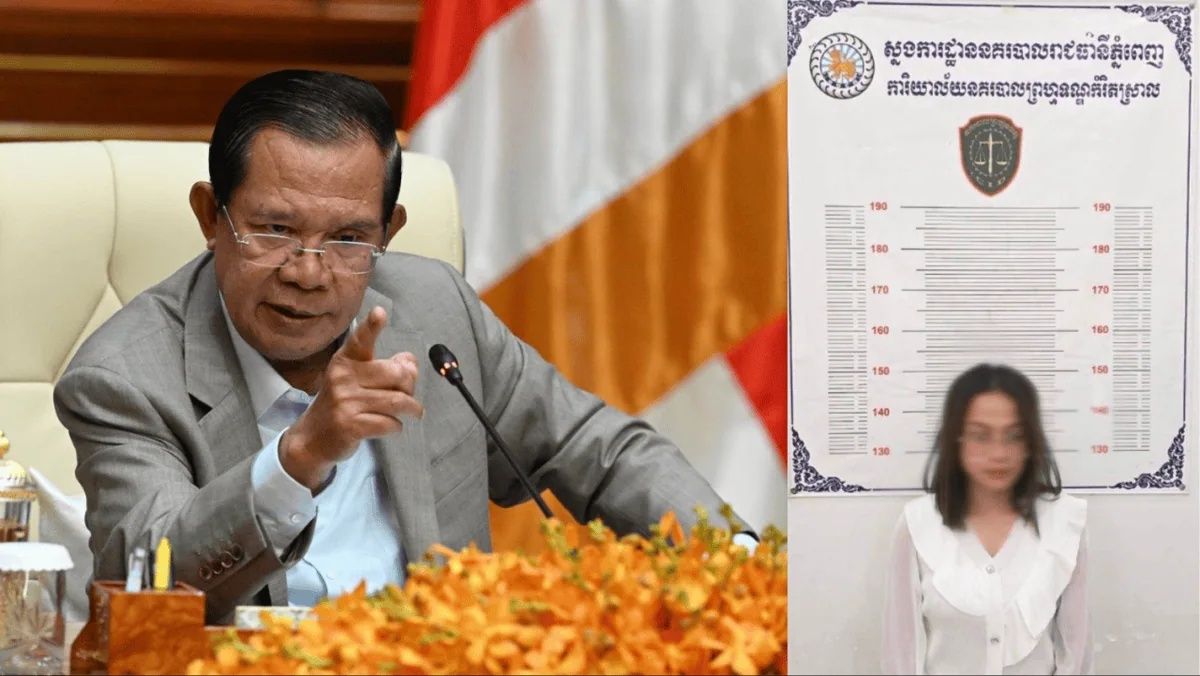
Cambodia's Senate president Hun Sen has set in motion a coordinated legal campaign to prosecute individuals whose speech he characterises as demeaning to women and corrosive to national values, marking an expansion of state oversight into personal conduct and online expression. During a Friday meeting with delegations from the National Council for Women, Hun Sen tasked the Ministry of Women's Affairs and allied agencies with serving as legal plaintiffs in cases against people accused of using vulgar or insulting language, framing such action as a defence of social morality rather than an infringement on rights.
The directive follows what Hun Sen described as a pattern of troubling incidents, including an unnamed woman's use of profanity directed at government institutions and civil servants, which he said prompted authorities to demand a formal written apology from both the woman and her husband. The intervention underscores an approach in which state institutions treat offensive speech as a collective injury warranting official redress. Hun Sen appeared to view the matter with particular gravity, suggesting that permitting such conduct would signal indifference to attacks on the state apparatus itself.
A second case highlighted by Hun Sen involved a woman identified as Chenda Sovannary, whose reported insult to a soldier during a dispute over a mobile phone purchase became emblematic of the broader problem he seeks to address. His rhetorical framing of this incident—emphasising the disproportionate nature of insulting someone over a consumer transaction—serves to normalise state intervention while portraying legal action as a proportionate response to obvious disrespect. The case exemplifies how routine interpersonal conflicts, particularly those involving uniformed personnel, can escalate into matters of state concern under this framework.
Hun Sen's comments reveal a conception of social order in which injury to individual dignity, especially that of state agents, represents a threat to collective values. He extended his concern beyond soldiers to construction workers and other working people, framing insult as a broader social pathology that courts should treat seriously. This rhetorical move attempts to position the crackdown as defending vulnerable groups rather than state authority, though the enforcement mechanism remains centred on state institutions.
Critically, Hun Sen sought to distinguish his approach from authoritarianism by invoking the practice of commercial social media platforms. He noted that companies including Facebook maintain community standards and ethical guidelines, implying that state-enforced speech codes represent merely a public equivalent of private enforcement. This comparison glosses over fundamental differences in enforcement mechanisms and constitutional constraints on state action, yet it signals Hun Sen's awareness that such policies require justification beyond simple assertion of state power.
The institutional architecture of the enforcement mechanism reflects a deliberate consolidation of authority across multiple state agencies. Hun Sen instructed the National Council for Women to coordinate with the Ministry of Interior, the Ministry of Information, the Ministry of Culture and Fine Arts, and the Ministry of Post and Telecommunications to establish a unified system for monitoring and prosecuting alleged insults to women and Khmer dignity. This inter-ministerial approach suggests a comprehensive surveillance and enforcement apparatus designed to identify and pursue cases across offline and digital spaces.
The explicit mention of Facebook and online monitoring indicates that Hun Sen views digital communication as a particular priority, reflecting broader concerns among Southeast Asian governments about the difficulty of controlling discourse on social media platforms. By tasking multiple ministries with tracking online insults, he appears to be signalling an intensification of state presence in spaces previously harder to regulate. The reference to establishing a dedicated team to monitor "cursing and insults on Facebook" represents a formalisation of what has occurred informally in various contexts across the region.
Hun Sen's insistence that these measures do not restrict rights but rather protect national dignity attempts to reframe enforcement as a positive state action rather than censorship or suppression. This rhetorical manoeuvre reflects a familiar pattern in which state authorities describe restrictions on expression as protective rather than limiting, presenting the state's role as defending vulnerable populations or social cohesion. Yet the practical effect remains a narrowing of acceptable public and private speech, with the state determining the boundaries of permissible expression.
For Malaysia and the broader Southeast Asian region, Cambodia's approach illustrates how governments increasingly justify speech restrictions by appealing to gender protection, social morality, and national dignity. These frameworks can be particularly effective politically because they align with genuine concerns about respect and social order while obscuring their role in expanding state control over expression. The Cambodian model combines enforcement across institutional lines with digital monitoring, creating multiple pathways through which individuals can face legal consequences for speech deemed insulting.
The implications extend beyond Cambodia. As regional governments confront the challenge of managing digital communication and public opinion, models emphasising coordinated inter-agency action and moral justifications for enforcement may prove attractive to policymakers elsewhere in Southeast Asia. The framing of such measures as protection rather than restriction, and the invocation of social media companies' own standards as precedent, provides rhetorical tools that governments throughout the region might adapt to their own contexts.
For civil society actors and digital rights advocates, Hun Sen's directive crystallises a concerning trend: the instrumentalisation of legitimate concerns about respect and social harmony to justify expanding state surveillance and enforcement powers. The mechanism Hun Sen has established—combining multiple agencies, digital monitoring, and legal liability for speech—represents a systematic approach to controlling expression that goes considerably beyond addressing isolated incidents of genuine misconduct.
Cambodia's experience suggests that once governments establish formal mechanisms for prosecuting speech deemed insulting to women, state officials, or national values, the scope of enforcement typically expands over time. Cases initially justified as responses to obvious transgressions gradually extend to cover broader categories of criticism, satire, or political commentary. The establishment of a dedicated team to monitor online speech for insults represents a structural commitment to such expansion, institutionalising surveillance in ways that prove difficult to reverse or constrain once established.

