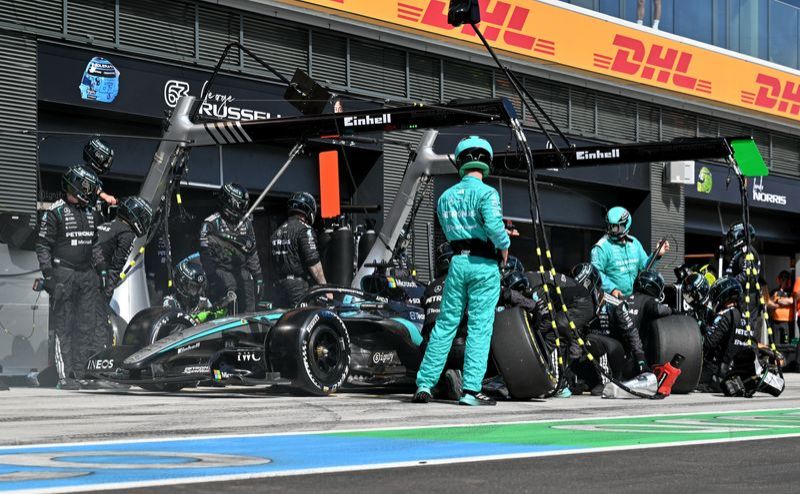
George Russell is running on empty. The Mercedes driver emerged from Sunday's Hungarian Grand Prix visibly worn down by yet another mechanical malfunction that derailed his race at the Hungaroring, with Formula One now entering its summer break until late August. What should have been a welcome respite has instead arrived as a mercy for a competitor pushed to his emotional limit by a relentless string of technical failures that have haunted his campaign.
The British driver's candid assessment of his predicament revealed a man wrestling not merely with disappointment but with exhaustion itself. Russell explained that wallowing in frustration over his circumstances would render him perpetually miserable, forcing him instead into a mental compartmentalisation that separates factors within his control from those beyond it. Yet this philosophical approach masks deeper anxieties about his standing within the sport and his team's ability to resolve cascading engineering problems that appear uniquely concentrated on his car.
Russell's championship position has deteriorated markedly since pre-season predictions crowned him as a title contender. He now trails his 19-year-old Italian teammate Kimi Antonelli by 59 points through eleven of twenty-three races, a gap that widens when considering their respective records: Antonelli has secured six victories against Russell's two, while the British driver has finished three races without points. This divergence speaks to something more systemic than momentary lapses in performance or tactical errors.
Sunday's Budapest nightmare epitomised the season's recurring pattern. Starting from sixth position with a genuine opportunity to challenge Antonelli, Russell's race imploded on the opening lap when his engine's anti-stall function activated unpredictably, leaving him powerless as competitors swept past. The technical explanation proved maddeningly vague: the engine simply refused to respond to throttle inputs four seconds before the start, despite having been freshly installed. Russell managed to recover to seventh position, but the damage to both his championship hopes and psychological resilience was substantial, particularly when Antonelli claimed a podium finish in third.
What intensifies Russell's predicament is the seemingly disproportionate frequency with which these failures target his machinery rather than his teammate's. While acknowledging that reliability issues occasionally affect the entire Mercedes team, Russell pointedly noted that his car appears to experience a substantially higher failure rate. This observation carries significant weight, as it implies either a systematic design flaw concentrated in his unit or perhaps inadequate maintenance protocols. Mercedes team principal Toto Wolff accepted full responsibility, describing the situation as unacceptable and acknowledging that Russell has endured far too many such incidents.
The emotional toll of this campaign has become unmistakable. Russell previously stated that he rarely feels the need for rest during a racing season, yet this year he explicitly welcomed the break, a candid admission of burnout. The string of external setbacks—technical failures, collisions not of his making, and compounding misfortune—has accumulated into something qualitatively different from the normal pressures elite athletes face. He appears mentally exhausted by circumstances beyond mitigation through skill or determination alone.
Context matters here for understanding Russell's particular vulnerability. As a pre-season favourite and championship contender, expectations were sky-high. The public narrative positioned him as a driver capable of delivering Mercedes' first championship since the team's glory days. Instead, he finds himself playing catch-up to a teammate nearly four years his junior, watching his rival accumulate victories whilst mechanical gremlins systematically undermine his own efforts. This inversion of expectations compounds the frustration.
The contrast between Russell and Antonelli extends beyond mere statistics. The younger driver has benefited from mechanical reliability whilst simultaneously demonstrating the maturity and pace required to capitalise on opportunities. For regional drivers and fans across Southeast Asia following Formula One through broadcasters across the region, the dynamic between experienced Russell and prodigious Antonelli illustrates how narrowly success margins operate at the sport's pinnacle. Technical performance and driver talent must align; when either fails independently, championship ambitions falter quickly.
Mercedes faces a critical juncture as the summer break commences. The team must conduct thorough investigation into why Russell's vehicle experiences failure rates substantially exceeding Antonelli's, then implement corrective measures during the recess. Should the problem persist into the second half of the season, it risks becoming not merely a mechanical issue but a crisis of confidence within the team's engineering department. Questions about quality control and diagnostic procedures would inevitably surface.
Russell's public composure masks genuine distress about circumstances that undermine sporting fairness. He cannot control engine electronics malfunctioning, contact from rivals, or mechanical failures. What he can control—his mental resilience and positive attitude—becomes the only refuge. This psychological compartmentalisation, whilst necessary for continued competitiveness, also represents a poignant acknowledgement of helplessness in the face of systemic problems. Whether Mercedes rectifies these issues during the shutdown period will largely determine whether Russell's championship dream remains viable or becomes another season defined by mechanical misfortune and unrealised potential.

