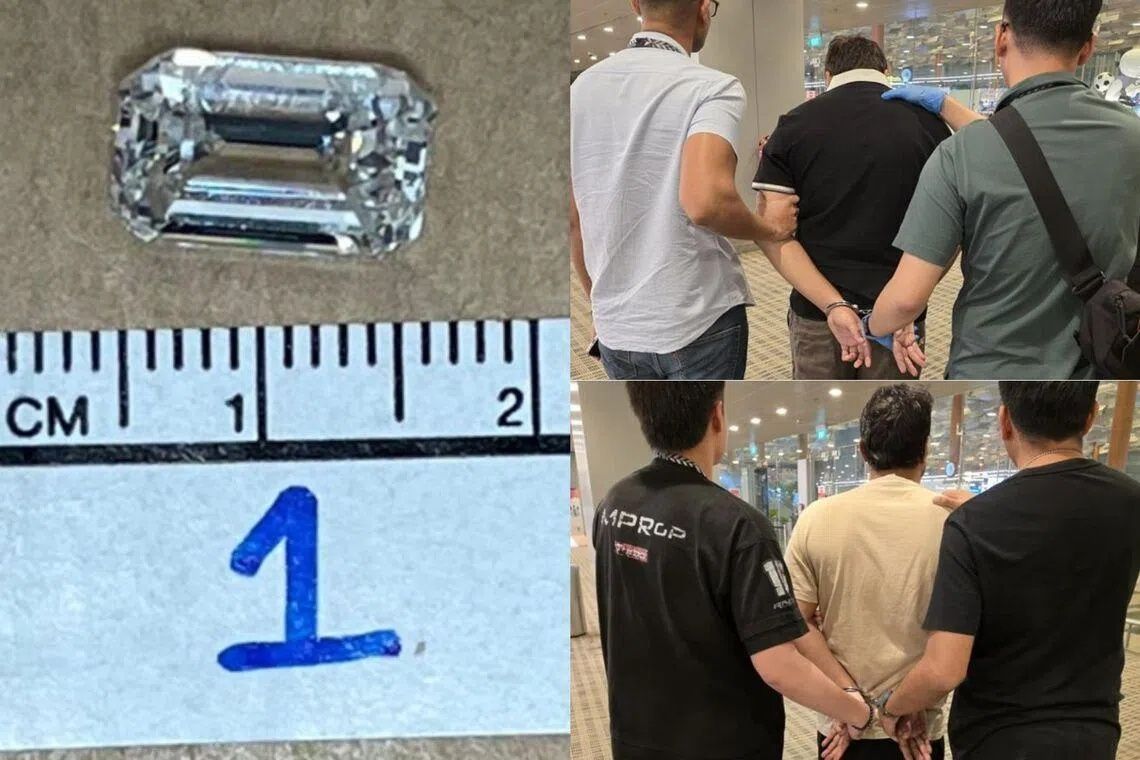
A 41-year-old Indian tourist has been handed a jail sentence exceeding two years for orchestrating the theft of a near-S$200,000 diamond from a jewellery store in Singapore's Chinatown district. Mangroliya Manojkumar Kurjibhai received his sentence on Friday, July 17, after pleading guilty to theft charges stemming from an audacious heist that unfolded over just a few hours on June 19 before authorities intercepted him at the airport.
The incident reveals the sophistication of international jewellery theft operations, with the perpetrators having meticulously planned their crime well before arriving in Singapore. Court documents indicate that Mangroliya and his 30-year-old accomplice, Serasiya Milan Ramnikbhai, commissioned a counterfeit diamond in India before travelling to the island nation. The fake stone was engineered to match the specifications and even the serial number of the genuine diamond they intended to steal, demonstrating considerable technical preparation and advance intelligence about their target.
On the afternoon of June 19, the two men presented themselves at Dianoche jewellery store on Kreta Ayer Road in Chinatown. Their strategy relied on misdirection and exploiting the natural trust that retail staff place in customers. Serasiya concealed the counterfeit diamond inside his mouth, a technique that suggests prior planning and a willingness to engage in unconventional methods to avoid detection. Mangroliya then requested to view the genuine stone, a 4.95-carat diamond valued at approximately US$154,000 or just over S$199,000. The diamond's substantial worth underscores why international criminals target Singapore's jewellery trade, which attracts high-net-worth individuals and maintains precious inventories.
Once the genuine diamond was produced by a sales manager, Mangroliya employed a classic diversionary tactic. He asked to examine several other items from the store's collection, causing the manager to repeatedly leave his position. During these absences, he signalled Serasiya to execute the swap. Serasiya discreetly removed the fake diamond from his mouth and substituted it for the real stone, then concealed the genuine article in his own mouth. The exchange was executed with enough smoothness that the pair could casually inform the manager they wished to consider their purchase before departing the premises without raising immediate suspicion.
The deception might have succeeded had the store not maintained comprehensive security measures. The jewellery outlet's closed-circuit television system captured the entire transaction, providing authorities with concrete visual evidence of the crime. More critically, the manager independently verified the swap when he examined the stone left behind using an optical gemstone identification machine, immediately discovering the counterfeit. This technological safeguard common in Singapore's retail jewellery sector thwarted what could otherwise have been a successful operation.
The pair's departure from the store was followed by rapid logistical movements indicating they understood the urgency of leaving Singapore. After checking out of their hotel, they booked flights back to India, attempting to execute what appeared to be a straightforward exit from the country. However, their timeline proved their undoing. Airport authorities apprehended both men at Changi Airport Terminal 3 around 9pm that evening, just hours after the theft. The quick arrest suggests that either the jewellery store alerted authorities promptly or that immigration systems flagged their departure attempt in connection with the reported crime.
When police recovered the genuine diamond, it was found in Serasiya's haversack, confirming their possession of the stolen goods. The swift interception meant neither man could reach India's jurisdiction, where extradition and retrieval of the diamond might have become significantly more complicated. For Malaysian and Southeast Asian readers familiar with jewellery theft operations across the region, this case illustrates how regional security mechanisms, particularly at Singapore's transport hubs, function to prevent criminals from exploiting porous borders.
The judicial outcome reflects Singapore's stern approach to organised theft. Mangroliya's sentence of two years, two months and two weeks represents substantial custodial time, though it falls short of the maximum seven-year imprisonment available for theft offences under Singapore law. The Prosecution's case, presented by State Prosecuting Officer Yip Cheng Yee, emphasised the premeditation evident in commissioning a counterfeit diamond with matching specifications and serial numbers. This detail alone suggests the perpetrators possessed insider knowledge or sophisticated criminal networks capable of accessing detailed jewel specifications.
Serasiya's case remains pending before the courts, and his eventual sentencing will likely be influenced by his role in the operation. While Mangroliya appeared to orchestrate the scheme and provide direction, Serasiya executed the physical exchange, making him an essential participant in the theft. The resolution of his case could establish precedent for accomplice liability in similar organised retail crimes across Singapore's jurisdiction.
For the regional context, this incident reflects broader challenges facing Southeast Asia's jewellery retail sector. High-value gemstone thefts often involve international criminal networks exploiting differences in enforcement capacity and extradition protocols across countries. Singapore's rapid apprehension and prosecution, combined with its modern forensic and security infrastructure, demonstrates why the city-state has become a challenging environment for such crimes. The case also underscores the importance of maintaining robust security protocols in jewellery stores, including CCTV systems and gemstone verification technology, as well as international cooperation in tracking suspects who may flee to neighbouring jurisdictions.
The incident carries implications for jewellery businesses throughout Malaysia and Southeast Asia, highlighting vulnerabilities in retail environments and the importance of staff training in recognising diversionary tactics. The sophistication of the counterfeit diamond, matched to exact specifications, suggests that international theft rings possess technical capabilities that legitimate retailers must account for in their security planning. As jewellery tourism continues to grow across the region, this case serves as a cautionary example of the evolving methods employed by organised criminals targeting high-value items in retail environments.

