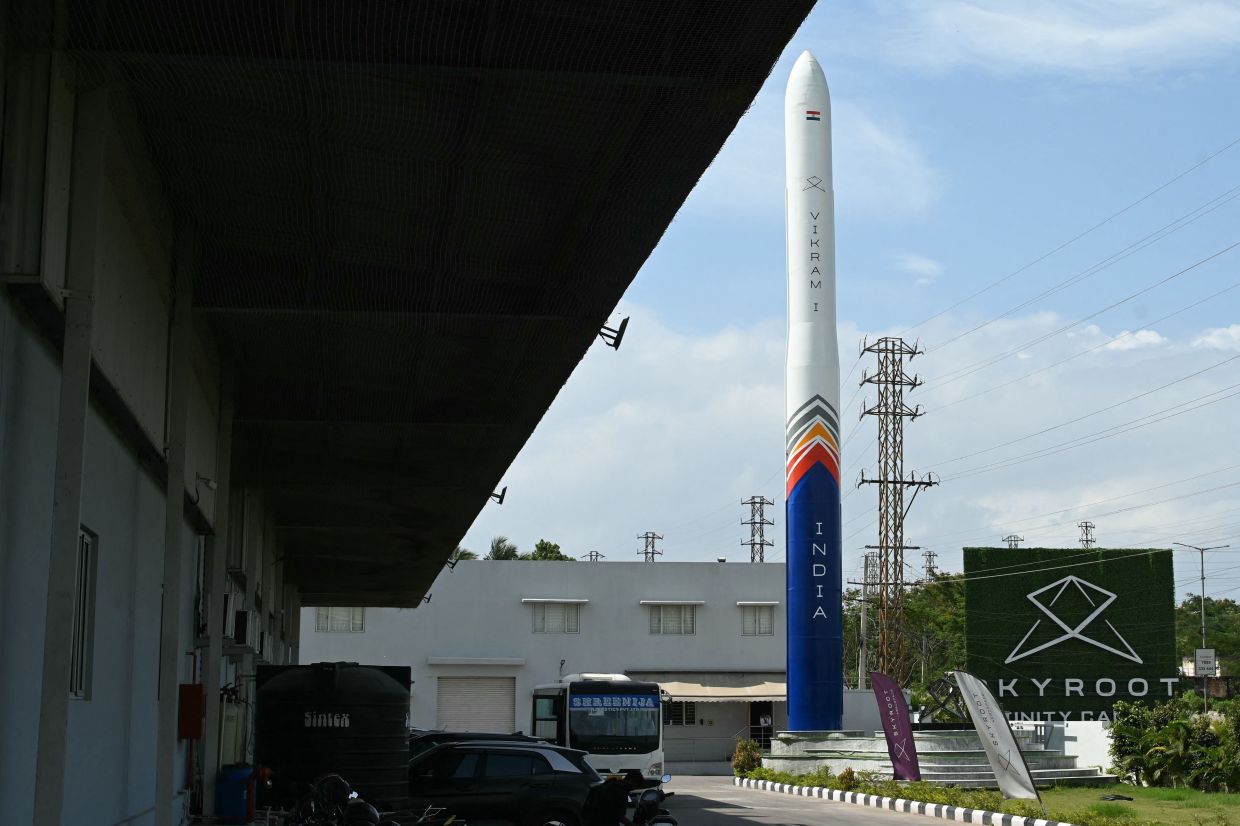
India's ambitious space programme is entering uncharted territory with the imminent launch of Skyroot Aerospace's Vikram-1 rocket, the country's first privately developed orbital-class vehicle. Set to lift off from Sriharikota between July 12 and August 4, this milestone represents far more than a single commercial achievement. It signals the arrival of a maturing private sector in a nation that has long been synonymous with government-led space exploration, marking a fundamental shift in how New Delhi approaches its place in the global space economy.
The Indian space sector has undergone remarkable transformation since the government opened the industry to private investment in 2020. What was once an exclusively state-controlled domain through the Indian Space Research Organisation (ISRO) has blossomed into a thriving ecosystem attracting over 400 space startups. The sector, currently valued at US$8.4 billion, represents one of Asia's most dynamic technological frontiers. New Delhi's projections underscore the trajectory: officials forecast the space industry will expand to US$44 billion by 2033 and potentially reach US$100 billion by 2040, assuming current growth rates persist and policy support remains steady.
India's credentials in space exploration extend far deeper than recent achievements alone. In 2014, India became the first Asian nation to successfully place a spacecraft in Mars orbit, a feat that demonstrated both technological prowess and cost-efficiency in complex deep-space missions. The lunar exploration programme, Chandrayaan, has delivered successive generations of capability. After an orbiter in 2008 and a narrowly missed landing attempt in 2019, India achieved a defining moment in 2023 when it successfully deployed a rover on the lunar surface, joining an exclusive club of nations capable of unmanned lunar landings. The government plans a fourth Chandrayaan mission for 2027 designed to retrieve lunar samples, advancing scientific understanding of Earth's nearest neighbour. Meanwhile, the Aditya solar observation mission continues monitoring the Sun's corona, providing critical data on space weather that affects satellite operations and communications infrastructure.
The proliferation of private space ventures reflects this confidence in India's technological capabilities. Skyroot Aerospace, preparing the Vikram-1 launch, represents the vanguard of this entrepreneurial wave. Beyond Skyroot, companies like Pixxel are developing earth observation satellites with applications spanning agriculture, environmental monitoring and urban planning. Bellatrix Aerospace focuses on satellite propulsion systems, while Agnikul Cosmos is pioneering manufacturing techniques using 3D-printed rocket engines for small satellite launch vehicles. This diversification strengthens India's position within the global commercial satellite market, where ISRO has already earned recognition through launching over 430 foreign satellites and generating revenues exceeding US$600 million.
The infrastructure supporting this growth is expanding deliberately across India's geography. The primary launch facility at Sriharikota on Andhra Pradesh's southeast coast is undergoing expansion to accommodate increased launch cadence. A second spaceport is under construction at Kulasekarapattinam on Tamil Nadu's southern tip, positioning India to handle multiple simultaneous launch operations. This geographic distribution reflects long-term strategic planning to reduce dependency on any single facility and distribute economic benefits across regions.
International collaboration has proven central to India's space achievements. Beyond partnerships with the United States through NASA, India maintains active cooperation with the European Space Agency, France, Germany, Italy, Japan and Saudi Arabia. Russia provides essential support for India's human spaceflight programme preparations, reflecting the persistence of Cold War-era space partnerships in contemporary geopolitical contexts. These international relationships facilitate technology sharing, joint missions and the development of interoperable systems that enhance India's capabilities while promoting multilateral engagement.
A distinctive feature of India's space programme lies in its cost efficiency. Since launching its first satellite aboard a Soviet rocket in 1975, India has cultivated a reputation for accomplishing complex missions within constrained budgets. This efficiency has become a competitive advantage as New Delhi pursues an expanding share of the commercial satellite launch market, where cost consciousness among international clients remains paramount. The ability to deliver reliable launch services at prices substantially below Western providers positions India favourably within the growing constellation of nations seeking affordable space access.
Yet the intersection of India's civilian space ambitions with defence considerations merits careful attention. ISRO collaborates extensively with government and private firms that simultaneously supply India's defence establishment. This blurring of boundaries encompasses launch rockets, propulsion systems, satellite technology, guidance systems and advanced electronics. The overlap extends to India's expanding missile and military drone programmes, where technologies initially developed for space applications find secondary military applications. ISRO has explicitly acknowledged "active coordination" with the Defence Research and Development Organisation and maintains close ties with BrahMos, the joint India-Russia missile venture. Private sector suppliers of avionics and guidance systems have experienced surging military orders, suggesting the space-defence nexus will deepen.
This convergence presents complex implications for regional security dynamics and international relations. The simultaneous development of peaceful space capabilities and military applications is neither unique to India nor inherently problematic within international law, yet it complicates assessments of India's broader strategic posture in South Asia and the Indo-Pacific. Neighbouring Pakistan has monitored India's space programme developments carefully, particularly regarding satellite reconnaissance and launch vehicle capabilities with dual-use potential. Meanwhile, China's evolving space capabilities and military applications create competitive pressures driving Indian advancement.
The Department of Space has articulated New Delhi's expansive vision encompassing deep-space exploration, space science, human spaceflight and orbital infrastructure development. These ambitions position India not merely as a capable space-faring nation but as a aspirant for permanent great-power status in the space domain. The Chandrayaan sample-return mission planned for 2027 and the Venus orbit mission scheduled for 2028 demonstrate commitment to sustaining momentum in planetary science. India's planned deep-ocean exploration through the Matsya submarine, designed to reach six kilometres depth by 2027 to access rare earth and critical minerals, reveals how space technology applications extend into maritime resource exploitation.
For Southeast Asian nations and the broader Indo-Pacific region, India's accelerating space capabilities merit serious engagement. India's commercial launch services offer regional states alternatives to relying exclusively on established providers. Singapore, Indonesia and other ASEAN members utilise Indian launch services and satellite technology for communications and earth observation. As India's private sector matures and competition intensifies, pricing and service offerings may become increasingly attractive for regional actors seeking space-based capabilities. Simultaneously, India's deepening space-defence integration warrants consideration by regional security analysts assessing military balance and potential arms race dynamics.
The launch of Skyroot's Vikram-1 rocket will be observed closely by space industry analysts globally. Success will validate India's transition toward a mixed public-private space ecosystem and demonstrate that emerging market actors can compete in the demanding orbital launch sector. Failure would temporarily setback India's private space ambitions but unlikely derail the longer-term trajectory. Either outcome will shape how international investors assess India's emerging space economy and whether the promised growth to US$100 billion proves achievable. For Malaysia and the region, India's space ambitions represent both opportunity for beneficial technological cooperation and a reminder that space development reflects broader geopolitical aspirations in an increasingly multipolar world.

