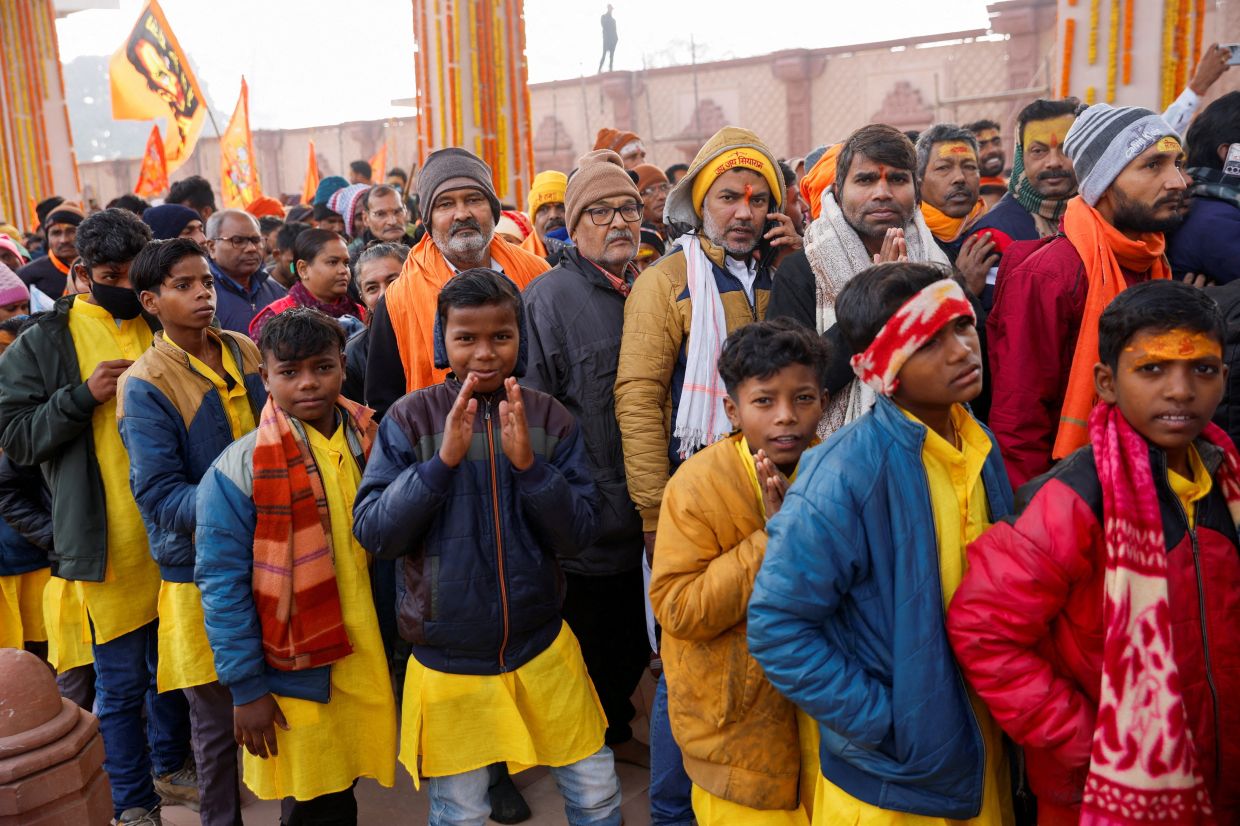
An ongoing police investigation into missing donations at India's prominent Ram temple in Ayodhya has thrust the murky world of religious finance into the spotlight, forcing uncomfortable questions about how the country's most revered shrines safeguard the offerings entrusted to them by millions of devotees. The probe, which began in June, resulted in eight arrests among temple staff tasked with managing donations, though investigators have remained tight-lipped on the precise amount allegedly diverted. Media accounts suggest the theft could exceed 30 million rupees, equivalent to roughly US$314,000, a sum that represents genuine sacrifice for many ordinary worshippers.
For everyday pilgrims like Ashok Prasad Kushwaha, an auto-rickshaw driver who has visited the temple three times in two years, the allegations strike at the heart of religious faith itself. The act of giving at a temple transcends mere financial transaction; it represents a covenant between the devotee and the divine, rooted in the belief that contributions will advance sacred purposes. When such money vanishes into the pockets of dishonest functionaries, Kushwaha observes, the emotional wound extends far beyond the monetary value. The violation feels intensely personal, a betrayal of trust by those positioned as guardians of the faithful's most sincere expressions of piety.
The Ram temple case is far from isolated within India's religious landscape. Prior scandals at other major pilgrimage destinations, including Badrinath shrine and the sprawling Tirumala Tirupati Devasthanams—a temple trust whose assets are estimated at US$31 billion—demonstrate a pattern of vulnerability across the sector. These are not small chapels operating on modest collections. India's religious and spiritual economy was valued at US$70.14 billion in 2025 and is projected to expand to US$135.41 billion by 2034 according to consultancy analysis, representing a market of extraordinary scale. Yet for all their financial magnitude, many religious institutions operate with financial controls that would be considered dangerously inadequate in the corporate world.
The structural vulnerabilities at the Ram temple were apparently elementary. Investigators found that temple staff exploited weak donation-counting procedures and gaps in surveillance systems to orchestrate the theft. The temple, inaugurated by Prime Minister Narendra Modi in 2024, now attracts approximately 90,000 visitors daily, each potentially contributing cash, gold, or precious metals. The sheer volume of daily offerings creates both opportunity and justification for improved systems, yet the very scale of operations seems to have outpaced institutional safeguards. Temple management appears to have operated under assumptions suited to a smaller, less commercialised religious site rather than a major pilgrimage destination of national importance.
Religious experts and governance specialists have begun articulating clear prescriptions for reform. Rahul Easwar, a Hindu activist and grandson of a former chief priest at Kerala's Sabarimala temple, diagnoses the core problem as fundamental absence of transparency and accountability mechanisms. He advocates for mandatory receipt generation for all donations, implementation of digital accounting systems comparable to those in modern businesses, comprehensive CCTV coverage of donation-handling areas, and crucially, independent external oversight to ensure no single group maintains unilateral control. Such measures would represent a significant departure from the informal, tradition-based management approaches that have long characterised temple operations.
The legal landscape surrounding Indian religious institutions further complicates efforts to impose uniform standards. Sonam Chandwani, managing partner at KS Legal & Associates, notes that religious organisations operate under multiple overlapping legal regimes and tax systems, with no unified national framework establishing consistent financial transparency requirements. This fragmentation means that a temple in one state might face entirely different regulatory obligations than an equivalent institution across a state border. The absence of standardised benchmarks creates opportunities for the less scrupulous to exploit jurisdictional ambiguities and regulatory gaps.
The sensitivity surrounding the Ram temple fraud cannot be divorced from the site's explosive historical background. The temple stands on land that was central to one of India's most prolonged and divisive religious disputes. Hindu tradition holds that the deity Ram was born at this location over 7,000 years ago, while the site was previously occupied by the Babri mosque, constructed in the 16th century. This overlap between sacred Hindu belief and Islamic heritage ignited devastating communal violence in 1992 when Hindu mobs destroyed the mosque, an act that sparked nationwide riots killing more than 2,000 people. The Supreme Court's 2019 decision to award the site for temple construction culminated a legal battle spanning decades and opened a nationwide fundraising campaign that ultimately mobilised US$341 million.
Given this fraught history and the immense resources mobilised to construct the temple, the discovery of internal theft carries additional significance beyond simple criminal wrongdoing. It represents a failure of institutional stewardship precisely when public trust was most essential. The temple was meant to symbolise Hindu religious unity and proper governance; instead, the scandal suggests that even India's most celebrated religious projects cannot insulate themselves from the financial corruption that plagues many large institutions across the country.
Political analyst Anurag Naidu argues that major temples handling enormous daily cash volumes require institutional infrastructure comparable to large public corporations or government agencies. Modern religious institutions, he contends, have fundamentally transformed from intimate places of worship into vast enterprise operations managing hundreds of millions in assets, employing thousands, and hosting millions of visitors annually. Yet many continue operating with governance structures inherited from centuries past, structures designed for intimate community worship rather than institutional complexity. The disconnect between operational scale and management sophistication creates inevitable vulnerabilities that sophisticated fraudsters will inevitably exploit.
The challenges intensify when considering mass pilgrimage events like the Kumbh Mela, where millions of devotees converge and collect enormous volumes of offerings within compressed timeframes. Managing donations under such extraordinary circumstances requires systems of considerable sophistication, yet Easwar notes that such events remain logistically overwhelming for most temple administrations. The combination of massive crowds, enormous cash flows, time pressure, and limited infrastructure creates an environment where even well-intentioned institutions struggle to prevent fraud and misappropriation.
Moving forward, religious institutions across India face pressure to professionalize their financial operations substantially. This need not compromise spiritual authenticity or traditional practices; rather, it represents a recognition that contemporary religious organisations serve functions their predecessors never imagined. Implementing transparent accounting systems, subjecting finances to independent audits, establishing clear chains of custody for donations, and creating oversight mechanisms that include external representation would strengthen public confidence. Such reforms, while challenging institutional resistance to external scrutiny, ultimately serve the genuine interests of devotees and the institutions themselves. The Ram temple investigation suggests that without such changes, future scandals remain inevitable.

