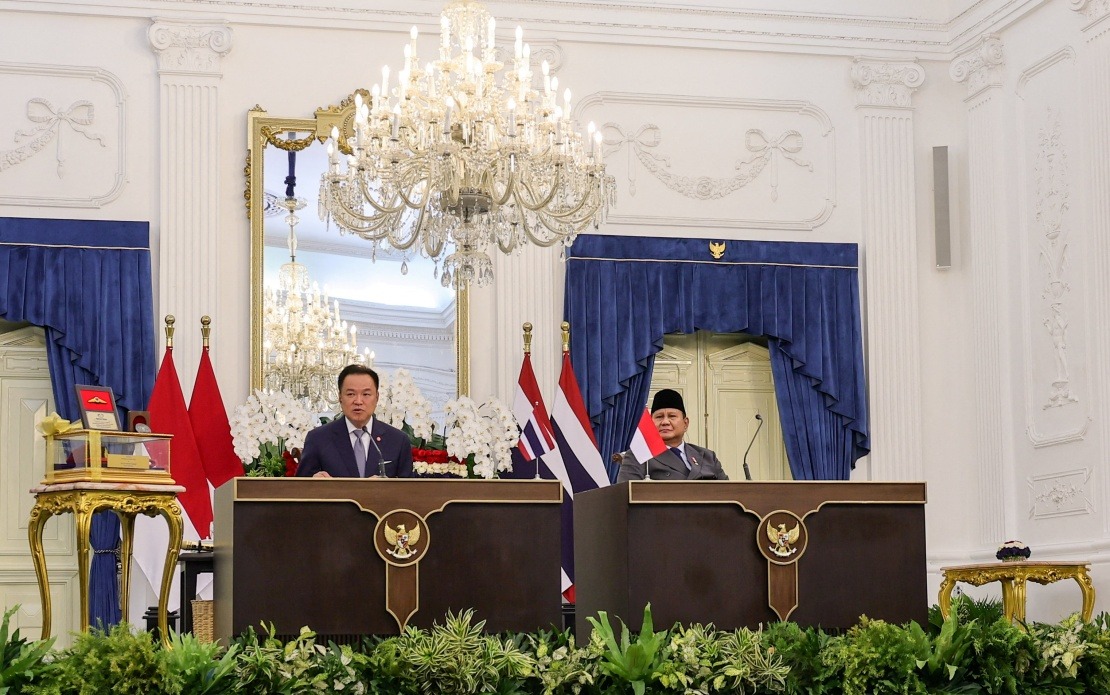
Indonesia and Thailand have reinforced their commitment to the ASEAN-led Myanmar peace initiative while simultaneously broadening their strategic partnership across defence and security matters. The pledges emerged from high-level talks in Jakarta on Monday between Indonesian President Prabowo Subianto and Thai Prime Minister Anutin Charnvirakul, marking a significant diplomatic moment that underscores Southeast Asia's ongoing efforts to stabilise the conflict-affected nation whilst addressing cross-border criminal challenges.
At the second Leaders' Consultation held at Jakarta's Merdeka Palace, both nations reiterated their determination to advance the Five-Point Consensus, the regional framework established by ASEAN in response to Myanmar's political crisis. The consensus framework emphasises cessation of violence, inclusive dialogue, humanitarian assistance delivery, and monitoring mechanisms overseen by ASEAN itself. By anchoring their bilateral discussions within this multilateral context, Jakarta and Bangkok signal to the broader region that they view Myanmar's stability as integral to ASEAN's collective security architecture and long-term prosperity.
Prabowo emphasised that maintaining ASEAN unity and centrality represents the fundamental pillar upon which peace and development in the region must rest. The Indonesian leader stressed that bilateral cooperation between Jakarta and Bangkok would serve as a practical demonstration of how member states can work constructively to encourage ASEAN as an institution to play a meaningful mediating role in Myanmar. This framing is significant for Malaysian observers, given Malaysia's own position within ASEAN's consensus-based decision-making structures and its interest in preventing regional fragmentation over Myanmar policy.
Beyond Myanmar, the two nations have agreed to substantially deepen their defence and security cooperation, with particular emphasis on dismantling transnational criminal networks that operate with growing sophistication across Southeast Asian borders. Intelligence sharing, joint investigations, financial tracking, and coordinated law enforcement efforts constitute the operational pillars of this enhanced partnership. The focus reflects a pragmatic acknowledgment that non-traditional security threats—from online fraud operations to human trafficking—often transcend national borders more readily than conventional military threats, requiring regional responses that match the borderless nature of modern criminality.
Online scam syndicates have emerged as a particularly acute transnational challenge, generating substantial losses for victims across the region and creating complex jurisdictional complications. Thailand has already facilitated the repatriation of nearly one thousand Indonesians who fell victim to such operations, underscoring the human cost and the practical necessity of bilateral cooperation. The development of a Transnational Referral Mechanism represents an institutional innovation designed to systematise the identification, protection, and dignified return of victims whose exploitation often involves forced labour, psychological coercion, and exploitation across multiple jurisdictions simultaneously.
Thai Prime Minister Anutin articulated a complementary set of priorities centring on enhanced maritime security cooperation, expanded defence industry collaboration, and intensified capacity-building initiatives. The Thai proposal for supply of thirty-six amphibious wheeled armoured vehicles to Indonesia signals practical defence cooperation extending beyond intelligence and law enforcement into material support. Such defence procurement arrangements both deepen operational interoperability between the armed forces of the two nations and create economic spillovers for defence industrial sectors in both countries.
Anutin's proposal for expanded defence industry collaboration deserves particular attention for Malaysian readers, as such partnerships often create regional supply chains and expertise networks that extend beyond the immediate bilateral relationship. Thailand's defence manufacturing capabilities, particularly in marine and armoured vehicle production, represent a growing regional industrial asset that integrates Southeast Asian armed forces into shared procurement ecosystems. This industrial dimension reinforces strategic partnership through economic interdependence and technical knowledge transfer.
The timing of Anutin's visit holds additional significance. His arrival in Jakarta on Monday represented his first official visit to Indonesia since assuming office as Thailand's thirty-second prime minister in September 2025, and the broader visit constituted the first Thai prime ministerial journey to Indonesia in fifteen years. This extended diplomatic hiatus underscores how bilateral relations between major ASEAN economies can experience cycles of reduced high-level engagement, making the current reactivation of prime ministerial consultations a notable reset in Jakarta-Bangkok ties.
For Malaysia and other ASEAN member states, the deepening Indonesia-Thailand security partnership carries implications for regional burden-sharing on transnational crime and Myanmar policy implementation. If Jakarta and Bangkok establish more effective institutional mechanisms for combating cross-border criminal networks and can demonstrate concrete results in victim protection and criminal network disruption, such approaches may serve as models for broader ASEAN-level initiatives. Conversely, bilateral security deepening among larger ASEAN economies occasionally generates concerns among smaller member states regarding agenda-setting and marginalisation in regional decision-making processes.
The commitment to combating online scam operations, human trafficking, and wildlife trafficking through enhanced law enforcement and intelligence sharing reflects ASEAN's growing recognition that traditional security frameworks prove inadequate for addressing contemporary criminal enterprises that exploit digital platforms, financial opacity, and jurisdictional gaps. Thailand's explicit emphasis on tackling transnational wildlife trafficking aligns with broader international conservation priorities and ASEAN's role as a critical region for combating wildlife trafficking into China and other markets with substantial demand for endangered species products.
Looking forward, the success of Indonesia-Thailand cooperation on these fronts will depend substantially on the technical capabilities, political will, and institutional coordination mechanisms both countries can deploy. Intelligence sharing between security agencies requires protocols protecting source information whilst enabling actionable intelligence exchange. Joint investigations across borders involve navigating differing legal frameworks, evidentiary standards, and criminal procedure norms. Financial tracking necessitates coordination with banking regulators and international financial institutions operating under varying regulatory regimes. These operational challenges, whilst surmountable, require sustained political commitment and adequate resource allocation.
The broader context of increasing global uncertainty and non-traditional security complexity provides the strategic rationale for enhanced Indonesia-Thailand cooperation. Both nations face pressures from great power competition, supply chain vulnerabilities, climate-related migration pressures, and digital security threats. By strengthening political and security cooperation bilaterally, Jakarta and Bangkok aim to enhance ASEAN's collective resilience and institutional relevance in addressing challenges that transcend individual member states' capacity to manage unilaterally. This perspective increasingly shapes how major ASEAN economies approach regional cooperation, moving beyond traditional territorial security concerns toward multifaceted threat management frameworks.

