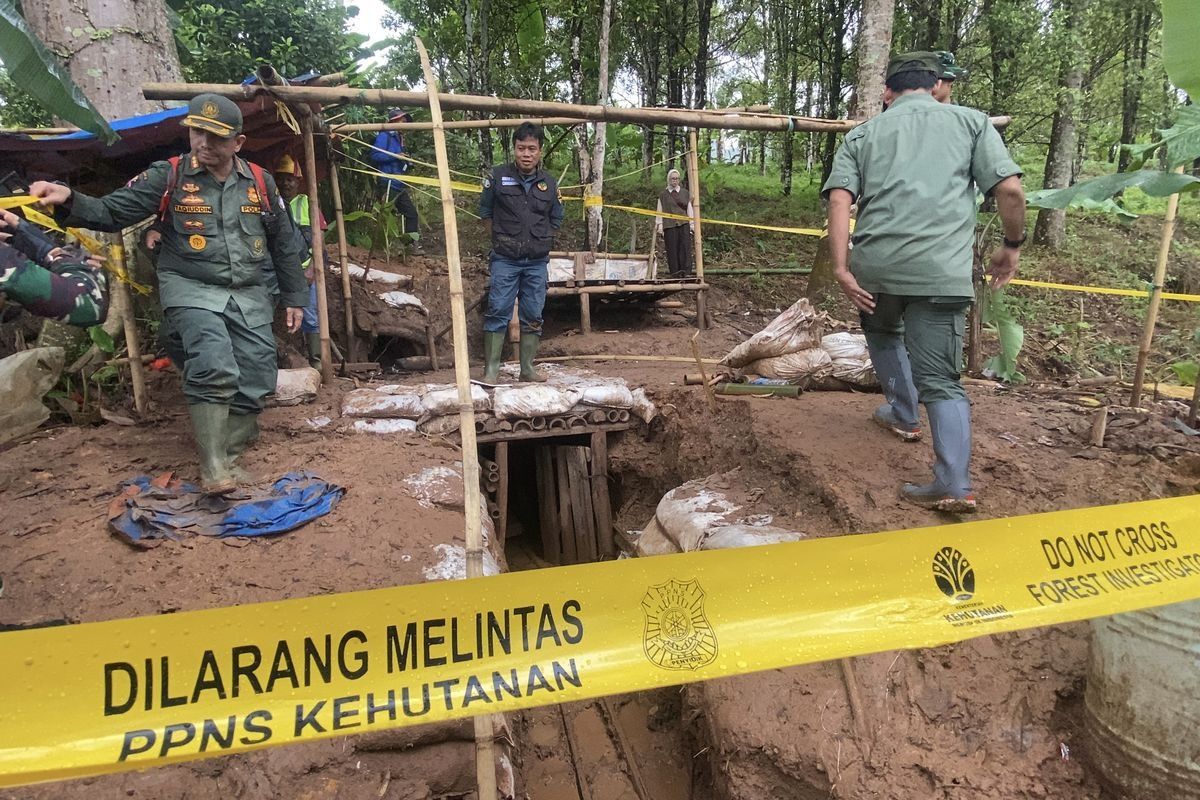
Indonesia's energy ministry has taken legal action against 24 foreign nationals accused of orchestrating an illegal gold mining enterprise in the Maluku region, marking another significant enforcement effort against foreign-led extraction operations that have plagued the country's mineral-rich eastern territories. The charges were announced through a statement by energy ministry official Jeffri Huwae on Thursday, bringing the case into the criminal justice system after months of investigation into mining activities centred on the Gunung Botak district.
The accused foreigners allegedly organised extensive infrastructure development to support their clandestine mining operation, constructing roads and establishing mineral processing facilities across the Gunung Botak locality. This level of systematic preparation suggests a sophisticated operation rather than opportunistic small-scale extraction, indicating that the suspects had invested significant resources into establishing what appeared to be a semi-permanent mining enterprise. The infrastructure development itself demonstrates premeditation and organised planning, elements that typically aggravate charges under Indonesian mining law.
Under Indonesian legislation governing illegal mining activities, those convicted face maximum prison sentences of five years, a penalty that reflects the government's attempts to deter foreign involvement in unauthorised extraction while remaining more lenient than statutes addressing other serious crimes. The specific statutory framework and sentencing guidelines indicate that Indonesian lawmakers view illegal mining primarily as an economic crime rather than categorising it with more severe offences, though the environmental damage and resource theft involved can be substantial. The five-year maximum provides prosecutors with a meaningful enforcement tool while maintaining sentences that international observers might consider proportionate.
The energy ministry's official statement notably omitted details regarding the nationalities of the defendants, a significant omission given that state news agency Antara had previously identified the detained suspects as Chinese nationals working under the sponsorship of local company PT Harmoni Alam Manise. This reluctance to explicitly confirm nationalities in the formal charging statement may reflect diplomatic sensitivities or standard prosecution practices, though it contrasts with earlier media reporting that had named China as the source country. The absence of information about total gold production quantities also limits public understanding of the operation's commercial scope and the scale of resource loss.
According to Antara's earlier reporting from the preceding month, the authorities had detained approximately 24 Chinese workers at Gunung Botak who operated under corporate sponsorship from PT Harmoni Alam Manise, a local company that presumably provided the legal cover and licensing framework through which the foreign workers accessed the mining sites. The relationship between foreign workers and Indonesian corporate entities in illegal mining typically involves the Indonesian company providing nominal local ownership and connections to facilitate operations that foreign individuals or organisations cannot legally conduct independently. This structure has become a common mechanism for circumventing Indonesia's restrictions on foreign-owned mining operations.
A critical complication in prosecuting this case is that approximately half of the accused foreigners—12 individuals—remain at large and have positioned themselves outside Indonesia's territorial jurisdiction, significantly complicating the ministry's enforcement capacity. Only 12 of the 24 charged suspects have been apprehended and detained within Indonesian territory, where they can face trial and potential imprisonment. The flight of half the defendant group raises questions about whether authorities had adequate intelligence before moving to formal charges, or whether the suspects were tipped off during investigation phases, allowing them to escape across maritime borders that the Maluku region shares with numerous neighbouring jurisdictions.
Beyond the 24 foreign nationals charged, Indonesian authorities also named two domestic nationals as criminal suspects in connection with the same mining operation, suggesting complicity from local facilitators who likely arranged permits, provided equipment, managed logistics, or engaged in other support functions essential to sustaining the illegal enterprise. These Indonesian co-defendants may have been more knowledgeable about navigating local regulatory systems and forging necessary documentation, making their participation potentially more culpable from an operational perspective. Their involvement underscores how foreign mining operations typically depend on corruption or cooperation from Indonesian officials or business figures with regulatory access.
This prosecution represents part of a broader pattern of foreign-led illegal mining in Indonesia's eastern regions, a phenomenon that has frustrated policymakers seeking to protect national resources and environmental integrity. Law enforcement successes against foreign mining operations, while symbolically important, often represent only isolated disruptions of larger networks that continue operating elsewhere. The energy ministry's willingness to pursue cases involving foreign nationals demonstrates commitment to enforcement, though the escape of half the defendants in this instance illustrates the practical limitations authorities face when suspects can transit across international waters.
Comparable enforcement actions have occurred across Indonesia's archipelago, with Papua's law enforcement agencies having previously arrested four Chinese nationals in Senggi district during the preceding year, according to Antara's records. These repeated incidents involving Chinese nationals suggest either that Chinese mining enterprises view Indonesia as a viable investment destination despite legal risks, or that Chinese workers are disproportionately represented in illegal mining employment relative to other foreign nationalities. The consistency of arrests involving specific nationalities may reflect either enforcement priorities or actual patterns of foreign participation in illicit extraction.
For Malaysia and regional observers, the Maluku case illustrates the challenge facing Southeast Asian governments in combating illegal resource extraction despite strengthened enforcement mechanisms. The ease with which foreign suspects can flee across jurisdictional boundaries highlights gaps in regional cooperation protocols, a concern equally relevant to Malaysia given shared maritime borders and transnational criminal networks. The involvement of local Indonesian corporate entities as fronts for foreign operations also mirrors patterns in other Southeast Asian countries where illegal mining, logging, and fishing operations exploit gaps between formal regulations and enforcement capacity on the ground.

