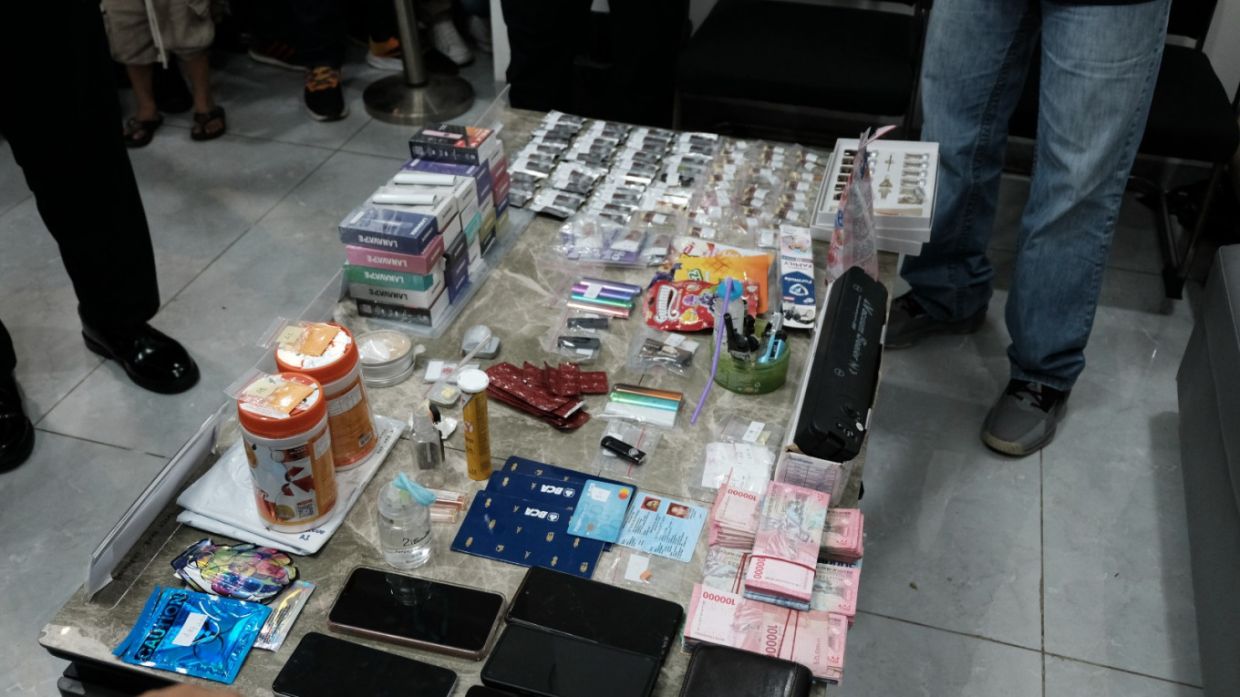
Indonesian authorities have successfully dismantled a cross-border narcotics network that orchestrated the trafficking of dangerous drugs through illegal maritime channels into the Riau Islands. The National Narcotics Agency (BNN) and the Customs and Excise Directorate General conducted coordinated raids across multiple locations in Batam on Wednesday, culminating in the arrest of six Indonesian nationals. Investigators are actively pursuing two Malaysian nationals identified as SL and WKC, who are believed to have orchestrated the supply of etomidate and other controlled substances to the criminal network.
The operation represents a significant interdiction point along a smuggling corridor that exploits Malaysia-Indonesia maritime borders, a persistent vulnerability in the region's drug control efforts. Insp. Gen. Aswin Sipayung, deputy head of BNN enforcement, detailed how the syndicate operated with sophisticated logistics, moving narcotics through unmonitored seaports before repackaging and distributing them across Batam and surrounding areas. The four sites targeted during the raids included a shophouse in Sakura Garden, apartments, and a boarding house where distribution and repackaging operations were conducted. This level of operational sophistication suggests the network possessed substantial capital and organizational experience in circumventing law enforcement.
The investigation originated from routine screening at Soekarno-Hatta International Airport, where Customs officers intercepted a parcel from Malaysia falsely declared as an orange fiber food supplement. Laboratory analysis at the Customs and Excise Laboratory in Jakarta revealed the package contained MDMA, ketamine, and other controlled substances masked within legitimate-appearing packaging. This discovery triggered collaborative investigation that would eventually expose the network's broader operations. The interception demonstrated how transnational smuggling networks increasingly exploit commercial shipping channels and misclassification of cargo to evade detection, a challenge facing authorities across Southeast Asia.
Following the airport seizure, officers moved swiftly to apprehend a man identified as BAP who was preparing to receive the package in Batam. His cooperation with investigators proved instrumental, as subsequent interrogation led to the rapid identification and arrest of three additional suspects at a hotel in Baloi, including ED who allegedly placed the order, and NC and TFS. This cascading arrest pattern revealed the network's operational structure, with specialists handling procurement, transportation, repackaging, and distribution across different geographic zones.
The raids yielded substantial quantities of narcotics and related materials. Officers recovered over 1,076 grams of MDMA, 50 grams of methamphetamine, 25.6 grams of ketamine powder, 170 vape cartridges containing etomidate, and 12 vials of liquid etomidate totalling 226 grams. Additionally, 86 tablets of Happy Five, 10 ecstasy pills, and various consumption paraphernalia including nine bongs were confiscated. The diversity of drug types suggests the syndicate supplied multiple customer segments, from recreational users to individuals seeking prescription alternatives through illicit channels. The seizure of 88 vape devices indicates the network had invested in distribution infrastructure designed to normalize drug consumption through contemporary delivery methods.
The syndicate's operational methodology reveals calculated deception tactics designed to exploit law enforcement gaps. Criminal operatives concealed controlled substances within dried food packages and food supplement sachets, then resealed them using plastic devices to replicate commercial packaging. This approach exploits the volume of legitimate cross-border food and supplement trade, making it statistically difficult for authorities to identify suspicious shipments. Such tactics represent an evolution in trafficking methodology that challenges traditional contraband detection based on product category alone.
Simultaneously, Customs officers at Batam Centre International Ferry Terminal intercepted a separate smuggling attempt by a Malaysian passenger identified as PS who had arrived from Stulang Laut International Ferry Terminal in Johor Bahru. Officers discovered 48 etomidate-containing cartridges in PS's possession, suggesting coordinated supply operations running parallel to the dismantled network or potentially indicating multiple actors exploiting the same trafficking routes. The proximity of these incidents underscores how certain maritime corridors have become established narcotics thoroughfares where multiple criminal networks operate with apparent frequency.
Beyond the immediate arrests, authorities seized multiple vehicles including a Toyota Alphard van, Toyota Agya hatchback, Chery sport utility vehicle, and two motorcycles used in distribution operations. Such asset seizures disrupt the network's mobility and logistics capacity while potentially yielding additional investigative leads through vehicle tracking and usage patterns. Batam Customs and Excise Office head Agung Widodo emphasized the public health dimensions of the enforcement action, calculating that the operation prevented approximately 6,770 potential drug users from accessing narcotics and avoided Rp10.8 billion (US$599,000) in projected state healthcare and rehabilitation expenditures.
The investigation remains ongoing regarding potential connections between this syndicate and a drug manufacturing facility recently raided by BNN and Customs personnel in Batam. Such connections would indicate vertically integrated operations spanning production, trafficking, and distribution—a more alarming organizational structure than isolated distribution cells. The two Malaysian fugitives SL and WKC remain priority targets, likely having fled across the border following the arrests of their downstream operatives.
The suspects face severe legal consequences under Indonesia's stringent narcotics laws. Article 114(2) and related provisions of Law No. 35/2009 on Narcotics mandate sentences ranging from five years' minimum imprisonment to capital punishment, with maximum fines reaching Rp10 billion. The possibility of death sentences reflects Indonesia's zero-tolerance approach to trafficking, particularly for individuals convicted of distributing large quantities or those occupying senior roles in criminal hierarchies.
This operation exemplifies the complex security challenges posed by maritime smuggling corridors connecting Malaysia and Indonesia. Despite substantial law enforcement presence, narcotics networks continue exploiting geographical proximity and shipping volume to move contraband. The involvement of Malaysian nationals as alleged suppliers suggests established distribution networks facilitating supply from production regions to Indonesian consumption markets. For Malaysian authorities, the case underscores the need for enhanced port-of-departure monitoring and tighter controls over package shipping from Malaysia into Indonesia. For regional drug policy makers, the incident demonstrates that interdiction capabilities, while effective, address symptoms rather than underlying supply chain vulnerabilities that organized crime repeatedly identifies and exploits across Southeast Asia.

