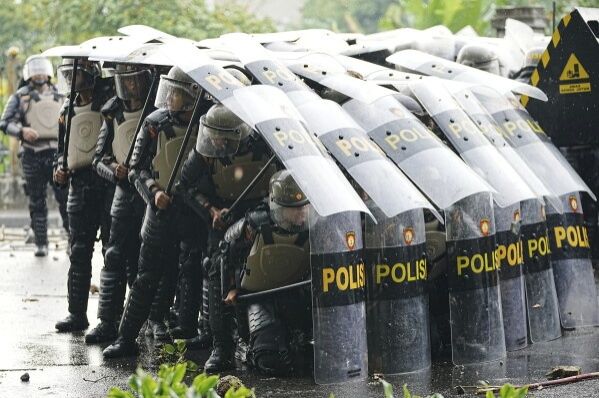
Tensions between Indonesia's police and military have surfaced publicly following a series of high-profile raids in Jakarta that recovered millions of dollars in cash and precious metals linked to ongoing corruption investigations. The dramatic security operations have drawn attention to a deputy attorney general and triggered a military response that observers warn could undermine civilian authority and the independence of law enforcement institutions across Southeast Asia's largest economy.
The raids, conducted earlier this week, represent part of a broader crackdown on alleged financial misconduct involving coal procurement irregularities blamed for recent power shortages, questionable handling of state insurance funds through Asabri and Jiwasraya, and debt settlement complications related to Krakatau Steel operations. Police investigators recovered more than $3 million in mixed currencies and valuables from a restaurant safe and adjacent money-changing facility in South Jakarta, demonstrating the scale of assets now under official scrutiny as authorities pursue multiple corruption and money-laundering threads simultaneously.
The investigation took on institutional dimensions when officers descended upon a residence in South Jakarta owned by Febrie Adriansyah, the Deputy Attorney General responsible for special crimes prosecution. Inside secured safes, authorities discovered approximately 74 kilograms of gold bars alongside considerable sums of cash and foreign currency distributed across seven locked suitcases, with the entire seizure valued at roughly $26.3 million. Febrie occupies a position of considerable significance within Indonesia's anti-corruption apparatus, overseeing major investigations that have touched prominent figures including former education minister Nadiem Makarim and matters related to President Prabowo Subianto's free-meals initiative for schoolchildren, as well as cases involving state entities Timah, Pertamina, and Garuda Indonesia.
What might have remained a significant but contained law enforcement operation escalated when armed military personnel subsequently took up position at Febrie's Jakarta residence. The Attorney General's Office justified the military deployment by citing institutional protocols governing protective arrangements for prosecutors working sensitive cases, framing the presence as a security measure rather than an investigative or supervisory action. This positioning, however, created an unusual scene: military forces establishing a presence at the home of a prosecutor during an active police investigation into his assets, a dynamic that immediately troubled observers concerned about institutional hierarchies and the proper allocation of authority among state security organs.
Responding to widespread public concern about potential institutional conflict, a military spokesman issued a statement insisting that security arrangements would not obstruct ongoing investigations and that no friction existed between institutions. The Indonesian military formally affirmed its commitment to supporting law enforcement activities and denied any interference in civilian judicial processes. These reassurances, while officially calibrated to address anxieties about military overreach, did little to dispel concerns among governance analysts and civil society observers who perceived deeper institutional fissures beneath the diplomatic language.
Febrie acknowledged ownership of the residence on Friday but categorically denied any connection to the discovered assets, suggesting they may have belonged to other persons or entities. He stated that the Attorney General's Office respected the investigative process and would await police conclusions while cautioning the public against premature judgements based on unverified social media reports or incomplete news coverage. His emphasis on presumption of innocence reflected standard legal doctrine but also signalled his office's wariness about how the discovery might influence perceptions of prosecutorial integrity during a sensitive moment for institutional credibility.
President Prabowo intervened with carefully chosen language during Friday's inauguration of a dam project on Lombok island, delivering remarks aimed at the broader security establishment without directly addressing the unfolding controversy. His call for officials, soldiers, and police to undertake introspection, combined with reminders that state institutions and their symbols ultimately derive legitimacy from the people they serve, carried unmistakable weight given his position and the context of his speech. By invoking the principle that state apparatus belongs to citizens rather than constituting autonomous power structures, Prabowo signalled presidential concern about institutional boundaries without explicitly commenting on the specific case or assigning blame to particular agencies.
International human rights monitoring organisations have responded with warnings about the broader implications of military deployment to a civilian law enforcement scene. Amnesty International Indonesia cautioned that such military involvement risks eroding civilian supremacy, a foundational principle of Indonesia's post-1998 democratic transition, and could compromise the credibility of investigative institutions by creating perceptions of intimidation or obstruction. These concerns reflect anxieties about gradual institutional drift toward patterns that recall earlier periods of military dominance in Indonesian governance, a prospect that remains sensitive given the country's democratic reconstruction over the past quarter-century.
Analysts at the Jakarta-based Center for Strategic and International Studies have identified the episode as symptomatic of broader institutional breakdown affecting Indonesia's rule-of-law infrastructure. According to researcher Nicky Fahrizal, the standoff demonstrates how institutional rivalries can accelerate what he characterises as creeping militarisation, a process whereby military actors progressively expand involvement in ostensibly civilian domains including law enforcement and judicial support functions. If such patterns persist unchecked, Fahrizal warns, the erosion of rule-of-law foundations could trigger cascading losses of confidence among both domestic publics and international investors whose assessments of political stability increasingly hinge on institutional predictability and the effective insulation of civilian processes from military influence.
The incident illuminates ongoing challenges facing Indonesia's security establishment as it navigates post-transition governance expectations. While anti-corruption efforts command public support and investigative initiatives targeting high-level misconduct enjoy legitimacy, the manner in which such operations unfold—particularly when they involve visible friction between institutional actors or apparent military involvement in civilian matters—can paradoxically undermine public confidence in the impartiality and integrity of those very institutions. For Malaysia and other Southeast Asian democracies observing institutional development across the region, Indonesia's experience offers instructive lessons about maintaining appropriate institutional boundaries during sensitive investigations, managing inter-agency rivalries transparently, and ensuring that security sector involvement in law enforcement remains clearly subordinated to civilian authority structures.
The coming weeks will prove critical in determining whether Indonesian authorities can navigate this institutional tension through careful procedural adherence and transparent communication, or whether the incident portends deeper institutional fractures requiring more fundamental governance reforms. The outcome will carry significance not merely for Indonesia's prosecutorial credibility but for regional perceptions of democratic consolidation in Southeast Asia's largest Muslim-majority nation.

