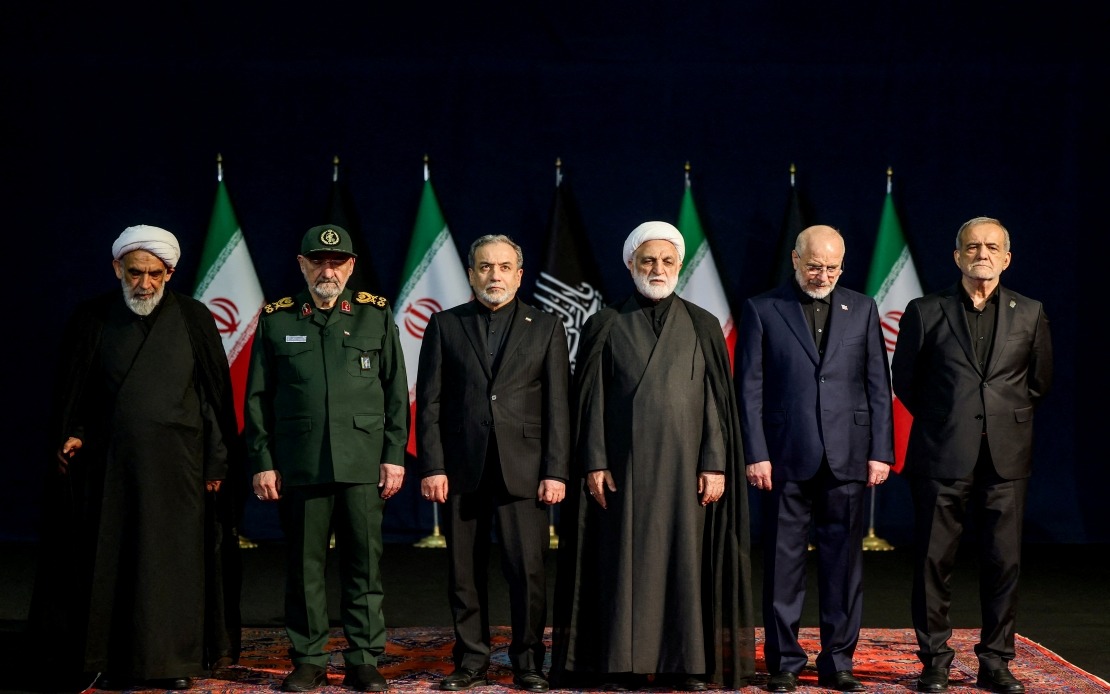
Iran's leadership and a substantial delegation of international dignitaries gathered on Friday in Tehran to pay solemn respects to the country's late Supreme Leader Ayatollah Ali Khamenei at a major state ceremony. The tribute event unfolded at Imam Khomeini's Mosalla prayer hall in the heart of the capital, with proceedings continuing throughout the day and reflecting the magnitude of the occasion within Iran's political and religious establishment. The ceremony underscored both Iran's internal transition and its diplomatic positioning on the regional and global stage during a period of significant geopolitical uncertainty.
The domestic representation was notably comprehensive, bringing together the uppermost tiers of Iran's governmental apparatus. Iranian President Masoud Pezeshkian, Parliament Speaker Mohammad Baqer Qalibaf, Judiciary Chief Gholamhossein Mohseni-Ejei, and Chairman of the Expediency Discernment Council Sadeq Amoli Larijani all attended, alongside numerous other high-ranking officials from various state institutions. This unified display of respect signalled continuity and institutional stability at a moment when questions about succession and governance transitions naturally surface.
The international attendance was equally striking, illustrating Iran's diplomatic reach across Asia and beyond, despite international sanctions and regional tensions. Pakistan's representation through Prime Minister Shehbaz Sharif and Chief of Army Staff Field Marshal Syed Asim Munir reflected the strategic partnership between Tehran and Islamabad, two neighbouring nations whose ties extend across security, energy, and religious dimensions. For Malaysian observers, Pakistan's high-level delegation highlighted how South Asian powers maintain substantive relations with Iran despite broader geopolitical pressures.
Armenian Prime Minister Nikol Pashinyan and Georgian President Mikheil Kavelashvili represented the Caucasus region, nations that navigate complex relationships with both Russia and the West while maintaining pragmatic ties with Iran. Their attendance suggested a desire to maintain balanced diplomatic channels with Tehran. Iraqi President Nizar Amedi and President of Iraq's Kurdistan Region Nechirvan Barzani underscored Iran's deep influence across its western border, where sectarian and political alignments have long favoured Iranian interests. This presence was particularly significant given Iraq's own internal dynamics and its ongoing efforts to manage relationships among various international and regional actors.
Tajik President Emomali Rahmon's participation indicated Iran's continuing engagement with Central Asian states, a region where Tehran competes with other powers for influence and economic partnerships. Senior officials from China and Russia attended as well, affirming the trilateral strategic alignment that has developed in recent years, particularly as these three nations have increasingly coordinated positions on international security matters and Western sanctions regimes.
Beyond official government representatives, the ceremony drew religious scholars, tribal leaders, and other community figures, reflecting the deeply rooted religious and cultural dimensions of Iran's supreme leadership institution. This breadth of participation illustrated that Ayatollah Khamenei's role extended far beyond conventional state governance, encompassing spiritual and ideological authority that resonates across Iran's diverse constituencies.
The funeral proceedings are scheduled to extend through July 9, with major public observances and processions planned for Tehran, Qom, and Mashhad—Iran's three most significant cities in terms of political and religious importance. Additional ceremonial rites will occur across the border in Iraq, reflecting the historical and religious connections that bind Iran to Shia communities throughout the region. Iranian authorities have declared closures and imposed airspace restrictions in Tehran and Mashhad on key dates, while Thursday was designated as a nationwide day of mourning, signalling the scale of the state funeral operation.
Ayatollah Khamenei died in a US and Israeli strike on February 28, an attack that reverberated across the region and sparked considerable international discussion about escalation risks and regional stability. His death represented a significant shift in Iran's power structure, as the Supreme Leader functions as the country's ultimate authority, commanding the military, judiciary, and state media while wielding considerable influence over legislative matters. The succession process carried considerable weight for Iran's future direction and regional posture.
His son, Mojtaba Khamenei, was selected as Iran's new supreme leader in March, continuing familial control of the position that has characterized Iran's governance since Ayatollah Ruhollah Khomeini established the Islamic Republic. This dynastic succession, while significant, raised questions internationally about generational shifts in Iranian policy and whether Mojtaba would pursue similar strategies in nuclear negotiations, regional conflicts, and engagement with adversaries. The speed of the transition and the choice of successor suggested institutional continuity, though observers continue assessing whether the younger Khamenei might introduce modified approaches to longstanding disputes.
For Southeast Asian nations like Malaysia, the succession carries implications for regional dynamics. Iran's influence extends into areas of interest to Malaysian foreign policy, including Middle Eastern stability, energy markets, and broader Islamic world affairs. The turnover in Iran's highest office creates both uncertainties and potential opportunities for countries seeking to maintain balanced relationships across competing powers in a multipolar world.

