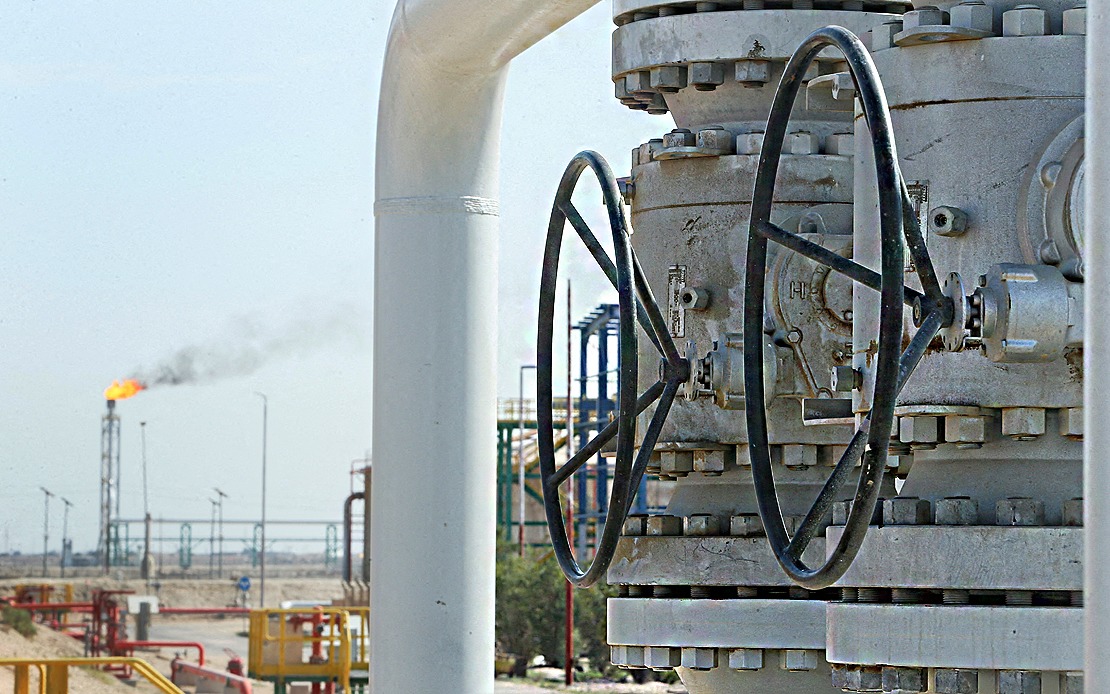
Iraq is accelerating development of an ambitious oil pipeline project that would establish direct access to Mediterranean export terminals, a strategic shift driven by mounting concerns over the security and reliability of the Strait of Hormuz as a shipping corridor. Oil Minister Bassim Khudair disclosed that Baghdad is conducting a comprehensive feasibility study for the new infrastructure, which would connect the country's two principal oil-producing regions—Basra in the south and Kirkuk in the north—to the Mediterranean ports of Ceyhan in Turkiye and Baniyas in Syria. The proposed network represents a significant reorientation of Iraq's export strategy as regional tensions continue to disrupt traditional maritime routes through the Persian Gulf.
The timing of this initiative reflects the escalating instability surrounding the Strait of Hormuz, one of the world's most critical chokepoints for global energy supplies. Months of heightened tensions between Iran and the United States have effectively constrained normal navigation through the waterway, creating substantial uncertainty for Iraq's hydrocarbon exports at a moment when the nation can least afford disruption. For a country whose economy rests almost entirely on petroleum revenues—accounting for over 90 per cent of state income in normal circumstances—any prolonged interruption to export capacity threatens the financial stability that underpins essential government functions and social programmes.
The economic stakes are particularly acute because Iraq's fiscal system depends heavily on oil revenues to sustain a vast network of public employment and welfare arrangements. More than 10 million Iraqis receive monthly government payments as civil servants, pensioners, and welfare beneficiaries, creating an enormous structural dependence on stable crude exports and uninterrupted international sales. This demographic reality means that export disruptions do not merely affect macro-level economic indicators; they directly threaten the livelihoods and purchasing power of millions of citizens, potentially fuelling social instability at a sensitive moment in the country's post-conflict reconstruction.
The proposed pipeline route presents considerable strategic advantages but also notable practical limitations. By establishing overland connections to Mediterranean terminals, Iraq would bypass the Strait of Hormuz entirely, eliminating vulnerability to the geopolitical pressures and military activities that currently constrain the waterway. The feasibility study indicates that the network could eventually be extended southward to the Jordanian Red Sea port of Aqaba, further diversifying export options and reducing concentration risk. Baghdad officials have characterised the initiative as reflecting a deliberate long-term vision and comprehensive strategy to develop multiple export pathways that enhance national energy security and reduce exposure to supply-chain bottlenecks.
However, the pipeline approach carries significant economic disadvantages compared to maritime shipping. Overland transport requires substantially higher operating and maintenance costs, operates at lower throughput efficiency, and demands considerable upfront capital investment in construction and management infrastructure. These factors mean that even successfully completed pipelines would never fully replace seaborne exports as Iraq's primary distribution method, but rather would function as a supplementary corridor during periods of crisis or heightened risk. The economic calculus suggests that Baghdad views the pipeline primarily as insurance against catastrophic supply disruptions rather than as a cost-effective alternative to conventional shipping.
Iraqi officials have also articulated a sobering acknowledgment of the geopolitical realities constraining this strategy. Even pipelines and related energy infrastructure positioned outside the Strait of Hormuz remain potentially vulnerable to Iranian military action or attacks by Iranian-affiliated actors. This vulnerability reflects Iraq's geographic position as a neighbour to Iran and the complex regional dynamics that affect Iraqi national security across multiple domains. The concern underscores that no single infrastructure project can entirely insulate Iraq from the broader regional tensions that shape Middle Eastern security, and that diversification alone offers only partial mitigation of systemic risks.
Iraq has already begun developing alternative export infrastructure through existing arrangements. The country currently operates an operational pipeline carrying crude oil through Turkish territory via the Kurdistan region, providing one established diversification route. More significantly, a second pipeline system designed to circumvent Kurdistan and thereby reduce dependence on the autonomous region's political cooperation is undergoing final commissioning and testing. This second system could commence operations within days, according to Minister Khudair, providing immediate relief by offering an alternative to the Kurdish corridor while the longer-term Mediterranean pipeline project proceeds through planning and development phases.
The broader context for this initiative reflects Iraq's continued vulnerability to supply-chain disruptions resulting from regional conflicts and great-power competition. The decline in Iraqi oil production during ongoing hostilities demonstrates how security instability directly translates into lost export revenue and reduced economic capacity. For regional observers, particularly Southeast Asian energy importers who depend on stable crude supplies from the Middle East, Iraq's pipeline investments signal a broader pattern of regional producers attempting to establish greater autonomy from volatile maritime routes. This diversification effort, if successful, could gradually reshape global energy logistics by reducing the disproportionate importance of the Strait of Hormuz and distributing export pathways across multiple routing options.
From a Malaysian perspective, Iraq's pipeline initiative carries significant implications for regional energy security and supply reliability. Southeast Asia's petroleum refineries and industrial sectors depend on stable imports of Gulf crude, and any persistent disruption to Iraqi exports affects regional energy prices and supply availability. Simultaneously, the development of overland Mediterranean pipelines represents a form of supply-chain resilience that could ultimately benefit global energy consumers by reducing concentration risk around the Strait of Hormuz. The success or failure of Iraq's diversification efforts will thus influence not only Iraqi economic stability but also the cost and availability of energy resources across Southeast Asia.

