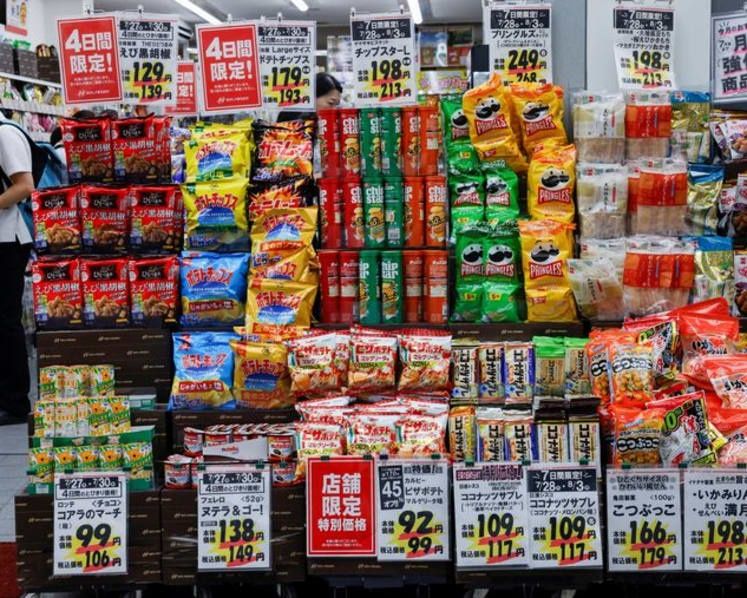
Japan will implement a dramatic cut to its consumption tax on food, reducing the rate from eight percent to just one percent beginning next April, Prime Minister Sanae Takaichi announced on Thursday. The temporary two-year reduction represents a historic shift in Japan's tax policy and underscores the government's determination to address mounting cost-of-living concerns that have gripped the world's fourth-largest economy. After the two-year period expires, the tax will revert to its current eight percent level, though Takaichi suggested the government would introduce more targeted support mechanisms for lower-income households by that time.
This marks the first reduction in the consumption tax since its introduction in 1989, making it a significant policy reversal for a nation that has grown accustomed to steady tax increases rather than cuts. The decision reflects Takaichi's electoral mandate, as she pledged in February to eliminate the sales tax on food and beverages entirely—a cornerstone of her campaign messaging that resonated strongly with voters and contributed to a decisive victory in the lower house elections. By delivering on a key election promise, albeit in modified form, the administration is attempting to translate political capital into tangible relief for struggling households.
The timing of the announcement comes as Japan grapples with elevated inflation driven by international pressures, particularly the ripple effects from Middle Eastern geopolitical tensions and the persistent weakness of the yen against major global currencies. These external factors have compounded domestic price pressures, making everyday essentials like food increasingly unaffordable for ordinary Japanese families. The government recognizes that without intervention, consumer sentiment could deteriorate further, threatening economic stability and household purchasing power at a critical moment for Japan's broader economic recovery.
The fiscal implications of this tax cut are substantial and unavoidable. The two-year reduction is estimated to result in approximately 10 trillion yen—roughly $61 billion—in foregone tax revenues, according to media reports. This represents a significant hit to government coffers at a time when Japan is already burdened by one of the world's highest public debt-to-GDP ratios, exceeding twice the size of its annual economic output. The debt burden presents a paradox for policymakers: citizens demand relief from inflation, yet the government's financial situation constrains its ability to implement expansionary policies without exacerbating long-term fiscal risks.
Takaichi acknowledged these fiscal constraints while defending the measure as necessary for social cohesion. She indicated that the government would pursue revenue-raising measures elsewhere in the tax code, including reassessment of existing tax relief schemes and subsidy programmes currently in operation. Rather than relying on increased government debt issuance—which could undermine market confidence and drive up borrowing costs—the administration aims to find offsetting revenue sources through restructuring existing fiscal outlays. This approach reflects a delicate balancing act between immediate relief and medium-term fiscal prudence.
The government's strategy includes introducing more carefully calibrated subsidies targeting lower-income workers when the food tax returns to eight percent in 2029. These subsidies would focus on households facing elevated burdens from rising social insurance premiums, particularly retirees and those with limited wage growth. By pivoting toward means-tested support rather than universal tax cuts, the approach aims to direct resources toward those most vulnerable to inflation while potentially achieving better fiscal efficiency than a blanket tax reduction.
For Malaysian and Southeast Asian observers, Japan's experience offers instructive lessons about the challenges of managing inflation through tax policy while maintaining fiscal sustainability. Like several ASEAN economies, Malaysia has grappled with inflation pressures and the temptation to provide broad-based tax relief. Japan's approach—using a temporary measure with a sunset clause and coupled with alternative revenue strategies—represents a middle path between doing nothing and pursuing open-ended fiscal expansion. However, the sheer scale of Japan's debt overhang underscores how previous years of stimulus spending have constrained current policymaking flexibility.
The announcement also signals Japan's continued concern about deflationary dynamics, despite recent inflation. The government remains wary of allowing price pressures to deter consumption, particularly given the structural headwinds facing Japan's aging population and shrinking workforce. By providing relief on essential goods, policymakers hope to sustain consumer demand and prevent inflation expectations from destabilizing, even as they manage the long-term fiscal consequences.
The implementation timeline of April 2025 provides sufficient lead time for retailers and administrators to prepare systems for the reduced tax rate, though the transition will still present logistical challenges across Japan's complex supply chain. Restaurants, supermarkets, and food producers will need to adjust pricing strategies and point-of-sale systems, potentially creating short-term disruption even as the measure aims to provide medium-term relief. The government has announced it will provide support to businesses managing this transition, recognizing that implementation success depends on smooth cooperation between the public and private sectors.
As Japan moves toward implementing this historic tax cut, observers will closely monitor whether the measure achieves its intended goal of meaningfully reducing household inflation burdens without further destabilizing an already fragile fiscal position. The two-year window will provide valuable data about the effectiveness of targeted consumption tax relief in combating inflation while revealing the true budgetary cost of the measure. For a nation seeking to balance social needs with long-term fiscal health, the stakes could hardly be higher.

