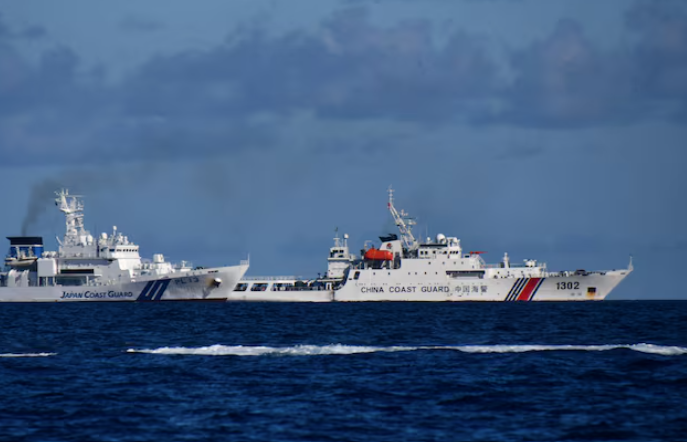
Japan has moved to forcibly remove two Chinese coast guard vessels from waters it claims as its own near the contested Senkaku Islands, marking the latest flashpoint in an increasingly fraught relationship between Asia's two largest economies. The expulsion occurred on Tuesday when the Chinese ships were detected approaching a Japanese fishing vessel operating in the disputed area, prompting Japan's coast guard to intervene and order the intruders to vacate the zone by approximately 9:20 am local time.
The incident underscores the persistent vulnerability of Japanese maritime operations in these waters, where Chinese vessels have grown increasingly assertive in recent years. While Chinese ships had previously entered areas Japan considers its territorial waters on June 10, the direct approach toward a Japanese fishing boat represents an escalation in the frequency and boldness of such encounters. The coast guard deployed additional vessels around the Japanese fishing boat to ensure its safety, a precautionary measure that reflects the unpredictable nature of these confrontations.
The broader context involves a decades-long territorial dispute centred on the Senkaku Islands, which Japan administers but China claims and calls the Diaoyu. These rocky outcrops sit strategically positioned between Taiwan and Japan's Okinawa prefecture, placing them at the intersection of multiple overlapping claims and strategic interests. Control of these islands carries symbolic weight in both capitals and potential economic significance, given the possibility of energy reserves beneath the surrounding seabed.
Japan's coast guard characterized the Chinese vessel activities as violations of international law, a charge that carries legal weight but little practical enforcement mechanism in the absence of international maritime bodies willing to adjudicate the dispute. Tokyo has explicitly stated its commitment to responding with measured firmness going forward, pledging to enforce its claimed territorial waters while adhering to established legal frameworks. This balancing act—maintaining resolve without escalating into military confrontation—reflects the delicate equilibrium both nations must maintain given their economic interdependence and regional significance.
The deterioration in bilateral relations traces back significantly to November, when Japanese Prime Minister Sanae Takaichi made public comments affirming Tokyo's willingness to intervene militarily should Taiwan face military assault from mainland China. Beijing interpreted these remarks as an unacceptable intrusion into its internal affairs, viewing Taiwan as an inalienable part of Chinese territory. The comments struck a nerve in Beijing precisely because they appeared to formalize what had previously remained implicit in Tokyo's strategic calculations, effectively raising the stakes in how Japan positioned itself on this most sensitive issue.
China's response to Takaichi's Taiwan remarks has extended well beyond diplomatic protests into the realm of economic coercion. Beijing has discouraged its citizens from travelling to Japan and imposed selective trade restrictions on certain Japanese companies, demonstrating how geopolitical disputes quickly translate into economic consequences for businesses and workers across both nations. These measures, while ostensibly targeted at elite policymakers, inevitably ripple through broader populations and commercial relationships, deepening mutual resentment.
The pattern of Chinese coast guard deployments around the Senkaku Islands reflects a long-standing strategy of persistent presence designed to establish effective control through continuous occupation rather than overt military confrontation. By regularly stationing vessels in these waters, China maintains its claim while avoiding the catastrophic escalation that direct military action would entail. This approach, sometimes called "creeping expansion," leverages China's larger coast guard fleet and greater tolerance for maritime standoffs to gradually shift the baseline of what constitutes normal activity in disputed zones.
Japan faces a particular challenge in responding to such tactics without appearing either overly aggressive or excessively accommodating. Each expulsion operation must be executed with sufficient force to demonstrate commitment to territorial integrity while remaining calibrated to avoid providing Beijing with justification for military escalation. The coast guard's role as the primary enforcer of Japan's maritime claims, rather than military vessels, helps maintain this calibration, as coast guard operations are theoretically distinct from military action under international conventions.
The East China Sea disputes extend beyond the Senkaku Islands to encompass broader disagreements over maritime boundaries and resource rights. China has simultaneously pursued claims and activities in other disputed waters within the East China Sea, where potential hydrocarbon deposits add economic dimensions to already fraught territorial questions. Japan's repeated protests against these activities have produced minimal behavioral change, suggesting that Beijing calculates the benefits of continued assertiveness outweigh the diplomatic costs.
For Southeast Asian observers, these incidents carry substantial significance as harbingers of how regional powers may handle overlapping claims and territorial disputes. Malaysia, Vietnam, and other nations with interests in the South China Sea watch closely as Japan and China navigate their Senkaku disagreement, examining whether negotiated settlements or incremental assertion better protects maritime interests. The absence of lasting resolution despite decades of tensions suggests that economic interdependence alone proves insufficient to overcome deeply rooted disputes over sovereignty and strategic positioning.
The Taiwan dimension adds another layer of complexity, as Japanese military support for Taiwan's defense capabilities has quietly grown while Tokyo officially maintains the fiction of neutrality on the island's political status. This careful balancing act becomes increasingly difficult as geopolitical pressures mount and Beijing demands explicit commitments to non-intervention. Takaichi's candid comments disrupted this established ambiguity, forcing Tokyo to choose between clarifying its position and attempting to walk back statements that had already reverberated throughout the region.

