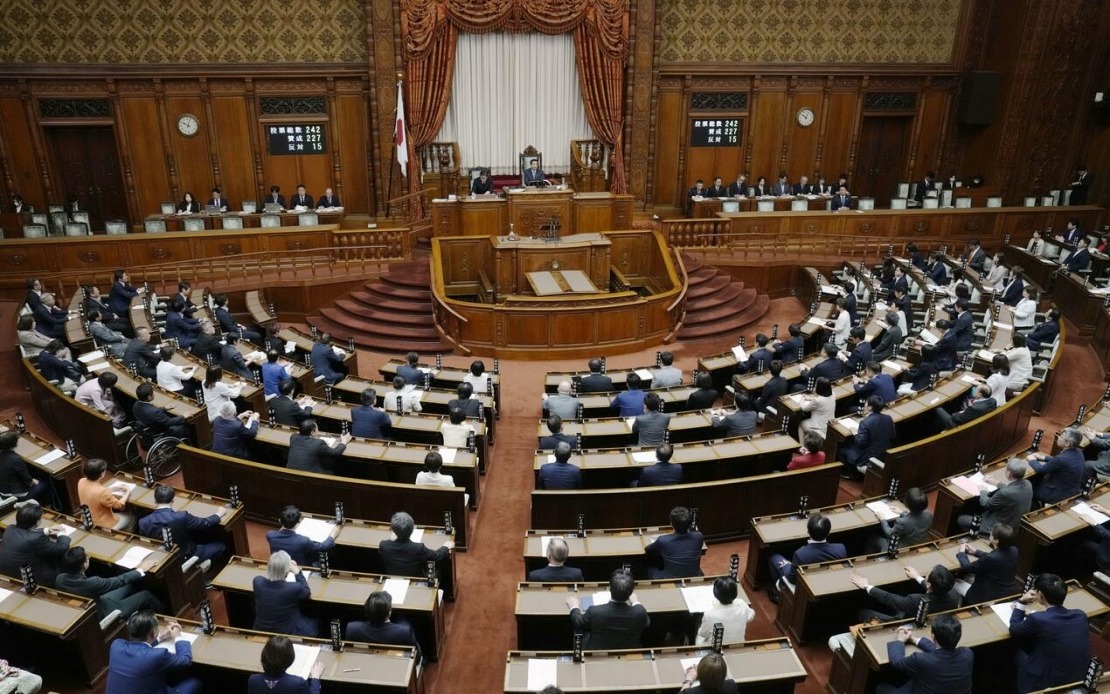
Japan's parliament has enacted sweeping defence legislation that will fundamentally reshape how the country's military addresses contemporary security challenges, particularly those emerging beyond traditional terrestrial domains. The House of Councillors voted on Friday to approve the reorganisation of the Air Self-Defence Force, marking a significant institutional shift that recognises the strategic importance of space-based operations in modern warfare and national security. The restructuring will formally incorporate space operations into the Air Force's official mandate, with implementation scheduled for the fiscal year ending in March 2027.
The centrepiece of this reorganisation is the establishment of a dedicated space operations group positioned under the command of a lieutenant general. This new command structure signals Japan's determination to develop robust capabilities in space domain awareness and satellite surveillance—areas increasingly vital to monitoring regional military movements and protecting critical national infrastructure. By creating a dedicated space command within the Air Self-Defence Force, Japan is joining other major powers in recognising that space has become a contested operational theatre requiring specialised expertise and resources.
Defence Minister Shinjiro Koizumi framed the restructuring as a response to the pervasiveness of space-based systems in contemporary society. Speaking at a press conference, he emphasised that civilian life has become inextricably dependent on space infrastructure, from satellite navigation systems that guide daily commutes to weather forecasting models that inform emergency preparedness. This framing is particularly significant for Malaysian and Southeast Asian observers, as it underscores how military space capabilities directly underpin economic and social stability across the region, where reliance on GPS-based systems and meteorological satellites has become fundamental to modern infrastructure.
The legislation also authorises the appointment of a second senior vice defence minister, addressing longstanding concerns about workload distribution within Japan's defence bureaucracy. With this additional position, the defence ministry will have enhanced capacity to manage contingencies and coordinate responses to major natural disasters—responsibilities that have grown increasingly demanding given the frequency of seismic activity and typhoons across the region. The new position will also facilitate expanded high-level defence exchanges with the United States and other regional security partners, potentially strengthening the network of defence relationships that underpins Indo-Pacific stability.
Japan's military has faced persistent recruitment and retention challenges, issues that the new legislation attempts to address through enhanced post-retirement benefits for Self-Defence Forces personnel. The mandatory retirement ages for SDF members typically occur earlier than standard civil service roles, creating a career structure that has proven less attractive to quality recruits. By improving benefits for service members and their families, the government hopes to create a more compelling professional pathway and retain experienced personnel whose expertise would otherwise be lost to civilian sectors.
Simultaneously, the legislation upgrades the Ground Self-Defence Force's 15th Brigade, stationed in Naha, Okinawa Prefecture, to a full division—a structural elevation that reflects heightened concerns about regional security dynamics. This enhancement directly addresses Japan's vulnerability in its southwestern remote islands, a geographic area where China's maritime assertiveness has created new strategic pressures. For Malaysia and other Southeast Asian nations navigating complex relationships with Beijing, Japan's military strengthening in these waters carries significant implications for regional balance and freedom of navigation in contested maritime zones.
The southwestern islands upgrade represents a tangible manifestation of Japan's strategic pivot toward addressing what Tokyo views as destabilising Chinese activities in shared maritime spaces. The Okinawa-based division upgrade will provide Japan with greater capacity to conduct sustained surveillance, rapid response operations, and coordinated exercises in the waters surrounding the Japanese archipelago's outer islands. This enhanced military presence will indirectly influence security calculations throughout Southeast Asia, where countries including Malaysia remain concerned about unilateral actions in disputed maritime areas.
Japan's multifaceted defence legislation demonstrates how modern security threats require institutional adaptation across multiple dimensions simultaneously. The space operations command addresses emerging technological domains, the additional vice minister position tackles coordination and crisis management, the benefits reforms tackle personnel sustainability, and the Okinawa division upgrade addresses geographic vulnerabilities. Together, these measures constitute a comprehensive effort to prepare the Self-Defence Forces for the complex security environment of the coming decades.
For Malaysian policymakers and defence planners, Japan's institutional restructuring offers instructive lessons about prioritising space capabilities and addressing force readiness challenges. As the region becomes increasingly integrated into strategic competition between major powers, countries throughout Southeast Asia will need to consider similar investments in space domain awareness and modernised command structures. Japan's legislative approach, which combines capacity-building with personnel incentives, provides a potential model for other regional nations seeking to strengthen their defence posture without triggering escalatory dynamics.

