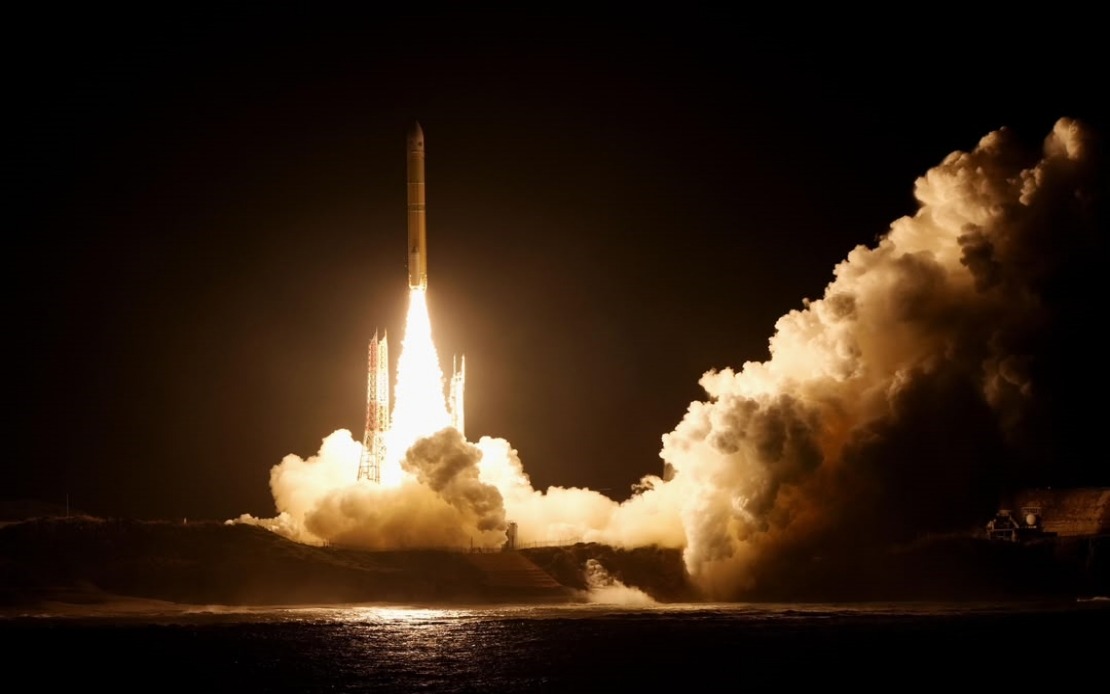
Japan's space programme achieved a significant milestone on Tuesday when the Japan Aerospace Exploration Agency successfully launched its H3 rocket from the Tanegashima Space Centre, located on a small southwestern island of the same name. The rocket carried the Michibiki No. 7 positioning satellite into orbit, representing the second consecutive successful deployment following a high-profile failure in December that had threatened the viability of Japan's flagship launcher. The achievement underscores the nation's determination to establish an independent space capability and reduce reliance on foreign launch providers in an increasingly competitive Asia-Pacific region.
The Michibiki No. 7 satellite forms part of Japan's Quasi-Zenith Satellite System, a sophisticated positioning infrastructure designed to deliver location services comparable to the American Global Positioning System and China's BeiDou. These satellites provide critical positioning data for civilian applications including smartphone navigation, vehicle tracking, and agricultural operations throughout Japan and the wider Asia-Pacific region. The system represents Japan's strategic commitment to maintaining technological autonomy in space-based infrastructure, a consideration that has grown more pressing as regional tensions and geopolitical uncertainties shape competition in advanced technologies.
The launch did not proceed without complications. Originally scheduled for Friday, the mission was postponed to Monday due to weather systems in the region, then delayed a further day as inclement conditions persisted around the launch facility. Such delays, while frustrating for programme managers, reflect the rigorous safety protocols that govern modern space operations and the unforgiving nature of launching from Japan's southern island location, where typhoon seasons and variable weather patterns frequently disrupt schedules.
The December setback that preceded this success had cast a shadow over the H3 programme's prospects. That launch of the H3 No. 8 rocket, intended to deploy the Michibiki No. 5 satellite, resulted in mission failure and left the positioning satellite constellation incomplete. The incident forced engineers to revisit fundamental systems and procedures, delaying the planned February launch of the Michibiki No. 7 satellite by several months. Such technical failures, while common in space exploration, carry particular weight in Japan where the aerospace industry has long prided itself on precision engineering and high reliability standards.
The successful June launch of an H3 rocket carrying multiple miniature satellites demonstrated that engineers had successfully diagnosed and corrected the deficiency that caused December's failure. Tuesday's deployment of Michibiki No. 7 now confirms that the remedial work was comprehensive and enduring, rather than a temporary fix. This consistency matters greatly for government confidence in the programme and for commercial operators considering whether to entrust their payloads to the H3 rocket.
The Quasi-Zenith Satellite System currently maintains five operational Michibiki satellites providing positioning services across Japan and the wider region. Government planners have established seven satellites as the optimal constellation size required to deliver comprehensive coverage and full service redundancy without dependence on foreign systems. Achieving this target would enable Japan to offer independent, reliable positioning services to its population and to regional partners, reducing strategic vulnerability to potential disruptions of American or Chinese positioning systems. The addition of Michibiki No. 7 moves Japan closer to this objective, with continued launches planned for the remaining required satellites.
The H3 rocket succeeded the highly successful H2A launcher that served as Japan's primary orbital vehicle for more than two decades. The H2A earned an outstanding reliability record through conservative design, continuous incremental improvement, and rigorous quality assurance, establishing Japan as a dependable launch provider in a competitive global market. Transitioning to the H3, which incorporates modern design philosophies and cost-reduction strategies, necessarily involved performance risks that manifested in December's failure. The current recovery trajectory suggests engineers have balanced innovation and reliability more effectively as the programme matures.
For Malaysian and Southeast Asian observers, Japan's space programme carries strategic significance beyond its immediate technical accomplishments. The region increasingly depends on space-based infrastructure for telecommunications, weather monitoring, disaster response, and economic development. Japan's success in developing independent positioning capabilities demonstrates that technologically advanced Asian nations need not remain entirely dependent on Western or Chinese systems. The Quasi-Zenith Satellite System and similar regional initiatives represent a broader pattern of Asian nations investing in space capabilities that serve regional interests and reduce external dependency. Malaysia and other ASEAN members engaged in space development efforts can observe Japan's engineering approaches, policy frameworks, and industrial strategies as models for building sustainable domestic capabilities.
The H3 programme's mixed early record reflects the genuine technical challenges involved in developing next-generation launch systems. The December failure and subsequent recovery represent not a weakness but rather the normal iterative process through which major engineering programmes advance. Japan's decision to persist with the H3 despite the setback, and to invest the resources necessary for thorough problem-solving rather than rapid schedule maintenance, reflects a long-term commitment to space independence that will likely ensure the programme's eventual success and operational credibility.

