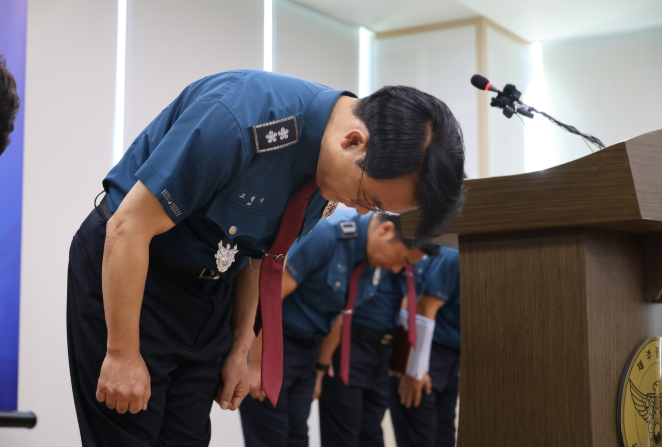
South Korea's Jeju Police Commissioner Ko Pyeong-gi issued a formal public apology on Thursday, August 27, following a troubling discovery that a police officer under his command had deliberately falsified details in missing person investigations, with both cases ultimately ending in fatalities. The admission marks a significant institutional failure in one of the nation's regional police forces and raises uncomfortable questions about oversight mechanisms within investigative units tasked with locating vulnerable individuals.
The scandal centres on officer Bu, who stands accused of deliberately misrepresenting his investigative efforts by claiming to have made contact with missing persons when no such interaction had occurred. In the case of Jang Mi-ran, a 37-year-old woman who vanished in May, Bu allegedly closed the file by falsely stating he had spoken with her. The deception proved consequential: Jang's body was discovered on Monday, August 24, several months after the case had been administratively closed and resources presumably redirected elsewhere. The premature case closure meant that active search efforts ceased, eliminating any possibility of locating her while she might have still been alive.
The gravity of Bu's misconduct became apparent when investigators determined that he had employed an identical falsification technique in a separate disappearance involving a man in his 60s. That individual's remains were located on Saturday, August 22, just days before Jang's body was found. The pattern of behaviour—systematically lying about investigative progress on multiple cases—suggests a deliberate pattern rather than isolated administrative carelessness, intensifying concerns about the officer's fitness for duty and raising uncomfortable implications about quality control within the Jeju Provincial Police Agency.
In his statement delivered at the Jeju Provincial Police Agency headquarters, Commissioner Ko expressed his contrition in measured but weighty language, acknowledging the profound human cost of his subordinate's actions. He directed his apology specifically toward the deceased victims, whose families were denied the possibility of reunion, and to the grieving relatives now grappling with the dual trauma of loss and the knowledge that police procedures had failed their loved ones at a critical moment. Ko recognised that the breach of duty extended beyond individual families to the broader Jeju community, whose confidence in police integrity had been undermined.
The commissioner's statement underscored a foundational principle of law enforcement: officers bear responsibility for protecting public safety and preserving human life. By fabricating investigative details and closing cases without legitimate cause, Bu had fundamentally betrayed that mandate. Ko characterised the false closures as having inflicted "permanent scars" on affected families—language that acknowledges not merely the loss itself but the compounded harm created when institutional deception prevents families from pursuing alternative avenues of assistance or intervention during critical hours.
Beyond the immediate cases, Ko announced a comprehensive review of all missing person investigations handled within Jeju's jurisdiction. This audit signals recognition that Bu's misconduct may not represent an isolated aberration but potentially symptomatic of broader systemic vulnerabilities in case management and supervisory oversight. The decision to conduct a sweeping examination suggests that police leadership had insufficient mechanisms for detecting false documentation and verifying investigative claims before case closure. Such vulnerabilities, if widespread, could affect other unsolved disappearances within the region.
The Jeju situation carries particular resonance for regional observers because missing person cases occupy a uniquely sensitive position within law enforcement priorities. Unlike investigations into reported crimes, missing person inquiries often involve limited physical evidence and must proceed with urgency before critical time windows close. False case closures represent not merely paperwork errors but active obstruction of family reunification efforts and potentially life-saving rescue operations. When officers deliberately misrepresent their investigative efforts, they essentially subordinate the lives of missing persons to administrative convenience.
South Korean police have faced recurring criticism over missing person case management, particularly involving vulnerable populations including elderly individuals and those with cognitive impairments. The Jeju incident illustrates how individual officer misconduct, left unchecked by supervisory systems, can cascade into irreversible harm. The families of Jang Mi-ran and the unidentified man in his 60s will now carry the burden of knowing that institutional failure prolonged their relatives' disappearances and eliminated opportunities for earlier discovery.
The promised transparent investigation into Bu's conduct and the broader system audit represent necessary but delayed accountability measures. For Malaysian observers monitoring regional policing standards, the Jeju case underscores the critical importance of developing robust verification protocols for case closure documentation and implementing supervisory mechanisms that systematically validate investigative claims. The incident demonstrates that institutional integrity depends not merely on official policy statements but on consistent operational oversight that verifies frontline officers are faithfully executing their duties.

