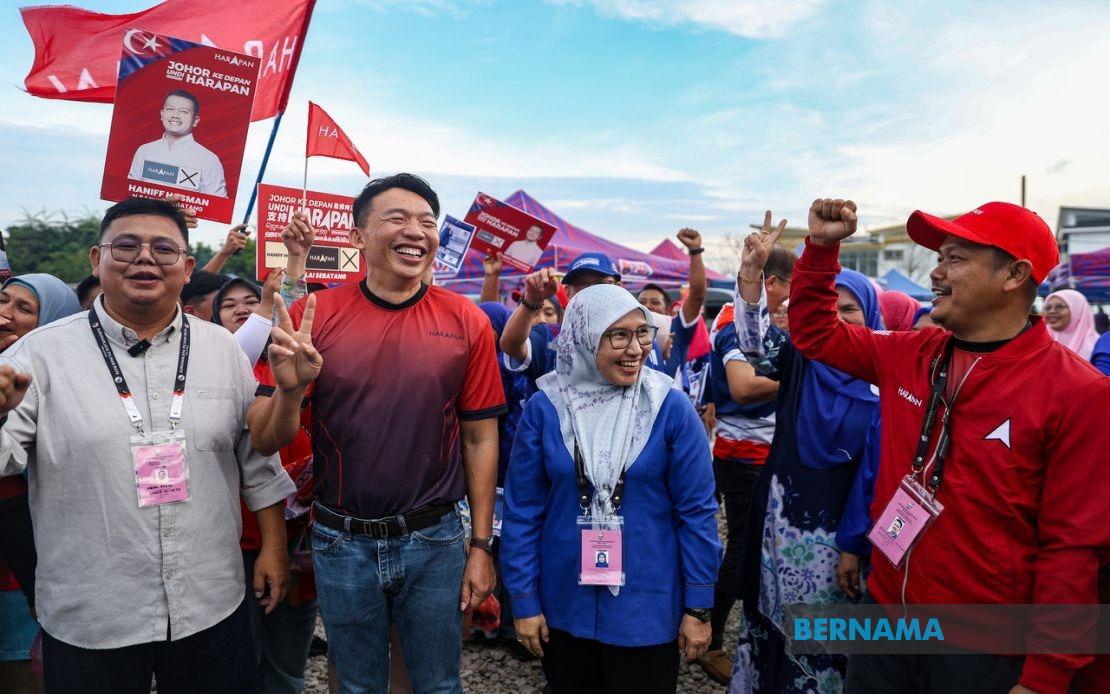
The Johor state election campaign is displaying signs of political civility rarely witnessed in recent Malaysian contests, as demonstrated by a spontaneous encounter between rival candidates at the Taman Megah night market in Pontian on June 29. Three representatives from the Pakatan Harapan coalition—Haniff @ Ghazali Hosman contesting Pulai Sebatang, Abd Razak Ismail in Benut, and Cheah Chee Hong in Kukup—found themselves at the same location as their Barisan Nasional opponent Hasrunizah Hassan, who is running in Pulai Sebatang. Rather than the tense or combative scenarios that sometimes emerge when opposing political teams occupy shared spaces during campaigning, the candidates greeted each other cordially, transforming what might have been an awkward moment into an exchange that impressed observers.
The initial meeting appeared briefly uncomfortable when the two campaign contingents, identifiable by their contrasting red and blue flags, converged at a junction within the bustling night market. However, the candidates quickly moved past the visual symbolism of their opposing coalitions and acknowledged one another with genuine courtesy. The spontaneous nature of the encounter meant it was unscripted and unrehearsed, lending authenticity to the apparent camaraderie displayed. Night market visitors paused in their shopping to observe the scene, seemingly struck by the rarity of witnessing politicians from competing teams interact with civility rather than confrontation. The moment underscored a different tone from what many Malaysian elections have produced in recent years, where campaign periods sometimes generate heated rhetoric and fractious public displays.
When approached by journalists following the encounter, Haniff characterised the meeting as emblematic of Malaysia's democratic health. He stressed that the Pontian campaign has unfolded in a peaceful environment free from disturbances or aggressive conduct. His framing of the incident as a normal part of the electoral process—rather than something unusual or noteworthy—suggests a genuine effort to normalise respectful political competition. The candidate's emphasis on peace and the absence of disruption indicates that campaign organisers across both coalitions have prioritised maintaining civility throughout the polling period. This approach carries particular significance for Johor, a state that has historically been a political battleground where competition between PH and BN has been intense and sometimes personal.
Cheah Hong of the PH campaign expressed pride in campaigning alongside his coalition partners in the three-cornered contest spanning Pulai Sebatang, Benut, and Kukup. His public appeal to voters in these constituencies reflected the standard messaging expected during an active campaign phase. The Kukup candidate's choice to highlight the collegial atmosphere within his own coalition whilst simultaneously remaining respectful toward opponents demonstrates a nuanced approach to modern political competition. Rather than exploiting the night market encounter as a propaganda opportunity, PH appears content to let the incident speak for itself as evidence of democratic maturity.
Hashrunizah Hassan's perspective on the meeting provides valuable insight into how both major coalitions are approaching this particular state election. She normalised encounters between opposing candidates as an expected feature of campaigning, framing them as demonstrations of Johor's democratic sophistication rather than unusual anomalies. Her statement that such moments do not diminish BN's campaign resolve—if anything, they galvanise efforts for Barisan Nasional and Maju Johor—indicates confidence in her coalition's position. Hasrunizah's measured response also suggests that both PH and BN have adopted a strategic decision to avoid inflammatory rhetoric that might undermine the relatively peaceful atmosphere currently prevailing in the state.
The context of the Johor election itself adds significance to this display of political civility. The state has been a traditional BN stronghold, though PH made substantial inroads during the 2022 general election. The upcoming July 11 state poll represents a crucial test of voter sentiment in a critical Malaysian state, with implications extending beyond Johor to national politics. Against this backdrop of significant political stakes, the ability of candidates to maintain respectful engagement suggests both maturity on the part of individual politicians and disciplined campaign management from party leadership.
The night market setting itself carries symbolic weight in the Malaysian political context. Night markets, or pasar malams, remain important social and commercial spaces where diverse communities converge, and they have historically served as accessible venues for politicians to connect with ordinary voters. The willingness of candidates from opposing camps to campaign simultaneously in such spaces—and to do so without generating conflict—demonstrates confidence in their respective messages and perhaps a recognition that voters are increasingly fatigued by divisive political theatre.
The peaceful nature of campaigning in Pontian and the broader Johor campaign environment stands in stark contrast to election periods in some other states or at the federal level, where personal attacks and heated exchanges have occasionally dominated public discourse. This relative tranquility may reflect lessons learned from previous contentious campaigns, or it may indicate a genuine shift in political culture among candidates operating at the state level. The emphasis from both PH and BN representatives on the orderly and peaceful nature of their campaigns suggests this is a conscious strategy rather than coincidence.
The voting timeline adds urgency to the campaign phase now underway. With early voting scheduled for July 7 and polling day on July 11, candidates have limited time to consolidate their messages and mobilise supporters. The friendly encounter at the night market, rather than detracting from campaign efforts, may actually serve both coalitions by presenting an image of responsible, mature political competition to voters weighing their choices. In an era when political polarisation affects many democracies, demonstrations of civility between rivals can carry outsized significance in shaping public perception.
For Malaysian politics more broadly, the conduct displayed in the Johor campaign offers a potential model for how electoral competition can proceed without sacrificing either vigour or decorum. The incident at the Taman Megah night market, whilst modest in itself, represents the kind of everyday political interaction that collectively shapes a nation's democratic health. Whether this tone persists through polling day and influences outcomes will be among the interesting questions emerging from the Johor state election.

