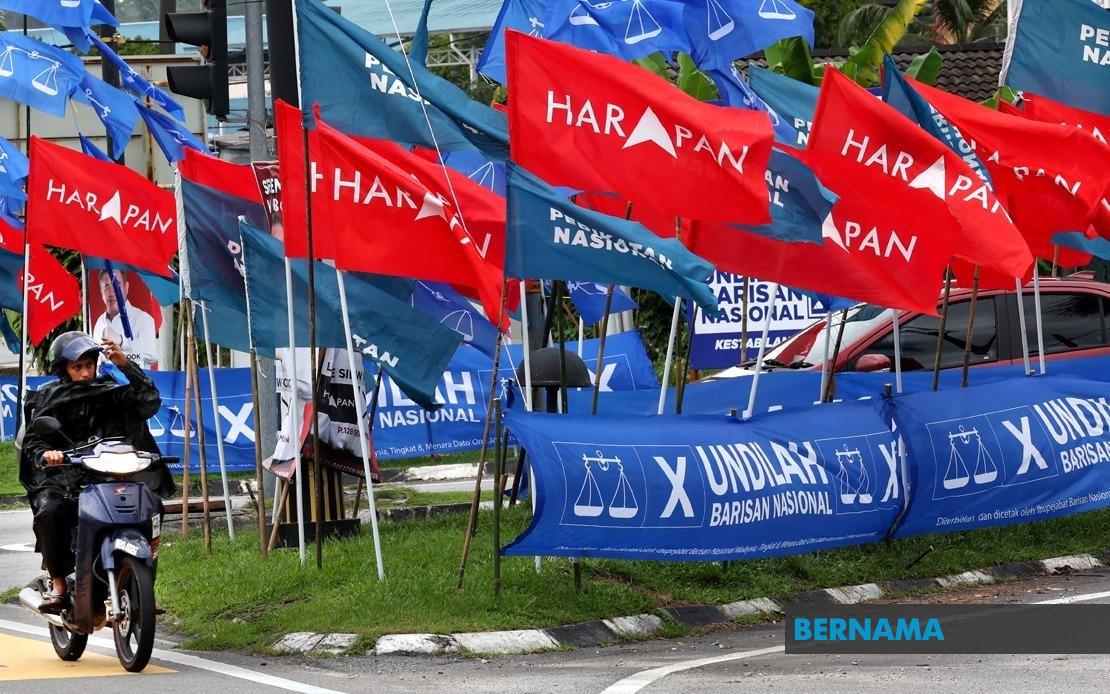
The Johor state election campaign has reached its decisive final chapter, with less than 48 hours remaining before candidates must cease their public appeals to voters. Heading into the closing stretch of the 16th Johor state election, political operatives from Pakatan Harapan, Barisan Nasional, Perikatan Nasional and smaller parties are maximising every remaining moment to secure voter support before polling day on Saturday, when 172 candidates will vie for 56 state assembly seats.
Though the campaign has already stretched across 13 days of intense activity, there is little sign of political fatigue among contesting parties. Instead, the mood has shifted toward heightened urgency. Candidates are broadening their approach beyond traditional large public rallies to include sustained grassroots door-to-door canvassing, targeted community dialogues, and motorcade convoys designed to reach voters in more intimate settings. This diversified ground strategy reflects recognition that undecided voters in Johor may require multiple touchpoints and personalised engagement rather than single mass-gathering moments.
The involvement of national political figures has become instrumental in shaping the campaign's final momentum. Prime Minister Anwar Ibrahim, simultaneously serving as Pakatan Harapan's chairman, is scheduled to campaign at three separate locations on the campaign's final evening, with particular attention directed toward the competitive Puteri Wangsa state constituency. This resource deployment underscores the coalition's strategic assessment of which seats remain genuinely contested. The decision to concentrate leadership firepower on specific constituencies reflects the mathematical reality of Malaysia's state-level contests, where a handful of marginal seats often determine overall electoral outcomes.
Puteri Wangsa has emerged as a focal point in the broader narrative, with PH candidate Maszlee Malik explicitly leveraging social media to drive attendance at what his party is branding as the "Grand Finale Harapan Johor Selatan" rally. His invocation of the fear-of-missing-out phenomenon reveals how contemporary political campaigns now blend traditional messaging with digital-age engagement tactics. The emphasis on attendance itself—beyond merely delivering policy arguments—suggests that campaign organisers understand that the optics of large, energetic crowds reinforce narratives about momentum and inevitable victory.
The Barisan Nasional coalition, seeking to arrest recent electoral losses across Malaysia, has committed comparable resources to its Johor campaign. Coalition chairman Ahmad Zahid Hamidi has personally conducted final campaign sweeps through the Endau and Kempas constituencies, activity designed to energise BN machinery rather than necessarily convert undecided voters at this late stage. Johor's Menteri Besar Onn Hafiz Ghazi, contesting as BN's candidate for Machap, has maintained a visible grassroots presence while leveraging Instagram to broadcast campaign messages directly to younger voters. The "Ziarah Kasih" programme operated by BN's Larkin candidate represents an attempt to reframe electoral competition as humanitarian engagement focused on governance results rather than partisan advantage.
Perikatan Nasional has organised what it describes as a mega rally in Endau featuring its chairman Ahmad Samsuri Mokhtar alongside PAS president Abdul Hadi Awang, demonstrating the coalition's determination to maintain pressure in constituencies where it competes directly against both BN and PH. The Endau constituency has apparently emerged as contested terrain worth significant leadership-level investment from multiple parties. PN's approach reflects its position as a challenger coalition without incumbent state government control in Johor, making visible momentum and grassroots energy strategically important for communicating viability to uncertain voters.
Even candidates facing challenging electoral circumstances have persisted in ground-level engagement through the campaign's final days. Dr A. Ruban, PH's Paloh candidate, briefly paused his campaigning for medical treatment before immediately resuming contact with constituents, a decision he publicised to emphasise commitment to his candidacy despite health setbacks. Such personal narratives, whether communicated through social media or word-of-mouth, contribute to the broader campaign ecology by humanising candidates beyond their policy positions. Johor PKR chairperson Zaliha Mustafa's participation in a 120-motorcyclist convoy for the Kemelah constituency demonstrates how campaigns mobilise party loyalists as both voters and ambassadors, transforming campaign activity into visible demonstrations of party organisation.
Smaller political entities have also intensified operations in the campaign's final phase. Parti Bersama Malaysia has deployed a branded campaign truck across constituencies, providing a mobile platform for candidate visibility and voter interaction. Bersama's strategy of operating smaller group community dialogues, exemplified by Larkin candidate Norsinah Abu's approach, acknowledges that not all voters respond equally to mass rallies. The fragmentation of campaign tactics across different scales and formats reflects sophisticated understanding that electoral persuasion operates through multiple channels simultaneously.
The intensity of final-week campaigning across Johor carries broader significance for Malaysian politics beyond the state election itself. How effectively each coalition mobilises voters in this Johor contest will provide crucial early indicators about national political momentum as Malaysia approaches its eventual general election. The Johor state election functions as a meaningful barometer of voter sentiment, given the state's substantial population, economic importance, and historical role as a swing jurisdiction in Malaysian electoral politics. Results on Saturday will offer both governing and opposition coalitions empirical data about which campaign strategies resonate most effectively and which constituencies remain genuinely contestable.
The saturation-level campaign activity evident in Johor's final hours reflects the competitive intensity now characterising Malaysian electoral politics across all levels. With 56 seats contested and leadership-level investment from all major coalitions, Saturday's polling will determine not merely Johor's state government but potentially reshape the broader balance of forces in Malaysian politics. For voters across the state's 56 constituencies, the volume and diversity of campaign engagement ensures that few remain unexposed to candidate messaging, though whether such exposure translates into voting behaviour aligned with campaign intentions remains the central uncertainty still unresolved.

