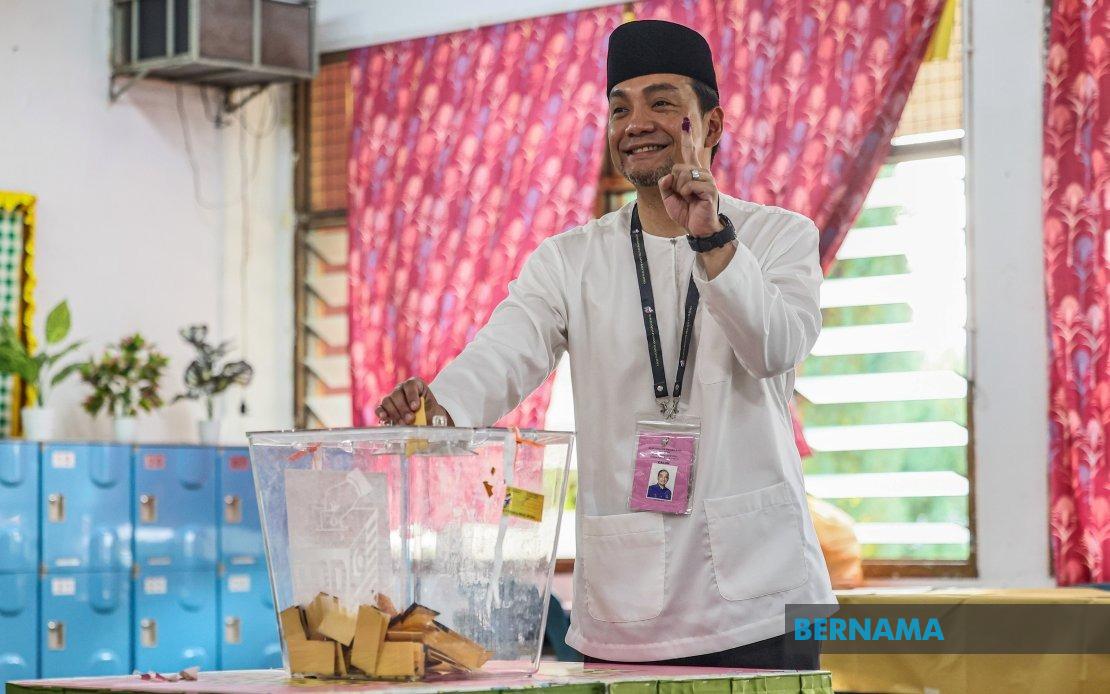
Johor Menteri Besar Datuk Onn Hafiz Ghazi exercised his voting rights on July 11 in the 16th Johor state election, arriving at Sekolah Kebangsaan Simpang Renggam early in the morning at 8.33 am to cast his ballot. The high-profile submission of his vote marked a significant moment in the state's democratic process, with the incumbent leader participating in the electoral exercise that will determine his political future and that of the Johor administration.
Before proceeding to cast his ballot at Stream 4, Onn Hafiz, who also chairs the Johor Barisan Nasional division, spent time engaging with voters gathered at the polling station. His presence and interaction with the electorate underscored the importance placed on personal connection during the election campaign, a strategy increasingly adopted by political leaders across Malaysia seeking to strengthen their standing with the grassroots. The informal mingling offered voters a direct opportunity to observe the incumbent in action and reinforced his campaign messaging of accessibility and civic engagement.
In this electoral contest, Onn Hafiz faces a direct challenge from Nur Hafiz Roslan, the Pakatan Harapan nominee, in what shapes up as a decisive two-way race. The straight fight between the two candidates reflects the bipolar nature of contemporary Malaysian politics, where the dominant coalitions dominate electoral outcomes. For Onn Hafiz, securing a second term would validate his administrative record and provide continuity for Johor's development agenda, while a defeat would signal significant voter discontent with the current administration.
Immediate upon completing his voting obligation, Onn Hafiz addressed the assembled media representatives with a plea for robust voter participation throughout the day. He stressed the importance of citizens fulfilling their democratic duty and called on the public to vote early, framing this participation as essential to maintaining orderly and efficient polling operations. His statement reflected broader election management concerns, as high turnout can strain administrative capacity at individual polling stations while simultaneously indicating strong civic engagement.
Across Johor, other election day activities unfolded with similar momentum. Dr Maszlee Malik, the Pakatan Harapan candidate contesting the Puteri Wangsa state seat, arrived at SJK (C) Tuan Poon in Simpang Renggam at 8.58 am to cast his vote. The former education minister's participation in this election represented another high-profile politician seeking electoral validation, and his candidacy carried particular significance given his previous cabinet experience and profile within opposition circles.
The Puteri Wangsa contest itself presented a complex multi-candidate scenario that illustrated the fragmented nature of Malaysia's contemporary political landscape. Dr Maszlee faced competition from five different directions, including Rashifa Aljunied representing the Malaysian United Democratic Alliance, a newer player in Malaysian politics; Teow Chia Ling from Barisan Nasional; Nicholas Paul Vincent from Parti Bersama Malaysia; and independent contender Wang Wee Siong. This five-way contest meant that winning the seat might require only a plurality rather than majority support, fundamentally altering campaign strategies and voter calculations.
The emergence of MUDA as a competing force in the Puteri Wangsa race demonstrated the broader realignment occurring within Malaysian electoral politics. Established in recent years, MUDA has positioned itself as an alternative to both traditional coalition partners, appealing particularly to younger voters and urban constituencies. Its presence in multiple contests across Johor indicated the party's ambitions to establish itself as a serious contender beyond its initial strongholds, challenging the duopoly long maintained by Barisan Nasional and Pakatan Harapan.
The inclusion of Parti Bersama Malaysia and independent candidates further illustrated the increasingly diversified political marketplace. These alternatives, while individually commanding smaller vote shares, collectively represented voter sentiment that the traditional two-coalition framework might not adequately represent their interests or values. For candidates like Teow Chia Ling seeking to retain seats under the BN banner, this splintering of the opposition vote could either prove advantageous or create risks depending on how support coalesced.
For Malaysian political observers and Southeast Asian analysts following Johor's trajectory, the 16th state election carried implications extending beyond the state's boundaries. Johor remains economically significant and strategically important as a gateway to Singapore and a major component of Malaysia's economic heartland. Electoral outcomes here often foreshadow national political movements, making the state a bellwether for broader trends in voter sentiment and coalition viability. The performance of newer parties like MUDA and the durability of traditional coalitions would provide important signals about the evolving nature of Malaysia's political competition.
The voting procedures observed at polling stations like SK Simpang Renggam and SJK (C) Tuan Poon, including the use of numbered streams to manage voter flow, reflected election management best practices refined through decades of Malaysian electoral experience. Stream 4, where Onn Hafiz voted, suggested sophisticated administrative divisions designed to prevent bottlenecks and maintain security throughout the polling day. Such operational details, while seemingly technical, substantially influenced voter experience and participation rates.
As polling continued throughout July 11 in Johor, the simultaneous voting of high-profile candidates like Onn Hafiz and Dr Maszlee Malik set the tone for a competitive and closely watched election. Their participation and statements to media reinforced the significance both major coalitions attached to Johor's outcome, signalling that resources, political capital, and strategic attention would remain focused on the state throughout the counting process and beyond.

