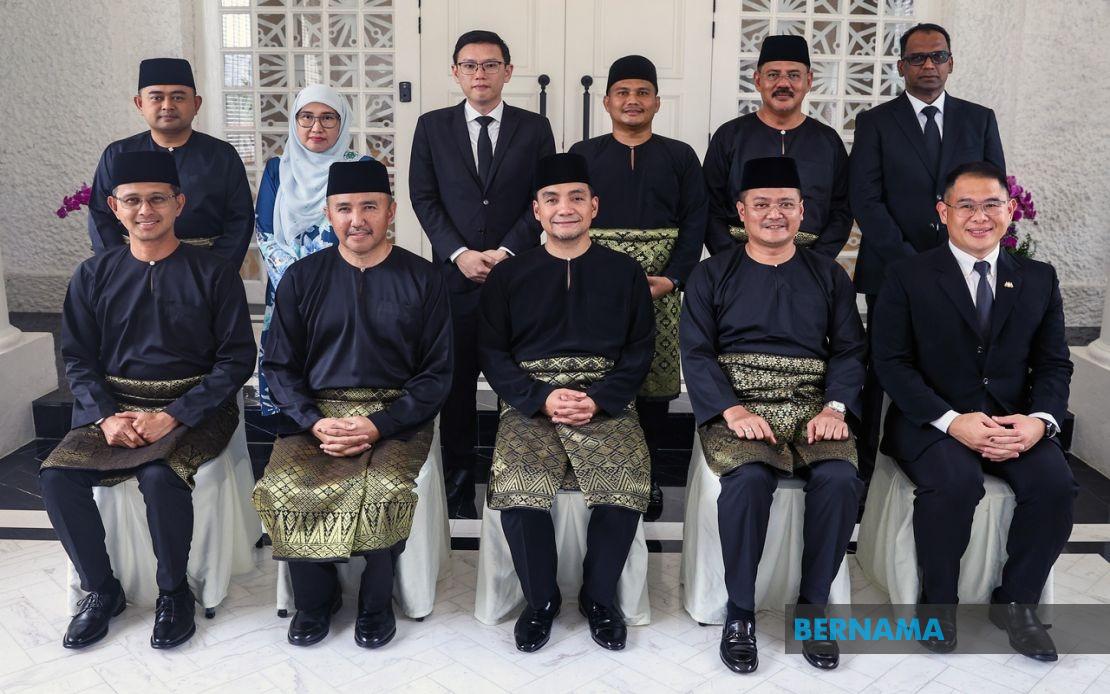
Johor's restructured State Executive Council took office on July 18, with Regent Tunku Mahkota Ismail overseeing the formal swearing-in ceremony at Istana Bukit Serene. The expanded administrative team blends continuity with fresh talent, featuring four incoming exco members alongside six veterans from the previous administration, reflecting the new state government's approach to governance following its recent electoral triumph.
The four new appointees represent different constituencies and bring diverse expertise to the council's operations. Md Israk Abdullah, representing Kukup, has assumed chairmanship of the Agriculture, Agro-Based Industry and Rural Development Committee, positioning him to influence Johor's substantial agricultural sector. P. Pannir Selvam from Perling now leads the Unity, Heritage and Culture Committee, a significant portfolio given Johor's multicultural composition and historical significance. Dr Muhammad Naqib Md Ghazali, elected from Panti, directs the Education and Information Committee, placing him at the centre of the state's knowledge and learning agenda. Hasrunizah Hassan, the Pulai Sebatang representative, heads the Women, Family and Community Development Committee, acknowledging the crucial role of gender-focused policies in contemporary governance.
The retention of six exco members signals continuity in sectoral management during the new administration's tenure. These returning officials maintain their existing committee assignments, allowing proven incumbents to persist with ongoing projects and institutional knowledge. This balancing act between renewal and stability is typical of state governments seeking to build momentum while avoiding administrative disruption. The composition demonstrates that Menteri Besar Onn Hafiz, who secured his second consecutive term with a commanding 15,375-vote majority in Machap, places confidence in both his experienced team and emerging leaders.
The exco appointments arrive in the aftermath of Barisan Nasional's commanding performance in the 16th Johor State Election, where the coalition captured 48 of 56 state seats. This supermajority provides the state government with substantial legislative flexibility and removes any immediate political constraints on policy implementation. Onn Hafiz, serving simultaneously as Johor Barisan Nasional chairman and Menteri Besar, leverages this electoral mandate to shape a cabinet reflecting his administrative priorities. The swearing-in ceremony, conducted formally before the Regent with appointment letters presented in proper ceremonial fashion, underscores the institutional weight of these positions within Johor's governance framework.
The expanded exco structure covers ten distinct portfolio areas, reflecting the complexity of modern state administration. Beyond agriculture, unity, education, and women's development, the council oversees housing and local government, youth and enterprise development, Islamic religious affairs, health and environment, investment and trade, and public infrastructure. This comprehensive division of responsibilities mirrors the breadth of issues Malaysian state governments must address, from economic diversification and investor attraction to social welfare provision and environmental sustainability. Each committee chairperson now shoulders accountability for their assigned domains within Johor's broader development agenda.
From a Malaysian perspective, Johor's administrative reshuffling carries significance beyond the state's boundaries. As the nation's third-largest state by population and a major economic engine anchoring the southern region, Johor's governance trajectory influences broader national discussions about effective administration, interethnic cooperation, and economic management. The council's composition, particularly the inclusion of officials from diverse ethnic backgrounds across multiple portfolios, demonstrates Barisan Nasional's continued emphasis on managing Malaysia's multicultural political landscape through shared representation in executive structures.
The agricultural and rural development portfolio assumes particular importance given global commodity price volatility and climate pressures facing Southeast Asian farming communities. Md Israk Abdullah's appointment to lead this committee positions him to respond to farmer concerns about market access, input costs, and technological adoption—issues increasingly mobilizing rural constituencies across Malaysia. Similarly, Pannir Selvam's cultural heritage responsibilities carry weight in a state where preserving Johor's sultanate legacy and managing diverse cultural institutions remain politically salient. These portfolios transcend routine administration, touching upon identity, livelihood, and community cohesion.
The Education and Information Committee, now under Dr Muhammad Naqib's leadership, holds particular relevance in an era of rapid digital transformation and evolving educational demands. Johor, hosting substantial manufacturing and technology sectors, requires educated workforces capable of supporting industrial evolution. The committee's remit extends beyond schools to encompassing state information governance, media relations, and public communications—functions critical to maintaining administrative transparency and managing the information environment surrounding state policy.
Hasrunizah Hassan's appointment to women and family development reflects evolving recognition of gender-focused governance within Malaysian state administrations. This committee oversees policies affecting maternal health, childcare infrastructure, women's economic participation, and family support services. In Johor, where manufacturing employment has historically drawn substantial female participation, targeted women's development policies can address specific economic and social vulnerabilities. The portfolio also encompasses family welfare initiatives relevant to increasingly diverse household structures and socioeconomic circumstances within modern Johor.
The formal completion of Johor's administrative structure provides clarity for civil servants, investors, and residents regarding decision-making authority across state departments. Government efficiency depends partly on clear lines of responsibility and accountability, which properly constituted exco arrangements facilitate. With portfolios assigned and officials sworn in, the state bureaucracy can now coordinate more effectively on cross-cutting issues requiring inter-departmental collaboration, from infrastructure development engaging public works, trade, and local government, to health and environmental protection initiatives requiring multiple agencies' coordination.
Looking forward, the exco composition will face tests ranging from economic management during commodity cycle volatility to addressing climate-related challenges affecting agriculture and coastal regions. Johor's position as a major manufacturing hub and logistics centre requires consistent policy frameworks attracting investors while managing labour relations and environmental pressures. The council's capacity to deliver on these fronts will shape not only Johor's development trajectory but also broader perceptions of Barisan Nasional's administrative competence heading into future electoral cycles across Malaysia.

