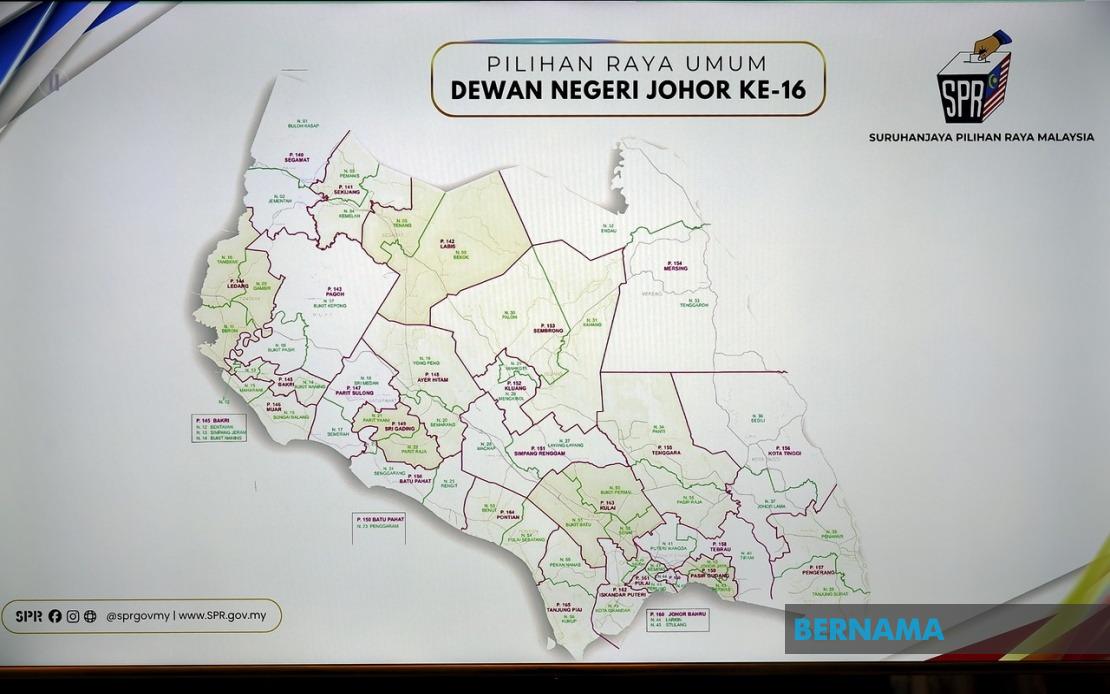
The 16th Johor state election enters its decisive phase tomorrow when nomination day opens the floodgates for a contested battle spanning the entire state assembly. Candidates from multiple political coalitions will formally register their candidacies between 9 am and 10 am at designated registration centres throughout Johor. Once the Election Commission completes its vetting process, the official roster of contenders will be released publicly, crystallising the political landscape for the campaign period ahead. The actual election will take place on July 11, with voters given the opportunity to cast ballots early on July 7 if they cannot participate on polling day.
Electoral authorities have prepared for substantial participation. The Election Commission has identified 2,727,926 eligible voters across the state, a figure that encompasses just over 2.7 million ordinary electors plus 12,041 military personnel and their spouses alongside 12,710 police officers and their families. This voter register represents the foundation upon which tomorrow's nominations will build, as candidates and parties seek to mobilise support across the sprawling state.
Pakatan Harapan has committed to contesting every available seat, deploying 56 candidates distributed among its three constituent parties. Parti Keadilan Rakyat contributes 20 nominees, Amanah fields 19, and the Democratic Action Party brings 17 candidates to the field. This comprehensive approach signals the coalition's confidence and determination to capitalise on any gains from their previous electoral performance in 2022. The strategy of fielding a complete slate across all constituencies reflects both ambition and an effort to present voters with genuine choice in every locality.
Barisan Nasional has matched this comprehensive approach with its own full slate of 56 candidates. The coalition distributes these nominees across its components, with the United Malays National Organisation providing 36 candidates, the Malaysian Chinese Association contributing 16, and the Malaysian Indian Congress fielding four. This composition underscores the continuing dominance of UMNO within the broader BN framework while maintaining token representation for its minority-focused partners. BN's performance in the previous 2022 election, when it secured 40 seats, provides a substantial foundation upon which the coalition seeks to build or maintain its advantage.
Perikatan Nasional presents a three-way combination of candidates. The Pan-Malaysian Islamic Party will contest 11 seats, Bersatu will field 16 candidates, and the Malaysian Indian People's Party will participate in five constituencies. This distribution reflects the junior positioning of MIPP within PN's hierarchy compared to the more established PAS and Bersatu. The coalition's 2022 showing of just three seats demonstrates that PN faces an uphill struggle to significantly expand its foothold in Johor, though the inclusion of Bersatu candidates suggests internal recalibration of the coalition's strength.
Several smaller entities will also participate in the election. The Malaysian United Democratic Alliance, which captured one seat in 2022, will contest four constituencies this time, potentially signalling greater ambition or strategic shifts in its targeting. The Socialist Party of Malaysia will field a single candidate, maintaining a minimal but principled presence in the electoral contest. Parti Bersama Malaysia, making what election officials describe as its debut in Johor state elections, will contest 15 seats, representing a significant entry by a new political force into the state's electoral arithmetic.
The Election Commission has issued guidance to prospective candidates to verify their nomination documents in advance at either the Returning Officer's Office or the State Election Office. This proactive measure aims to eliminate last-minute administrative complications that could invalidate candidacies or delay proceedings. Additionally, the commission has advised candidates to settle deposit payments promptly and retain receipts as evidence when submitting their formal nomination papers, streamlining the administrative process during the necessarily compressed timeframe of nomination day itself.
Anti-corruption and election integrity remains a focal concern as the campaign season approaches. The Malaysian Anti-Corruption Commission has distributed explicit warnings to all participating candidates and political parties, cautioning them against conduct that violates either the MACC Act 2009 or the Election Offences Act 1954 as amended in 2012. The warnings carry substance, as violators face serious legal consequences during and after the election period. To enforce these standards, the MACC has operationalised five dedicated 24-hour operations rooms positioned strategically across Tampoi, Batu Pahat, Kluang, Segamat and Mersing, creating infrastructure through which citizens can report suspected corruption or abuse of authority throughout the election cycle.
The path to nomination day itself followed the dissolution of the Johor State Legislative Assembly on June 1, a constitutional step that initiated the formal election machinery. The preceding 2022 state election established the baseline from which tomorrow's contest will proceed. In that election, Barisan Nasional dominated with 40 seats, Pakatan Harapan secured 12, Perikatan Nasional claimed three, and the Malaysian United Democratic Alliance captured one seat, leaving no seat unaccounted for across the 56-member chamber. This distribution demonstrated BN's commanding position but also suggested some fragmentation of opposition support and opportunities for coalition reconfiguration.
The 2022 results carry significant implications for the upcoming election. Barisan Nasional's substantial majority meant that the coalition enjoyed relatively comfortable governance, though not overwhelming dominance that would protect against determined opposition mobilisation. For Pakatan Harapan, the 12-seat outcome represented respectable opposition strength but reflected the coalition's difficulty in penetrating Johor's more conservative electoral heartland. The minimal PN presence at three seats, despite the coalition's national relevance, highlighted Johor's resistance to the coalition's brand of politics. Tomorrow's nomination day will establish which parties and candidates seek to alter this distribution and through what strategies they intend to reshape Johor's electoral map.

