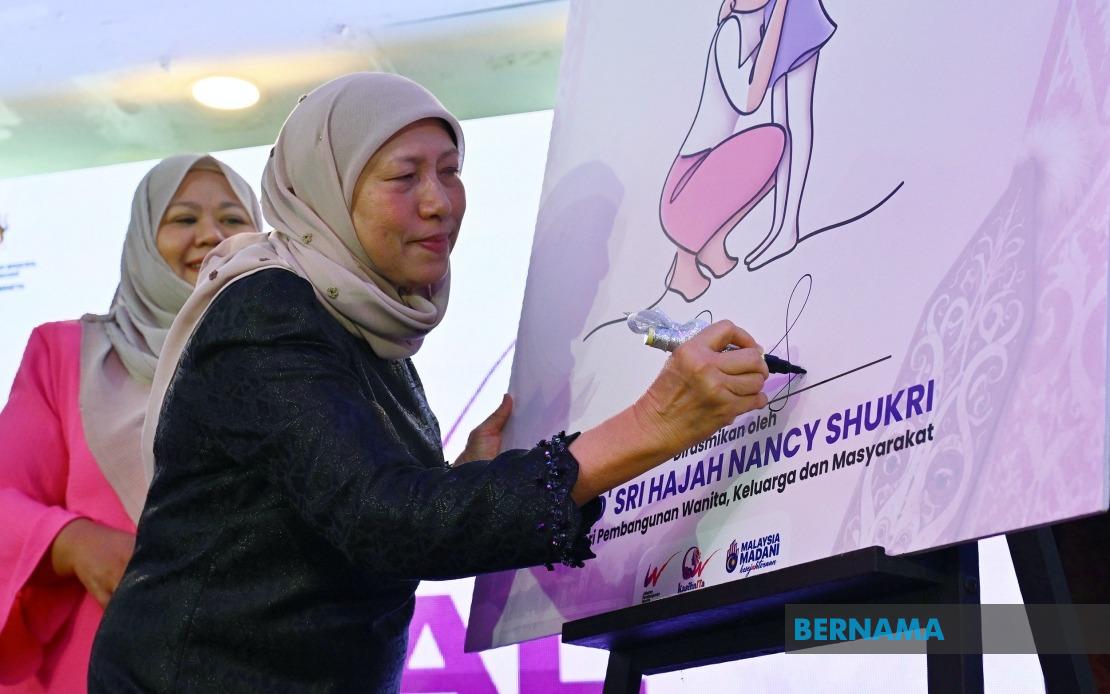
The Ministry of Women, Family and Community Development (KPWKM) has brought its Single Mothers Support programme, KasihnIta, to Sarawak as part of a staged national rollout aimed at providing comprehensive assistance to single mothers across Malaysia. Datuk Seri Nancy Shukri, the minister overseeing the initiative, formally launched the Sarawak component of the KasihnITa 2026 programme, marking the second state to receive the full-scale intervention after Selangor. The expansion reflects growing recognition that single mothers, a demographic facing distinct economic and social vulnerabilities, require coordinated support from multiple government touchpoints rather than fragmented assistance.
The KasihnITa framework operates by convening representatives from various government institutions under one platform to ensure single mothers receive holistic guidance. This integrated approach draws on the expertise of the Credit Counselling and Debt Management Agency (AKPK), Bank Negara Malaysia, the Legal Aid Department, and the Syariah Judiciary Department. Rather than directing participants to seek help from multiple offices over weeks or months, the programme consolidates these resources, allowing single mothers to access financial literacy, debt management counselling, and legal information during concentrated engagement sessions. The inclusion of Bank Negara Malaysia signals particular emphasis on financial capability, recognising that many single-income households face cash flow constraints and limited knowledge of banking products suited to their circumstances.
A critical dimension of the Sarawak launch involved financial management education tailored to household budgeting realities. Single mothers often juggle competing financial obligations—childcare costs, education fees, housing, medical expenses—with limited household income. The programme equips participants with practical frameworks for prioritising expenditure, building emergency reserves, and accessing formal credit responsibly rather than relying on informal lending channels that can perpetuate debt cycles. This pedagogical focus addresses a root cause of financial instability rather than treating symptoms through temporary cash transfers alone, aligning with broader policy trends toward financial inclusion and capability-building across Southeast Asia.
Child maintenance enforcement emerged as another key pillar highlighted during the Sarawak rollout. Datuk Seri Nancy noted that many single mothers face practical and legal barriers when ex-partners fail to honour court-ordered maintenance payments, effectively pushing custodial parents and children into economic precarity. By embedding legal advisors from the Legal Aid Department and Syariah Judiciary Department within the KasihnITa programme, KPWKM reduces barriers to accessing justice machinery. Single mothers learn their rights, understand enforcement mechanisms, and receive guidance on pursuing claims without bearing prohibitive legal costs—a crucial safeguard for a cohort that typically lacks disposable income for private legal counsel.
The inaugural Sarawak gathering drew approximately 130 participants across a three-day format, providing sufficient duration for participants to digest complex information spanning financial planning, legal procedures, and welfare entitlements. This scale suggests KPWKM is piloting a replicable model: intensive, multi-agency engagement sessions that can be adapted to different state contexts and community sizes. Sarawak's geographic dispersal and mixed urban-rural composition make it a meaningful test case for whether the KasihnITa model functions effectively across diverse settlement patterns and economic contexts within Malaysia.
Beyond immediate service delivery, KPWKM has explicitly framed KasihnITa as a feedback mechanism for policy refinement. Datuk Seri Nancy stated that the ministry intends to harness participant input to inform future policy design, ensuring that government support genuinely reflects the lived experiences and priorities of single mothers rather than reflecting bureaucratic assumptions. This consultation imperative is significant: too often, social programmes are designed through top-down processes without sustained engagement with beneficiary communities. By institutionalising feedback loops within KasihnITa, KPWKM signals commitment to responsive, evidence-informed policymaking—a principle increasingly important as Southeast Asian governments grapple with ensuring welfare systems remain relevant amid rapid socioeconomic change.
The psychological and social dimensions of the programme merit particular attention. Datuk Seri Nancy emphasised that KasihnITa provides space for single mothers to share experiences and build mutual support networks. Single motherhood, though increasingly common across Malaysia, remains socially stigmatised in some communities, potentially isolating individuals from information and peer support. Structured peer engagement within a government-endorsed programme can mitigate isolation, normalise challenges as shared rather than personal failings, and create informal knowledge networks where participants exchange experiences navigating schools, employers, and welfare bureaucracies. These social benefits often prove as valuable as formal assistance.
The thematic framing of leaving no woman behind in Malaysia's development agenda reflects broader political commitments to inclusive growth articulated across Southeast Asia. Single mothers represent a subset of the population with disproportionate poverty risk and constrained economic mobility. Supporting this group through financial capability, legal access, and welfare coordination directly addresses inequality and enables human capital development within affected households, benefiting children's educational outcomes and long-term earning potential. From a macroeconomic perspective, policies enabling single mothers' economic participation expand the effective labour supply and productive capacity of the economy.
Looking forward, the KasihnITa model's success in Sarawak will likely influence expansion timelines to other states. Peninsular Malaysia and Labuan remain outside the current rollout, and resource constraints may necessitate phased geographic expansion. Questions persist regarding sustainability: whether KPWKM possesses sufficient funding to maintain regular KasihnITa sessions, how the programme adapts to rural areas with sparse government agency presence, and whether participants experience tangible improvements in financial security, legal outcomes, and household wellbeing months after engagement. Evaluation mechanisms measuring long-term impact would strengthen the programme's evidence base and inform scaling decisions. Additionally, coordination with state-level women and family agencies, as well as non-governmental organisations already serving single mothers, will be essential to avoid duplication and maximise reach.
The Sarawak launch demonstrates Malaysia's institutional capacity to mobilise multiple government agencies toward a cohesive social support objective. Whether this coordination extends beyond the KasihnITa initiative—to other vulnerable populations or policy domains—remains to be seen. Nonetheless, the programme exemplifies a policy approach increasingly prevalent in the region: recognising that complex social challenges require integrated responses spanning financial services, legal systems, and welfare administration, and that beneficiary engagement in programme design enhances legitimacy and effectiveness.

