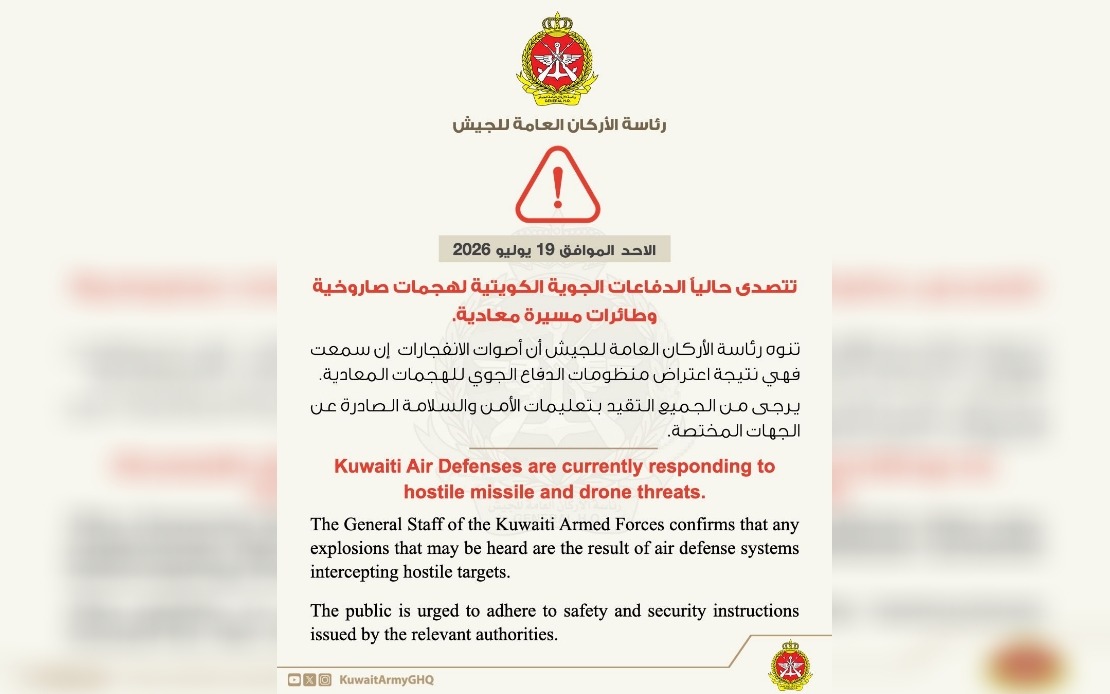
Kuwait has found itself on the frontline of intensifying US-Iran hostilities, with its military now engaged in active air defence operations against incoming missiles and unmanned aircraft. In a statement released Sunday, the Kuwaiti armed forces acknowledged that hostile projectiles and drones were being targeted by the nation's air defence systems, asking residents to disregard loud explosions they might hear as merely the consequence of intercepting these threats. The announcement underscores how the small Gulf state has become an unwilling participant in a broader regional conflict between Washington and Tehran, with the potential for civilian disruption and safety concerns mounting as the confrontation deepens.
The current crisis represents an escalation of tensions that have simmered throughout the summer. For approximately one week prior to Kuwait's statement, the United States had conducted repeated military strikes against targets within Iranian territory, prompting swift retaliation from Tehran. Iran, in turn, has targeted various facilities and military installations that it claims are operated or utilised by American forces across multiple countries in the Middle East—with Kuwait standing as a prominent location housing significant US military presence and infrastructure.
This tit-for-tat pattern of attacks demonstrates how quickly regional stability can deteriorate when both superpowers adopt increasingly aggressive postures. The cycle of strikes and counter-strikes reflects the absence of effective diplomatic channels and the breakdown of earlier negotiation attempts. What began as localised incidents has evolved into a sustained campaign of cross-border military action that threatens to destabilise the entire Gulf region.
Particularly noteworthy is the apparent futility of recent diplomatic efforts aimed at de-escalation. In June, Pakistan had brokered a memorandum of understanding between Washington and Tehran—an agreement explicitly designed to halt their hostilities and establish the foundation for lasting peace. Yet barely a month later, both parties have abandoned any pretence of honouring these commitments, resuming their military operations with renewed intensity. The rapid deterioration suggests fundamental incompatibilities in their strategic objectives that cannot be bridged through simple agreements without robust verification mechanisms and enforcement provisions.
For Malaysia and other Southeast Asian nations monitoring regional developments, the Kuwait situation carries important implications. The Gulf region remains economically vital to the broader Indo-Pacific, with massive volumes of oil and liquefied natural gas flowing through its waterways to Asian markets. Prolonged instability threatens energy security across the region and could drive up commodity prices affecting everything from electricity costs to manufacturing expenses. Malaysian policymakers and business leaders would be prudent to consider contingency plans should the conflict expand or disrupt maritime shipping lanes critical to Asian trade.
Kuwait's predicament also illustrates the vulnerability of smaller nations caught between competing great powers. Despite hosting substantial American military personnel and installations, Kuwait lacks the independent capacity to defend itself against sophisticated Iranian weaponry. The nation must rely on US air defence capabilities while simultaneously managing its own civilian security concerns. This dependency reflects a broader pattern in Gulf geopolitics where smaller states trade sovereignty for security guarantees they cannot independently provide.
The pattern of Iranian responses suggests Tehran views attacks on US facilities in allied countries as legitimate targets in its broader conflict with Washington. By striking at American military infrastructure based in Kuwait, Iraq, and other regional allies, Iran effectively extends the theatre of conflict and implicates these nations in a war they may not have chosen. This approach carries risks of widening the conflict beyond bilateral US-Iran tensions into a full regional conflagration involving multiple state and non-state actors.
Civilian populations in Kuwait face the immediate consequence of these military operations. Air defence systems, while necessary for protection, create noise and potential collateral risks. Residents following emergency instructions indicates a civilian population being asked to accommodate military operations within their living spaces—a reality that normalises the presence of warfare in everyday life and highlights the human cost of geopolitical confrontation.
The failure of the Pakistan-brokered memorandum raises questions about the utility of diplomatic initiatives without adequate enforcement mechanisms or commitments from both sides to restrain escalatory actions. Pakistan's role as mediator, meanwhile, underscores the importance some regional powers place on preventing wider Gulf instability, yet also demonstrates the limits of Pakistani leverage in influencing American or Iranian decision-making at moments of heightened tension.
Looking ahead, the trajectory of US-Iran conflict will significantly influence regional stability and global energy markets. Should the current pattern of strikes and counter-strikes persist or intensify, it could trigger broader regional involvement, with various state and non-state actors drawn into the confrontation. Kuwait, sitting at the intersection of these competing interests, faces the uncomfortable reality of being both a critical American ally and a geographically vulnerable neighbour to Iran. Its ability to maintain this balancing act while protecting its citizens will test the nation's diplomatic skills and military readiness in ways few anticipated just months ago.

