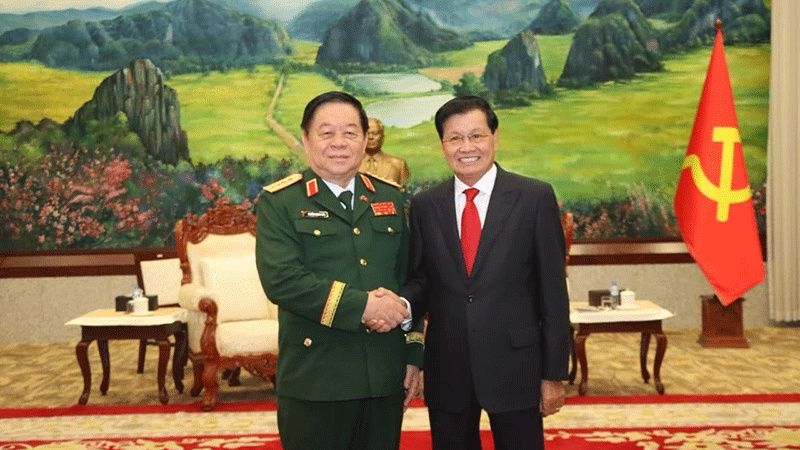
The leadership of Laos and Vietnam have moved to further cement their military partnership through a series of official engagements that underscore the two countries' deepening defence relationship. During an August 5–7 visit to Vientiane, General Nguyen Trong Nghia, Chairman of the General Department of Politics of the Vietnam People's Army, held discussions with senior Lao officials that resulted in commitments to expand practical cooperation across multiple defence and security domains. The visit represented a significant diplomatic moment for the two neighbouring nations, with Lao President Thongloun Sisoulith, who also leads the Lao People's Revolutionary Party, using the occasion to publicly affirm the value placed on the strengthening ties.
President Thongloun's characterisation of the visit as "another step in deepening the great friendship, special solidarity, comprehensive cooperation and strategic cohesion" reflects the language consistently employed by both governments when discussing their relationship—a pattern that reveals the intentionality behind their bilateral engagement. The Lao leader warmly received the Vietnamese delegation and explicitly praised the successful outcome of talks between the General Departments of Politics of both militaries, suggesting that the discussions produced substantive agreements rather than merely ceremonial exchanges. This emphasis on concrete outcomes signals that the two defence establishments have identified specific areas where cooperation can be expanded and deepened in practical terms.
The scope of the agreements reached during General Nghia's visit encompasses several pillars of military cooperation that reflect the modern security landscape facing both nations. Political education emerged as a distinct focus area, indicating an interest in aligning ideological messaging and ensuring uniformity in how both parties' militaries understand their strategic missions. Military exchanges—ranging from officer training programmes to joint exercises—will provide opportunities for personnel from both countries to work together and build institutional relationships that transcend individual postings. The emphasis on border management cooperation holds particular significance for Southeast Asia, given that effective land border administration is crucial for preventing smuggling, human trafficking, and unauthorised cross-border movement that could destabilise either state.
Personnel training constitutes another major plank of the expanded partnership, with both nations committing to develop younger military generations with a deep understanding of Lao-Vietnamese historical ties. This generational approach suggests that both governments view their defence alliance not merely as a contemporary necessity but as a relationship requiring ongoing cultural and institutional reinforcement. By ensuring that emerging military officers and enlisted personnel understand the historical foundations of the alliance, both countries aim to create multiple cohorts of defence professionals invested in maintaining strong bilateral relations. Such long-term human capital development can prove more durable than any single treaty or agreement.
General Nguyen Trong Nghia's courtesy calls on both President Thongloun and Lao Deputy Prime Minister and Minister of National Defence, General Khamlieng Outhakaisone, followed a structured protocol that highlighted the diplomatic importance accorded to the visit. The General's subsequent detailed discussions with Lieutenant General Vongsone Inpanphim, Deputy Minister of National Defence and Director General of the General Department of Politics of the Lao People's Army, allowed for more technical exchanges on defence matters. This layered approach to high-level engagement—mixing presidential-level courtesy visits with working-level military discussions—maximises both the symbolic value and substantive content of the visit.
The reaffirmation by both Vietnamese and Lao officials that defence cooperation represents a "key pillar of the Laos-Vietnam comprehensive strategic partnership" places military alignment at the centre of the bilateral relationship rather than positioning it as a secondary concern. This framing carries implications for how both nations approach regional security matters and their alignment on issues ranging from territorial integrity to responses to external powers' presence in Southeast Asia. The language of "strategic cohesion" further suggests that the two countries are working towards coordinated positions on matters affecting their respective and collective interests.
For Malaysia and other Southeast Asian nations, the strengthening of Lao-Vietnamese military ties represents an important regional development with several implications. The consolidation of defence cooperation between these two nations occurs within the broader context of great power competition in Southeast Asia, where traditional alliances and strategic partnerships take on heightened significance. The Laos-Vietnam relationship, rooted in decades of close party-to-party and state-to-state relations, reflects the kind of enduring alignment that can shape how different regional actors respond to transnational challenges and security dilemmas.
The emphasis both countries place on honouring historical bonds and "special solidarity" indicates that this is not a relationship of convenience but one anchored in shared historical experience and ideological alignment. For Malaysian policymakers and regional analysts, understanding the depth and nature of such partnerships provides valuable insight into how regional coalitions form and how neighbouring states navigate their relationships within the broader structure of Southeast Asian geopolitics. The commitment to border management cooperation between Laos and Vietnam also offers lessons for other pairs of nations grappling with cross-border security challenges.
Looking forward, the expanded defence cooperation framework established through General Nghia's visit is likely to manifest in increased military exercises, officer exchange programmes, and coordinated approaches to regional security matters. The visit underscores a pattern whereby Vietnam continues to cultivate its strategic partnerships with neighbouring Laos, a relationship that carries both historical weight and contemporary strategic value. For regional observers, the consistent reaffirmation of these ties serves as a reminder that while Southeast Asia contains considerable diversity in its international alignments, certain partnerships have proven remarkably durable across decades of political and economic change.

