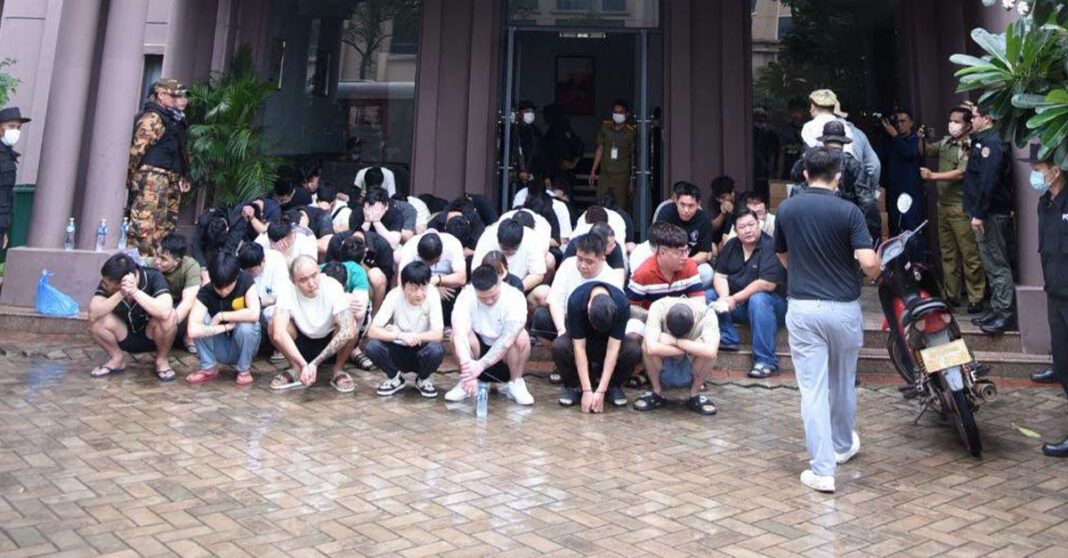
Laotian police have dealt a significant blow to a sprawling international fraud network with a major enforcement action at Vientiane's Thatluang Lake Special Economic Zone. The 8 August operation targeted a sophisticated telecommunications fraud and online gambling setup, resulting in the detention of 261 suspects representing seven different nationalities. The scale of the operation underscores how Southeast Asia's porous borders and economic zones have become attractive bases for organised scamming operations that prey on victims across the region and beyond.
The arrested suspects reveal the multinational character of modern cybercrime networks. Chinese nationals dominated the detainee roster with 153 individuals, suggesting either operational leadership or significant involvement in the technical infrastructure. Vietnamese citizens constituted the second-largest contingent at 61 people, followed by 36 Thai nationals. Smaller numbers included five Taiwanese, two Malaysians, two South Koreans and two Myanmar nationals. This ethnic and national composition indicates that such operations typically involve coordinated criminal enterprises drawing talent and manpower from multiple countries, often with distinct roles assigned based on nationality and expertise.
The physical infrastructure seized during the raid demonstrates the industrial scale of these scamming enterprises. Police confiscated nearly 500 desktop computers and laptops alongside 2,355 mobile phones, quantities that suggest multiple shifts of operators simultaneously running fraudulent schemes. Such equipment caches point to high-volume operations targeting numerous victims across borders simultaneously, likely managing thousands of fake accounts and fabricated personas. The sheer technological footprint illustrates why such networks require substantial capital investment and coordination, placing them beyond the reach of amateur criminals and firmly in the realm of organised crime syndicates.
Authorities identified the building as property belonging to Lao Thatluang Investment Development Co., Ltd., raising questions about how corporate entities in special economic zones can be appropriated for criminal purposes. The nominal company ownership may represent either a front structure intentionally created for illicit operations or a legitimate business compromised and exploited by criminal networks. Such ambiguity frequently complicates investigations, as determining culpability requires establishing whether company principals knowingly collaborated with scammers or were themselves victims of infiltration by criminal elements seeking to exploit their business registration and economic zone status.
The Vientiane operation represents only one component of a broader enforcement campaign that has accelerated across Laos in recent months. Authorities have signalled their commitment to dismantling scam networks through systematic operations conducted with speed and coordination. The concentration of such facilities within special economic zones, areas traditionally designed to attract legitimate foreign investment, highlights how these zones have become inadvertent sanctuaries for criminal enterprise when regulatory oversight proves insufficient. For Malaysia and other Southeast Asian nations whose citizens increasingly fall victim to scams originating from such bases, the Laotian crackdown offers modest reassurance that neighbouring authorities recognise the problem's severity.
Compounding the initial detention was a coordinated deportation operation that underscored regional cooperation against fraud networks. On 10 August, just two days following the Thatluang Lake raid, Laotian authorities transferred 41 Thai suspects to Thai custody via the 1st Lao-Thai Friendship Bridge. This deportation followed an earlier handover of 32 Thai nationals on 6 August through the same crossing, bringing the total number of Thai citizens deported to at least 73. The speed and efficiency of these transfers suggest developing protocols between Laotian and Thai authorities to expedite repatriation of suspected scammers, though questions remain about whether Thailand possesses adequate capacity to prosecute all returned suspects effectively.
The deportations trace back to an earlier enforcement action conducted on 18 July targeting the ST Vegas complex in Dongphosy village, Hatsayfong district, Vientiane. That operation had netted 589 suspected scammers, predominantly Thai nationals but also including Lao, Vietnamese and Cambodian individuals. The ST Vegas operation dwarfs the Thatluang Lake raid in total detainee numbers, suggesting that the visible enforcement actions may represent merely the surface of much larger criminal infrastructure remaining undetected or unaddressed. The concentration of such facilities within Vientiane itself indicates that the capital has become a regional hub for organised scamming, a concerning development given the city's accessibility to criminals across Southeast Asia.
For Malaysian readers, these developments carry particular relevance. Malaysian citizens periodically appear among arrested scammers in regional busts, suggesting that a subset of Malaysian nationals participates in these operations either as technical specialists, money handlers or recruitment operatives. More significantly, Malaysians constitute a substantial victim population for scams originating from Laotian bases, targeted through romance fraud schemes, investment frauds and job recruitment hoaxes. The Laotian crackdown, if sustained and deepened, could reduce the operational capacity of networks that specifically target Malaysian victims, though scammers typically prove highly adaptive and may simply migrate operations to alternative jurisdictions.
The broader context reveals how special economic zones across Southeast Asia, intended as engines of legitimate development, have attracted criminal exploitation when host governments lack enforcement capacity or willingness. Laos's decision to conduct these operations suggests growing political pressure domestically and internationally to address scamming networks that damage the nation's international reputation and destabilise regional security. However, enforcement alone proves insufficient without corresponding efforts to dismantle the financial infrastructure enabling these operations—the money laundering networks, cryptocurrency exchanges and remittance channels that convert scam proceeds into usable capital and facilitate criminal profit repatriation.

