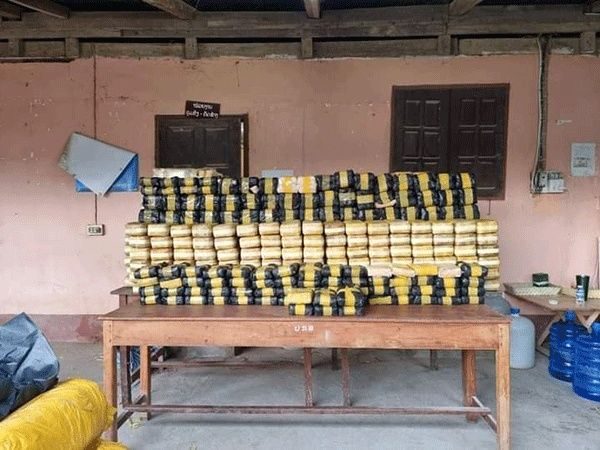
Xaysomboun province in central Laos is confronting a serious drug crisis that has emerged as its primary law enforcement challenge, with narcotics-related crimes dominating the provincial crime landscape during the opening months of 2024. Of the 54 criminal cases documented by the Xaysomboun Provincial Public Security Force between January and June, drug offences constituted 24 incidents—representing 43.7 percent of total recorded crime. This striking concentration underscores how thoroughly substance trafficking has penetrated local communities and infiltrated criminal networks operating within the province, making it a considerably more prevalent threat than traditional property crimes or violence.
The numerical snapshot reveals significant workload pressures on provincial law enforcement. Among the two dozen drug cases handled, only two have been resolved and transferred to prosecutors for potential charges, leaving the vast majority—22 cases—still in investigative limbo. This backlog illustrates both the complexity of narcotics investigations and potential resource constraints affecting the security apparatus. When examining the broader criminal docket, police have similarly struggled to close cases efficiently: across all 54 incidents, they managed to settle six, conclude four for prosecution, and successfully resolve 15 others, while 29 remain pending. The accumulated case load suggests that Xaysomboun's security infrastructure may be stretched across multiple fronts simultaneously.
Police Brigadier General Ouday Insouvanh, commanding the provincial force, presented these figures during discussions with Police Lieutenant General Vanthong Kongmany, the national Minister of Public Security who conducted an inspection on August 7. The briefing articulated efforts to preserve political stability and maintain social order throughout the six-month period, emphasizing intelligence gathering and situational monitoring to support the broader security apparatus. However, the minister's response indicated dissatisfaction with the current trajectory and signalled expectations for intensified action. Lieutenant General Vanthong directed the provincial command to escalate operations against drug trafficking specifically and to prioritize emerging drug variants that pose particular dangers to communities.
The focus on narcotics enforcement aligns with a sustained national commitment formalized five years ago when the Laotian government designated drug suppression as a core policy objective. Prime Minister Sonexay Siphandone reported to the National Assembly last month that authorities nationwide had processed 1,786 drug-related cases during the same six-month window, resulting in 4,025 arrests including 93 foreign nationals. Confiscated assets encompassed substantial drug quantities and associated paraphernalia alongside vehicles implicated in trafficking operations. Xaysomboun's situation therefore reflects broader struggles occurring across multiple provinces, though the 44 percent concentration in this single jurisdiction suggests particularly acute challenges in this region.
Beyond traditional narcotics enforcement, the ministerial guidance expanded the security agenda considerably. Lieutenant General Vanthong instructed local commanders to strengthen oversight of social media platforms and address cybercrime threats, designating these digital security concerns as priorities alongside smuggling, human trafficking, theft, and burglary. This directive reflects evolving criminal methodologies that exploit online channels for coordination, recruitment, and commerce—including drug distribution networks that increasingly leverage encrypted messaging and cryptocurrency. The integration of cybercrime into provincial security protocols acknowledges the contemporary reality that criminal enterprises operate simultaneously across physical and digital domains.
Transportation safety emerged as another significant concern during the ministerial visit. Throughout the first half of 2024, Xaysomboun province recorded 60 traffic accidents resulting in four fatalities and 80 injuries, with material damages to 109 vehicles totalling approximately 2.56 billion kip. These figures translate to tangible human suffering—deaths in communities, injuries affecting families' economic productivity, and substantial financial losses. The roadway toll demonstrates how security challenges extend beyond conventional criminality into public health and economic dimensions that warrant integrated policy responses.
Immigration and foreign national management constituted another focus area, reflecting Laos's status as an increasingly visited destination for international tourism. Provincial security personnel conducted inspections of 1,698 tourist arrivals during the six-month period, identifying 396 foreign nationals among them. This monitoring function serves multiple purposes: verifying compliance with visa regulations, identifying potential security threats, and collecting intelligence on transnational criminal networks or human trafficking operations that frequently involve foreign participants. The scale of tourism flows through even a central provincial checkpoint underscores Laos's growing integration into regional travel markets.
The ministerial guidance emphasized not merely tactical enforcement adjustments but also institutional and personnel management considerations. Lieutenant General Vanthong directed provincial commanders to strengthen political and ideological education among officers, reinforce adherence to Party policies and state legislation, and enhance disciplinary compliance within the security forces. He advocated for leadership approaches responsive to evolving conditions and stressed that personnel must acknowledge operational limitations rather than passively awaiting instructions. This developmental emphasis suggests concerns about institutional capacity, officer initiative, and alignment with central government directives across provincial commands.
Professionalization emerged as a recurring theme, particularly regarding immigration administration and foreign national management. The minister emphasized assigning responsibilities transparently, deploying personnel according to expertise levels, and ensuring investigations and detention procedures conform to legal frameworks. These prescriptions indicate potential concerns about irregular practices or discretionary enforcement patterns that might undermine rule-of-law principles. Similarly, rehabilitation operations must adhere strictly to established procedures, and the provincial command should maintain readiness to confront emerging security challenges through sustained preparedness.
For Malaysian observers, Xaysomboun's experiences carry important implications. As a regional neighbour sharing borders with Thailand and Vietnam, Laos occupies a critical geographic position within Southeast Asia's narcotics transit corridors. Drug trafficking networks operating through central Laotian provinces inevitably intersect with Malaysian concerns, particularly methamphetamine production and distribution chains that extend throughout the region. Enhanced enforcement in Xaysomboun signals evolving operational capacity in supply-chain disruption, though the significant case backlog and investigative delays suggest that institutional constraints may limit effectiveness.
The expansion of cybercrime awareness into provincial security protocols reflects global trends affecting all Southeast Asian jurisdictions. Malaysian authorities similarly confront increasingly sophisticated digital criminal networks, making coordination with regional partners on online investigative techniques and intelligence sharing increasingly valuable. Laotian initiatives to integrate cybersecurity into provincial public safety frameworks demonstrate progressive recognition of transnational digital threats that transcend traditional border frameworks.
The institutional development agenda outlined by the national security minister carries broader implications for regional law enforcement cooperation. More professional, better-trained, and appropriately motivated security forces across Laos enhance Malaysia's ability to conduct effective cross-border operations, share intelligence reliably, and pursue transnational criminals collaboratively. Conversely, persistent institutional challenges or resource constraints in neighbouring jurisdictions may create enforcement gaps that criminal networks exploit to their operational advantage. Malaysian policymakers should monitor whether Xaysomboun's experience catalyzes broader security sector reforms across Laos or whether these directives reflect episodic responses to localized problems.

