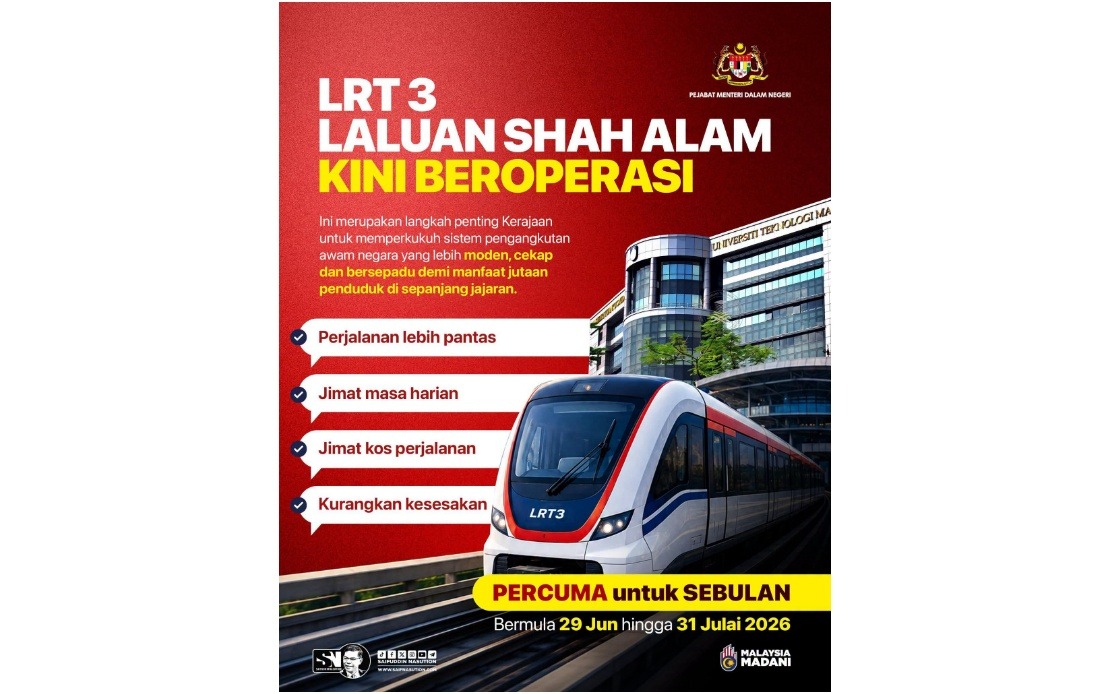
The Shah Alam Line LRT3, which commenced operations in late June, represents a significant infrastructure milestone for the MADANI Government's broader vision of transforming Malaysia's public transport landscape. Home Minister Datuk Seri Saifuddin Nasution Ismail has positioned the new rail corridor as tangible evidence of the administration's commitment to delivering integrated mobility solutions that serve the nation's rapidly growing urban centres. Speaking publicly about the project, Saifuddin emphasised that the initiative transcends conventional infrastructure development, functioning instead as a deliberate policy instrument designed to reshape commuter behaviour and enhance quality of life across several densely populated municipalities.
The Shah Alam Line addresses persistent traffic challenges that have plagued the Klang Valley, one of Malaysia's most congested metropolitan regions. By introducing a dedicated rapid transit corridor, authorities aim to redistribute passenger volumes away from increasingly saturated road networks, thereby alleviating pressure on highway infrastructure that has struggled to accommodate explosive growth in private vehicle ownership. The route specifically serves communities in Shah Alam, Klang, Subang and intermediate localities, connecting residential areas with major employment zones and educational facilities. This strategic routing acknowledges the directional flow of commuter patterns and targets precisely those populations whose daily mobility requirements have traditionally relied almost entirely on personal vehicles.
Beyond simple congestion reduction, the LRT3 project embodies a more nuanced policy objective centred on accessibility and affordability for ordinary Malaysians. Saifuddin articulated that the new line shortens travel duration, lowers commuting expenses and provides alternatives to motorised personal transportation. For workers, students and people managing daily responsibilities across the region, these operational improvements translate into measurable economic benefits. Time savings compound across thousands of daily journeys, while reduced fuel consumption and vehicle maintenance costs generate tangible household savings, particularly for lower-income commuters who rely most heavily on public transit systems.
To accelerate public adoption and demonstrate the service's practical value, Prime Minister Datuk Seri Anwar Ibrahim announced a promotional fare waiver spanning June 29 through July 31. This complementary travel period extends to Prasarana Malaysia Bhd feeder bus services that integrate with the main rail line, creating a comprehensive zero-cost transit ecosystem across the corridor. The government's rationale explicitly targets behavioural change, reasoning that risk-free experiential exposure will convert sceptical motorists into committed public transport users. By eliminating financial barriers during the critical launch phase, authorities maximise trial ridership volumes and allow commuters to evaluate whether the service genuinely improves their daily routines before regular fare structures commence.
Saifuddin's messaging strategy leveraged this promotional window to encourage demographic segments most likely to abandon private vehicles. Residents of Shah Alam, Klang, Subang and nearby locations—particularly those with established commuting patterns—received explicit invitations to participate in the trial period. His rhetorical framing positioned the free travel offer as an unprecedented opportunity rather than a temporary concession, suggesting that experiencing the LRT3's convenience would generate self-sustaining demand once paid service commenced. The minister's informal language and direct appeal reflected confidence that the service quality would justify sustained ridership once the novelty period expired.
The LRT3 project exemplifies how the MADANI Government approaches infrastructure investment as a mechanism for tangible lifestyle improvement rather than abstract development metrics. Rather than emphasising engineering achievements or project timelines, official communications stressed passenger-centric benefits: reduced congestion, shorter journeys, lower costs and expanded mobility options. This messaging approach acknowledges that infrastructure's political legitimacy derives from measurable impacts on daily life rather than technical accomplishments. For Malaysian commuters accustomed to protracted traffic delays and expensive vehicle ownership, a functioning rapid transit alternative represents a significant development.
The Klang Valley context renders the LRT3 particularly significant for broader Malaysian transport policy. As the nation's economic heartland encompassing Kuala Lumpur, Selangor and adjoining regions, the valley contains roughly one-third of Malaysia's population and generates a disproportionate share of national economic output. Transportation infrastructure limitations in this zone create bottlenecks that constrain economic productivity and diminish quality of life for millions. Successful rapid transit implementation here generates demonstration effects for other congested corridors nationwide, potentially establishing templates for future urban transit development.
The integration of feeder bus services alongside the LRT3 reflects evolved thinking about public transport architecture. Rather than designing isolated rail corridors, planners recognised that comprehensive mobility networks require seamless multimodal integration. Prasarana's bus services supplement rail capacity by connecting neighbourhoods beyond walking distance from stations, extending effective service reach across broader geographic areas. This hierarchical approach—high-capacity central rail complemented by flexible local bus connectivity—represents international best practice adapted to Malaysian urban development patterns and density distributions.
From a regional perspective, Malaysia's LRT3 deployment contributes to Southeast Asian conversations about urban transit modernisation amid rapid urbanisation. Peer nations across the region confront similar congestion and air quality challenges, making Malaysian transit developments relevant case studies for policymakers and planners elsewhere. The MADANI Government's explicit prioritisation of public mobility signals regional commitment to sustainable urban development models that constrain private vehicle dependency and associated environmental externalities.
The promotional fare strategy employed during LRT3's launch reflects sophisticated understanding of transport adoption psychology. Free or heavily subsidised initial access removes economic decision barriers and allows users to evaluate service quality independently. Governments recognising this principle have increasingly deployed temporary fare reductions as introduction mechanisms rather than permanent policy. Malaysia's approach demonstrates alignment with evidence-based transit promotion methodologies that prioritise experiential familiarity over abstract marketing claims.
As Malaysia continues urbanisation and confronts mounting transportation pressures, projects like the LRT3 acquire significance extending beyond immediate passenger convenience. They signal governmental willingness to invest in alternatives to car-dependent mobility systems and represent tangible commitments to the sustainability and livability principles embedded in national development frameworks. Whether the promotional period successfully converts car commuters into permanent transit users will substantially influence the venture's ultimate policy success and inform future infrastructure decisions across the nation's expanding metropolitan regions.

