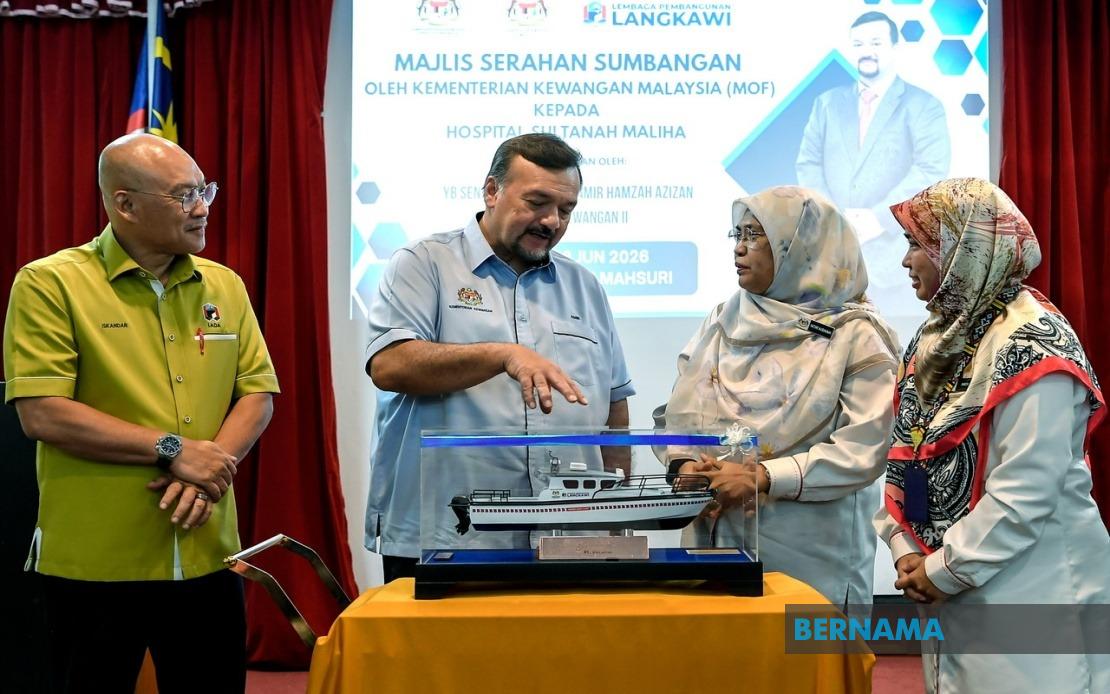
Malaysia's Ministry of Finance has committed RM5.5 million to procure and initially operate a dedicated sea ambulance service for Langkawi, addressing longstanding gaps in emergency healthcare logistics for the island community and its substantial tourism sector. Finance Minister II Datuk Seri Amir Hamzah Azizan announced the initiative on June 28, emphasizing that the service represents a significant modernization of patient transfer infrastructure that currently relies on conventional passenger ferry operations. The sea ambulance is expected to commence operations in early 2024, marking a watershed moment for emergency medical services on the island.
The crux of the problem that prompted this intervention lies in Langkawi's geographical isolation and dependence on ferry schedules for urgent patient evacuations. Hospital Sultanah Maliha, the island's primary healthcare facility, has historically struggled to transfer critically ill patients to mainland tertiary care centers when ferry services operate at reduced capacity or during adverse weather conditions. These constraints create genuine medical risks, particularly in time-sensitive emergencies where minutes determine clinical outcomes. By establishing a dedicated sea ambulance with marine medical capabilities, the government aims to eliminate these delays and provide immediate, uninterrupted access to advanced emergency care available on the peninsula.
Operational management of the new service will fall under Hospital Sultanah Maliha, which will assume full responsibility for vessel operations, crew training, and patient care protocols during transfers. The vessel's specifications reflect practical medical needs, as it will accommodate two stretchers simultaneously alongside 12 personnel—sufficient for medical staff, paramedics, and support crew to maintain comprehensive patient monitoring and stabilization during the crossing to mainland facilities. This capacity ensures that complex cases requiring continuous clinical intervention during transfer can be managed safely, eliminating the risks inherent in moving critically unstable patients aboard public ferries designed for passenger comfort rather than emergency medical transport.
Beyond operational efficiency, the dedicated sea ambulance addresses a frequently overlooked dimension of emergency care: patient dignity and privacy. Public ferry transfers expose vulnerable patients to the scrutiny of other travelers and compromise confidentiality during medical emergencies. The dedicated vessel eliminates these indignities while providing a controlled medical environment that matches standards patients would expect in hospital settings. This aspect carries particular importance for Langkawi's tourism-dependent economy, as visitors require confidence that medical emergencies will be handled with the same professional standards and discretion available in their home countries.
Concurrently, the Ministry of Finance announced a separate RM700,000 contribution of advanced healthcare equipment to Hospital Sultanah Maliha, reflecting a comprehensive strategy to strengthen the island's medical infrastructure. The equipment portfolio encompasses medical devices, information technology systems, furniture, vehicles, and security infrastructure—a multifaceted approach that recognizes healthcare delivery depends on physical assets, digital systems, and operational support structures in equal measure. This parallel investment demonstrates government recognition that the sea ambulance represents only one component of necessary healthcare modernization.
Particularly significant within the equipment allocation is integration of the Electronic Medical Record system, part of the Health Ministry's broader digital transformation agenda. The procurement includes mobile computing stations—computers on wheels—that enable nursing and medical staff to input patient data in real-time during ward rounds while maintaining instantaneous synchronization with interconnected hospital networks. This technological architecture eliminates the information silos that traditionally compromise care coordination, as patient records become immediately accessible to all healthcare personnel involved in treatment across Hospital Sultanah Maliha and connected mainland facilities. For patients transferred via the new sea ambulance, this digital continuity means their complete medical histories travel with them electronically, enabling receiving physicians to access critical clinical information instantaneously rather than waiting for paper transfers.
The implications for Langkawi's healthcare ecosystem extend considerably beyond emergency transfers. The island attracts millions of international visitors annually, creating demand for responsive emergency medicine that matches global standards. Medical emergencies among tourists represent a significant operational burden for Hospital Sultanah Maliha, as foreign nationals often require rapid escalation to specialized care unavailable locally. The sea ambulance service transforms the hospital's capacity to manage this tourist population responsibly, demonstrating Malaysia's commitment to visitor safety and reducing the reputational risks associated with delayed emergency responses. This positions Langkawi more competitively within regional tourism markets where healthcare reliability influences destination choices.
For local residents, the service addresses profound equity considerations. Islanders with serious medical conditions currently face genuine uncertainty about transport availability during emergencies, creating health anxiety that wealthier populations with private helicopter access need not experience. A government-operated sea ambulance eliminates this disparity by guaranteeing rapid, dignified transfer regardless of personal financial resources. This egalitarian approach reflects expanding recognition that emergency healthcare access constitutes a fundamental public good rather than a market commodity.
The sea ambulance initiative also reflects broader Southeast Asian patterns in healthcare infrastructure development. Island communities throughout the region face similar logistical challenges in emergency care delivery, suggesting that Langkawi's experience may establish a replicable model for other maritime states. Malaysia's investment could demonstrate feasibility to neighboring countries while positioning domestic expertise as exportable medical logistics knowledge. The implementation timeline through early 2024 provides adequate lead time for crew training, protocol establishment, and integration with existing hospital operations and mainland emergency response networks.
Implementation success will depend substantially on sustained funding beyond the initial procurement period, as operational costs for vessel maintenance, fuel, crew compensation, and medical supply replenishment accumulate significantly. The RM5.5 million allocation includes initial operating expenses, but long-term sustainability requires embedding the sea ambulance within regular Health Ministry budgets rather than treating it as discretionary spending. Langkawi's development authority leadership, notably Amir Hamzah's role as co-chairman of the Langkawi Development Authority alongside his finance portfolio, suggests institutional commitment to maintaining the service as permanent infrastructure rather than temporary initiative.
The dual investment in emergency transport capacity and digital medical infrastructure represents sophisticated recognition that healthcare modernization requires simultaneous attention to physical logistics and information systems. Patients benefit maximally when rapid transport connects to hospitals equipped with contemporary technology and integrated data systems. The coordinated approach taken in Langkawi establishes a template for comprehensive healthcare development that addresses multiple constraints simultaneously rather than pursuing piecemeal improvements that leave systemic vulnerabilities unresolved.

