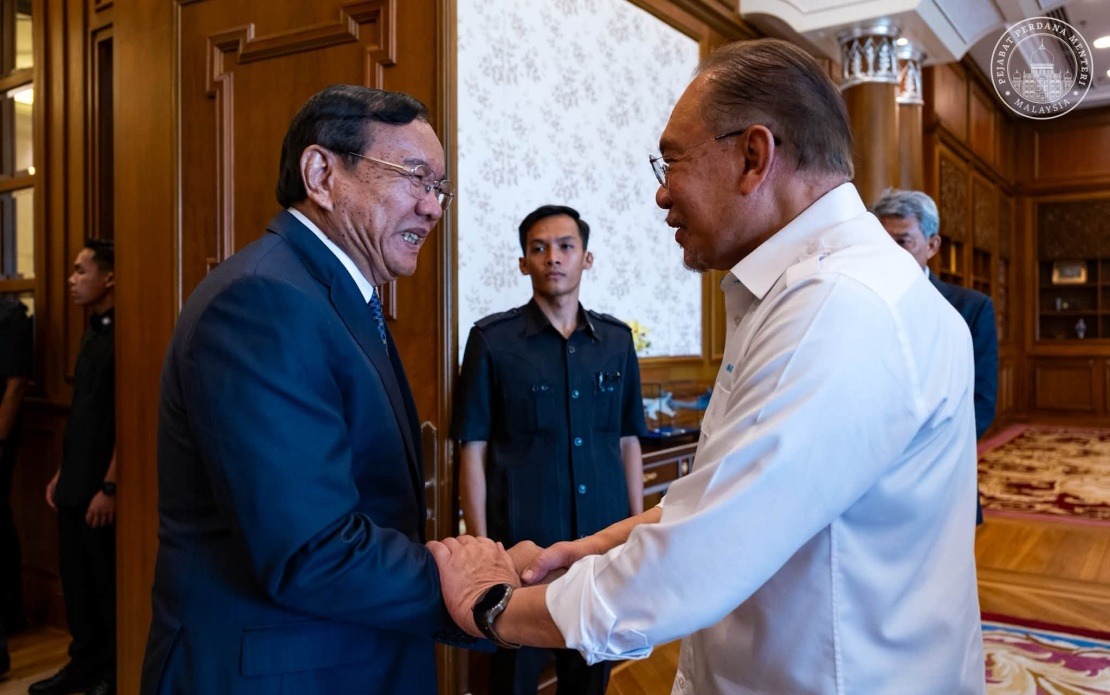
Prime Minister Datuk Seri Anwar Ibrahim has underscored Malaysia and Cambodia's shared commitment to broadening cooperation across multiple economic and security domains, signalling intensified engagement between the two Southeast Asian neighbours. The announcement came following a bilateral meeting with Cambodian Deputy Prime Minister and Foreign Minister Prak Sokhonn, who arrived in Kuala Lumpur to lead a two-day official visit that reflects the deepening strategic partnership between Kuala Lumpur and Phnom Penh.
The scope of collaboration outlined by Anwar encompasses emerging technological frontiers alongside traditional development priorities. Digital economy initiatives and artificial intelligence capabilities rank prominently among the areas slated for joint exploration, reflecting broader regional trends toward harnessing technology for economic competitiveness. This emphasis aligns with ASEAN's strategic imperative to maintain technological parity with global powers whilst building indigenous innovation ecosystems that benefit member states.
Beyond technology, the two nations have identified the halal industry as a significant growth corridor. Malaysia's established position as a global halal standards-setter and certification hub positions it to share expertise with Cambodia as the latter seeks to develop halal production and export capabilities. Such cooperation carries commercial implications extending beyond bilateral trade, potentially enhancing ASEAN's collective capacity to capture growing global demand from Muslim-majority markets across the Middle East, North Africa and beyond.
Food security and human capital development feature prominently in the expanded agenda, reflecting mutual recognition of these sectors' centrality to regional stability and prosperity. Cambodia's substantial agricultural base and Malaysia's advanced farming technologies and expertise suggest complementary advantages that cooperative frameworks could leverage. Investment in developing Cambodian human resources through Malaysian training programmes and educational partnerships would strengthen institutional capacity across borders whilst building interpersonal networks that reinforce diplomatic bonds.
Critically, both nations have recommitted to combating cross-border crime, an issue of persistent concern throughout mainland Southeast Asia. Human trafficking, drug smuggling and organised crime networks operating across the Malaysia-Cambodia frontier require coordinated enforcement responses and intelligence-sharing mechanisms. This dimension of bilateral cooperation addresses security challenges that no single nation can resolve unilaterally, acknowledging that prosperity and stability depend on porous borders being managed through cooperative rather than isolationist approaches.
The timing of Prak Sokhonn's visit carries symbolic weight beyond immediate policy discussions. The Third Malaysia-Cambodia Joint Commission for Bilateral Cooperation meeting scheduled for August 4 provides the formal institutional framework through which these commitments will be operationalised into concrete mechanisms and timelines. Such structured dialogue mechanisms ensure that high-level pledges translate into sustained, coordinated action rather than remaining rhetorical flourishes.
Perhaps most significantly, both countries are explicitly positioning their deepening cooperation within broader ASEAN architecture. As fellow ASEAN member states, Malaysia and Cambodia share collective responsibility for preserving regional peace, maintaining ASEAN unity and realising the ASEAN Community Vision 2045. This language underscores how bilateral initiatives increasingly serve multilateral objectives, with strengthened Malaysia-Cambodia ties contributing to broader regional cohesion and prosperity. In an era of great power competition and external pressures on regional autonomy, such solidarity amongst ASEAN members carries heightened strategic value.
The forward-looking reference to Malaysia and Cambodia's 70th diplomatic anniversary in 2027 indicates long-term strategic thinking. Rather than merely commemorating past relationships, both governments are framing upcoming celebrations as milestones motivating accelerated cooperation over the next three years. This approach transforms a historical marker into a deadline for delivering tangible outcomes that justify the rhetoric of friendship and partnership.
For Malaysian stakeholders, this expanded engagement offers multiple benefits. Access to Cambodian markets for technology and halal products creates commercial opportunities for Malaysian enterprises. Enhanced border security cooperation protects Malaysian citizens and economic interests. Human capital initiatives generate soft power returns as Cambodian leaders and professionals develop ties with Malaysian counterparts. Simultaneously, Malaysia's commitment reinforces its credibility within ASEAN as a reliable partner genuinely invested in regional development rather than pursuing narrow national interests.
Cambodia's perspective reflects complementary strategic calculations. Accessing Malaysian expertise in digital transformation, halal industry development and human capital strengthens Cambodia's economic diversification efforts. Border security collaboration addresses immediate threats to Cambodian stability. The structured dialogue mechanism signals Cambodia's integration into ASEAN's institutional fabric at a moment when regional unity faces testing.
For the broader Southeast Asian context, Malaysia-Cambodia cooperation demonstrates ASEAN's capacity for internal strengthening despite external pressures. When member states invest in deepening bilateral relationships across multiple dimensions, they collectively reinforce regional resilience. The sectors identified—technology, food security, human capital—directly address development challenges facing all ASEAN members, suggesting that bilateral frameworks may yield multilateral benefits through knowledge transfer and experience-sharing.
The emphasis on institutional mechanisms like the Joint Commission reflects matured diplomatic practice. Rather than relying on personality-driven relationships vulnerable to leadership changes, both nations are embedding cooperation in permanent structures that survive political transitions. This institutionalisation increases the likelihood that commitments will persist across electoral cycles and governmental changes, providing continuity essential for transformative partnership.

